

What Is a Sailing Itinerary? Your 2026 Planning Guide

TL;DR:
A sailing itinerary provides a day-by-day route plan with key stops and backup anchorages to ensure safety and flexibility. Planning 20 to 35 nautical miles each day and scheduling 3 to 5 major stops helps balance progress with exploration. Flexibility is essential to adapt to weather forecasts and crew needs, making the trip enjoyable and safe.
A sailing itinerary is a structured day-by-day plan that maps your route, anchorages, daily distances, and key stops across a sailing trip. Think of it as the backbone of any successful voyage. Without one, you risk overextending your crew, missing the best anchorages, or spending precious vacation time making decisions that should have been made on shore. Whether you’re planning a week in the Mediterranean or a weekend along the Portuguese coast, a solid sailing itinerary turns a good trip into a great one.
What is a sailing itinerary made of?
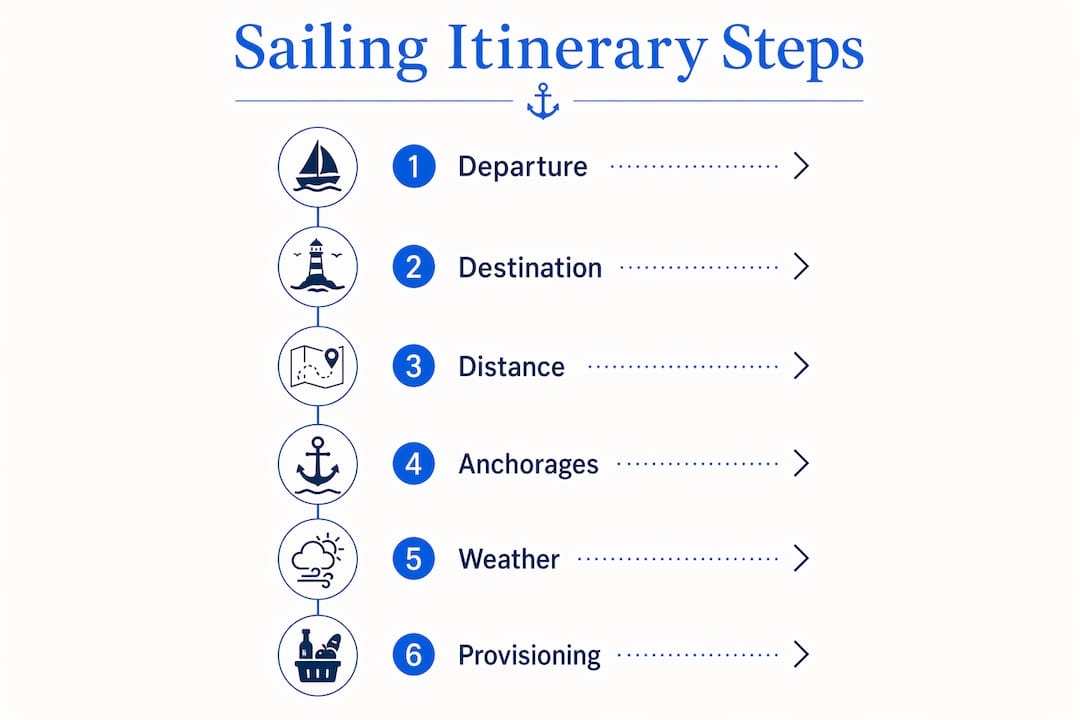
A sailing itinerary is built from six core components: a departure base, a destination or loop endpoint, daily sailing distances, primary stops, alternative anchorages, and provisioning points. Each element serves a specific purpose. Remove one, and the plan develops gaps that weather or fatigue will exploit.

Daily sailing distance is the most misunderstood component. A well-structured 7-day loop covers 20–35 nautical miles per day. That range keeps the crew rested, leaves time for swimming and exploring ashore, and still makes meaningful progress along the route.
Primary stops are the ports or anchorages you plan to reach each night. These should be confirmed in advance, especially during peak season when marinas fill up fast. Alternative anchorages are your backup plan. Every leg of your route needs at least one fallback option in case the primary stop is full, the wind shifts, or the crew simply wants to stop early.
Provisioning points are often overlooked until someone runs out of coffee on day three. Mark towns with supermarkets or chandleries on your chart before you leave. Rest days, at least one per week, give the crew time to recover and give you a buffer if a weather window closes unexpectedly.
Departure base: your starting marina or anchorage
Daily distance target: 20–35 nautical miles for a relaxed pace
Primary stops: confirmed ports or anchorages for each night
Alternative anchorages: at least one backup per leg
Provisioning points: towns with food, fuel, and supplies
Rest days: built-in buffer for weather and crew recovery
Pro Tip: Mark your alternative anchorages on your chart app before departure. When conditions change at sea, you want that decision already made.
How to plan a realistic and flexible sailing route
The best itineraries flow naturally from the embarkation point rather than forcing long transit legs just to reach a famous destination. Start with where you are, then build outward.
Fix your embarkation point and trip duration. Know your marina, your departure date, and your return deadline. Everything else fits around those anchors.
Calculate realistic daily distances. Use 90% of your vessel’s theoretical max speed as your planning speed. Real conditions, current, leeway, and light winds, always slow you down from the theoretical figure.
Protect the first and last days. Reserve the first day for onboarding, provisioning, and a short shakedown sail. Reserve the last day for a comfortable return with time to spare. The middle days carry the real adventure.
Schedule 3–5 major stops over a week. Successful charters limit overnight stops to 3–5 per week to allow real exploration at each location rather than a blur of quick arrivals and early departures.
Assign alternative anchorages to every leg. Flexible itineraries with backup stops reduce pressure and let you respond to weather, marina availability, and crew mood without stress.
Check weather forecasts daily and adjust. When forecast models diverge, delay departure or adjust the route rather than push to stay on schedule. Safety and comfort always outrank the plan.
For sailors planning along the Portuguese coast, the Porto and Lisbon sailing holiday guide offers a practical framework for structuring week-long routes with daily activity suggestions built in.
Pro Tip: Build your itinerary in a spreadsheet with columns for each day: departure port, destination, distance in nautical miles, estimated sailing time, and one backup anchorage. That single document becomes your decision-making tool at sea.
What challenges should you expect when planning a sailing itinerary?
Overplanning is the most common mistake. Beginners often try to reach a new port every day, which turns a sailing vacation into an exhausting relay race. The fix is simple: plan fewer stops and stay longer at each one.
Weather unpredictability is the second major challenge. Forecasts are reliable 24–48 hours out, but beyond that, conditions can shift significantly. Applying a safety buffer of 5–10 knots below your comfort wind threshold accounts for forecast inaccuracies and localized squalls that models miss. That buffer is not timidity. It is good seamanship.
Overplanning: Trying to cover too much ground leaves no time to enjoy where you are. Fewer stops, longer stays.
Weather shifts: Build in rest days and alternative anchorages so a weather delay does not cascade into a ruined trip.
Crew fatigue: Long sailing days wear people out faster than expected, especially on passages with little wind and a lot of motoring.
Crowded marinas: Peak season fills popular ports quickly. Call ahead or use a marina booking app to reserve slips in advance.
Provisioning gaps: Running low on food or water mid-passage is avoidable. Map your provisioning stops before you leave the dock.
The Portugal travel planning tips page covers logistics specific to sailing in Portuguese waters, including provisioning stops and itinerary flexibility along the Lisbon coast.
Sailing itinerary examples: what a real week looks like
A 7-day loop itinerary from Lisbon illustrates how the principles above translate into a real plan. The structure below shows how each day balances sailing time with leisure.
Day | Departure | Destination | Distance | Notes |
Day 1 | Lisbon marina | Setúbal | 25 nm | Short sail, provisioning, crew settles in |
Day 2 | Setúbal | Sines | 30 nm | Coastal passage, afternoon beach stop |
Day 3 | Sines | Rest day | 0 nm | Explore town, weather buffer built in |
Day 4 | Sines | Sagres | 35 nm | Longer passage, dramatic cape scenery |
Day 5 | Sagres | Portimão | 20 nm | Short sail, marina berth, evening ashore |
Day 6 | Portimão | Setúbal | 28 nm | Return leg, favorable winds typical |
Day 7 | Setúbal | Lisbon | 25 nm | Easy return, arrive by early afternoon |
This is a loop itinerary, meaning the boat returns to its starting point. Loop routes suit charter sailors because they avoid one-way repositioning fees and let the crew relax on the final day without rushing to a distant drop-off port.
A one-way itinerary works differently. You sail from point A to point B, which often allows more ground to be covered. The tradeoff is logistics: the crew needs transport back, and the charter company needs the boat repositioned. For most vacation sailors, the loop format is simpler and more enjoyable.
Adapting a sample itinerary to a different region follows the same logic. Replace Lisbon with your home port, keep the daily distance targets in the 20–35 nautical mile range, and assign rest days on days three and six. The framework transfers anywhere. For day trip ideas near Lisbon, the Lisbon beach day trips guide shows how shorter coastal sails can be structured with the same planning discipline.
For sailors considering a luxury charter experience as a reference point for high-end itinerary planning, the Captiva Island yacht charter guide demonstrates how guest-focused itineraries balance comfort with destination variety.
Key Takeaways
A sailing itinerary works best when it combines a clear daily structure with built-in flexibility for weather, crew needs, and unexpected opportunities.
Point | Details |
Daily distance target | Plan 20–35 nautical miles per day to balance progress with rest and exploration. |
Protect first and last days | Reserve day one for provisioning and day seven for a relaxed return, not sailing. |
Limit major stops | Schedule 3–5 overnight stops per week to allow real time at each destination. |
Always have a backup | Assign at least one alternative anchorage to every leg before leaving the dock. |
Apply a weather buffer | Set your wind limit 5–10 knots below your comfort threshold to account for forecast error. |
What I’ve learned from planning sailing itineraries on the Lisbon coast
The most common mistake I see is treating the itinerary as a contract rather than a guide. Sailors who grip their plan too tightly end up frustrated when the wind does not cooperate, which it often does not. The plan is a starting point. The sea has the final word.
What actually makes a trip memorable is the unplanned afternoon. The anchorage you found because the original stop was full. The village you walked through because the wind died and you had two extra hours. A good itinerary creates the conditions for those moments by keeping the schedule loose enough to say yes to them.
From our experience running sailing tours along the Lisbon coastline, the sailors who enjoy their trips most are the ones who planned carefully and then held that plan lightly. They knew their distances, they had their backup anchorages, and they were genuinely fine when the day went differently than expected. That combination of preparation and flexibility is the real skill in sailing itinerary planning.
— Lisbon
Sailing with Lisbonbyboat along the Lisbon coast
Planning a sailing itinerary is one thing. Experiencing it on the water is another.
Lisbonbyboat offers private daily cruises on sailing yachts and catamarans along the historic Lisbon coastline, from 2-hour tours to full-day voyages. Every trip includes expert guides who explain the major monuments and sights as you sail past them. If you want to see what a well-planned coastal itinerary actually feels like from the deck of a yacht, the luxury yachts in Lisbon page shows the vessels available for private charter. For curated group experiences with itinerary support built in, the ByBoat Tours program offers a ready-made starting point.
FAQ
What is a sailing itinerary?
A sailing itinerary is a day-by-day plan that outlines your route, daily distances, overnight stops, and alternative anchorages for a sailing trip. It serves as the operational guide for the entire voyage.
How many miles should you sail per day on a charter?
A well-paced charter covers 20–35 nautical miles per day, which leaves time for exploration, rest, and weather adjustments without exhausting the crew.
How many stops should a 7-day sailing itinerary include?
Successful 7-day charters include 3–5 overnight stops, giving sailors enough time to explore each location rather than rushing through a new port every single day.
What speed should I use when planning a sailing itinerary?
Use 90% of your vessel’s theoretical maximum speed as your planning speed. Real conditions consistently reduce performance below the theoretical figure.
What should I do when weather forecasts conflict during a sailing trip?
When forecast models diverge, delay departure or adjust your route rather than pushing to maintain the original schedule. Safety and crew comfort take priority over the plan.
Recommended
Comments