

How Tides Affect Sailing Tours: What You Need to Know
- lisbonbyboat
- 7 hours ago
- 9 min read
TL;DR:
Tides significantly influence sailing routes, water depth, and current strength, affecting safety and wildlife encounters. Skippers plan departures and routes around tidal conditions, adjusting for opposing currents and shallow channels. Flexibility and awareness of tidal cycles ensure safer, more enjoyable, and wildlife-rich sailing tours.
Tides are the regular rise and fall of sea levels caused by the gravitational pull of the moon and sun, and they have a direct, practical impact on how tides affect sailing tours by shaping water depth, current speed, and navigational safety. Every sailing tour operates within a tidal window. Get that window right, and the boat moves efficiently through calm, accessible waters. Get it wrong, and the same route becomes slow, rough, or outright dangerous. Understanding tidal range, tidal currents, and the daily 50-minute cycle shift gives travelers a real edge when booking and enjoying a sailing tour.
How tides affect sailing tours: water depth and route accessibility
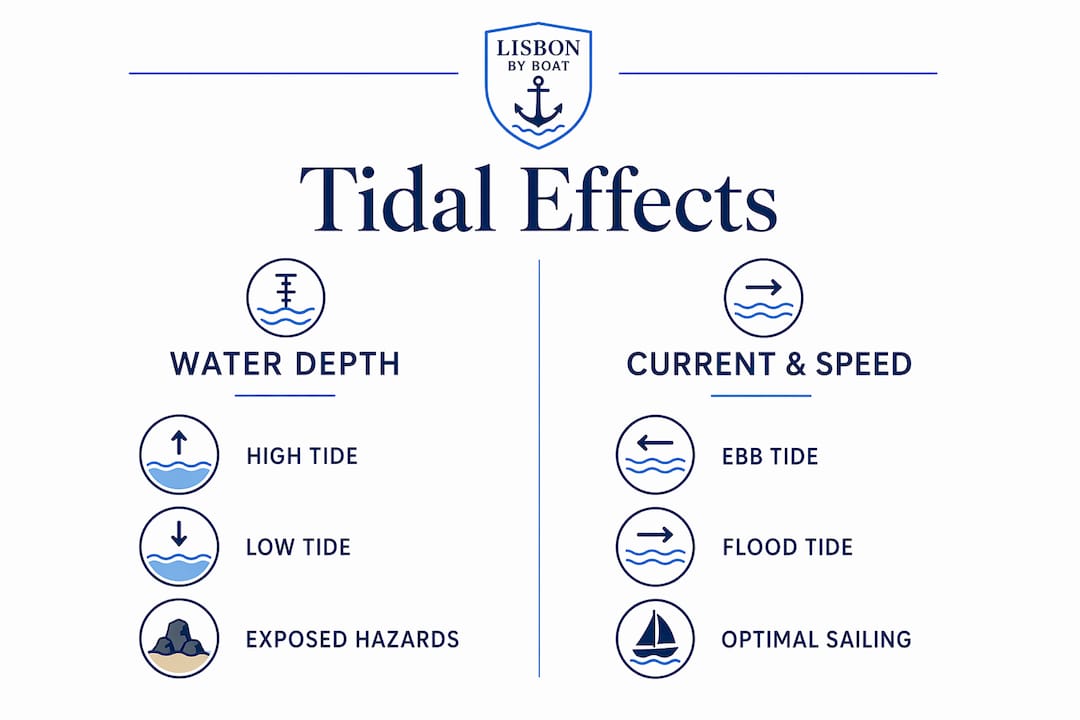
Tidal range is the vertical difference between high tide and low tide, and it determines which routes, channels, and anchorages a sailing tour can safely use at any given time. A route that is perfectly navigable at high tide can become impassable just six hours later when the water drops. This is not a theoretical risk. It is a daily operational reality for every skipper running coastal tours.
Low tides expose submerged hazards like sandbars and rocks that sit invisibly beneath the surface at high water. A boat that strikes a sandbar at speed can suffer serious hull damage. Knowing the tide schedule before departure is not optional. It is the first line of defense against preventable accidents.
Tidal range also opens and closes access to specific areas of interest. Some sailing tours adjust routes based on tide levels, safely accessing narrow canals at high water and shifting to wider harbor areas when the tide drops. This kind of route flexibility requires advance planning, not improvisation on the water.
Practical effects of tidal range on route planning include:
Shallow channels: Only accessible within a specific tidal window, typically within two hours of high tide.
Harbor entrances: Some marinas have depth restrictions that prevent entry or exit at low water.
Anchorages: A spot that looks safe at high tide can leave a boat grounded as the water recedes.
Scenic passages: Narrow coastal cuts that offer the best views are often only navigable at mid to high tide.
Pro Tip: When booking a sailing tour, ask the operator what tidal state the tour is planned around. A tour scheduled near high tide typically offers the widest route options and the fewest depth-related restrictions.
For travelers curious about how tidal conditions shape sailing tour accessibility, the relationship between water depth and route planning is the most immediate factor to understand.
How do tidal currents change sailing speed and comfort?
Tidal currents are the horizontal movement of water driven by the tide, and they are the single biggest variable affecting how fast and comfortably a sailboat moves through the water. A current running in the same direction as the boat adds speed and reduces fuel or sail effort. A current running against the boat does the opposite, and the effect is significant.
Tidal currents in narrow areas can reach 1.5–2 knots, which is enough to cut a sailboat’s effective speed nearly in half or push it well beyond its comfortable cruising pace. That kind of current variation directly affects how long a tour takes and how smooth the ride feels for passengers. Skippers plan around these windows deliberately.
Tactical current management on a sailing tour follows a clear logic:
Depart with the current. Leaving the marina on an outgoing tide means the current carries the boat away from shore, reducing engine use and improving speed.
Time the return. Returning on a flooding tide means the current assists the boat back into harbor, making docking easier and safer.
Avoid peak ebb in constrictions. The strongest currents occur in narrow passages during peak ebb or flood. Skippers route around these windows when possible.
Adjust speed in opposing currents. When a current cannot be avoided, reducing speed lowers the impact of short, steep waves that build when current and wind oppose each other.
Sailing tours in tidal regions require tactical navigation choices like avoiding strong opposing currents and selecting shallower waters to reduce resistance and improve speed. This is not just about efficiency. It is about keeping passengers comfortable for the full duration of the tour.
Pro Tip: If you feel the boat working harder than expected or notice choppy conditions despite calm winds, the boat is likely fighting a tidal current. Ask the skipper about the tidal state. Understanding what is happening makes the experience more interesting, not less.
When is the best time for sailing based on tidal cycles?
The tidal cycle does not repeat at the same clock time each day. Tidal cycles shift daily by approximately 50 minutes, meaning the optimal departure window for a sailing tour moves forward by nearly an hour every day. This shift matters enormously for tour scheduling, especially for wildlife-focused tours where the best conditions occur at specific tidal states.
This daily drift means a tour that catches perfect conditions on a Monday will be 50 minutes off that ideal window by Tuesday. Over a week, the optimal window shifts by nearly six hours. Operators who track this shift can align departures with the best tidal states. Operators who ignore it deliver inconsistent experiences.
The table below shows how tidal state affects key aspects of the sailing experience:
Tidal state | Water depth | Current strength | Wildlife activity |
High tide | Maximum depth | Slack, minimal flow | Moderate |
Ebb (falling) | Decreasing | Increasing outward | High, especially spring ebb |
Low tide | Minimum depth | Slack, minimal flow | Low to moderate |
Flood (rising) | Increasing | Increasing inward | Moderate |
Spring tide ebbs produce increased fish concentration and more intense dolphin feeding activity. Spring tides occur roughly twice a month, near the new and full moon, when the gravitational pull of the moon and sun align. The stronger water movement during a spring ebb concentrates baitfish, which draws larger predators to the surface. For travelers on wildlife-focused sailing tours, booking around a spring ebb is the single most effective way to increase the chance of a memorable encounter.
Key scheduling insights for travelers:
Check the lunar calendar. Spring tides near the new or full moon produce the strongest ebbs and the best wildlife activity.
Ask about the 50-minute shift. A tour operator who tracks daily tidal shifts is actively managing your experience, not just running a fixed schedule.
Flexible booking windows pay off. Travelers who can shift their tour by a day or two to match a favorable tidal window consistently report better experiences.
Experienced skippers advise guests to ask about tidal forecasts and remain flexible with bookings to maximize the quality of wildlife viewing and sailing conditions. That advice applies whether you are booking a two-hour coastal tour or a full-day private charter.
How do tour operators adapt sailing tours for tidal safety?
Safety is the primary reason tour operators monitor tides as closely as weather forecasts. Tidal conditions do not just affect comfort. They create physical hazards that require active management before and during every departure.
Tour operators delay or shorten tours based on changing tidal and wind conditions to maintain safety and quality. A delay of 30 to 60 minutes can mean the difference between departing into a strong opposing current and leaving on a favorable flood tide. Experienced operators treat this flexibility as a feature, not a failure.
Wind and tide interact in ways that amplify risk. Wind against tide creates short, steep waves that make sailing uncomfortable and, in stronger conditions, genuinely hazardous. A 15-knot breeze over a 2-knot opposing current can produce conditions that feel far rougher than either factor alone would suggest. Skippers who understand this combination adjust departure times or routes proactively.
Safety adaptations operators use in response to tidal conditions:
Delayed departures: Waiting for a tidal window to shift from opposing to favorable before leaving the marina.
Route modifications: Choosing wider, deeper water routes when tidal currents in narrow passages are too strong.
Early returns: Cutting a tour short when conditions deteriorate faster than forecast.
Timing around morning calm: Early morning sailing tours are more reliable due to calmer winds and favorable tidal conditions, with 6:00 AM departures showing better schedule reliability than afternoon slots.
Travelers who want a deeper understanding of how operators balance tidal awareness with passenger safety will find practical guidance in Lisbonbyboat’s article on safe Lisbon boat tours. The principles apply across coastal sailing destinations worldwide.
Key Takeaways
Tides control water depth, current strength, and wildlife activity, making tidal awareness the most important planning factor for any sailing tour.
Point | Details |
Tidal range shapes route access | Low tides expose hazards and close shallow channels; plan tours near high tide for maximum route options. |
Currents reach 1.5–2 knots in constrictions | Opposing currents slow boats and create rough conditions; skilled skippers time departures to run with the tide. |
Tidal cycles shift 50 minutes daily | The optimal tour window moves forward each day; operators who track this shift deliver more consistent experiences. |
Spring tide ebbs boost wildlife activity | Book near a new or full moon for the strongest ebb currents and the best chance of dolphin or wildlife encounters. |
Operators adapt for safety | Delays, route changes, and early returns are standard responses to unfavorable tidal and wind combinations. |
Tides are not obstacles. They are the experience.
After years of running sailing tours along Lisbon’s coastline, the most common misconception I encounter is that tides are something to work around. Travelers hear about a delayed departure or a route change and assume something went wrong. Nothing went wrong. The skipper read the water correctly.
The Tagus estuary and the Atlantic approaches to Lisbon have a tidal range that genuinely shapes what is possible on any given day. A tour that departs on a strong ebb tide moves differently than one that leaves at slack water. The light sits differently on the river. The birds behave differently. The boat responds differently. That variability is not a flaw in the product. It is the product.
What I tell every traveler who asks about tides is this: the operators who adjust their schedules around tidal conditions are the ones paying attention. A fixed schedule that never changes regardless of tidal state is a red flag, not a sign of reliability. Flexibility is the mark of a skipper who actually knows the water.
Ask your operator about the tidal forecast before you book. Ask whether the departure time is aligned with a favorable current. If they can answer those questions clearly, you are in good hands. If they look confused, keep looking.
The best sailing experiences I have witnessed happen when travelers arrive curious about the conditions rather than indifferent to them. Tides give every tour a character that no two departures share exactly. That is worth paying attention to.
— Lisbon
Sailing Lisbon with Lisbonbyboat: tide-aware tours every day
Lisbonbyboat plans every departure around tidal and weather conditions to give travelers the best possible experience on the water. Whether you are booking a two-hour coastal tour along Lisbon’s historic waterfront or a full-day private charter, the scheduling reflects real tidal awareness, not a fixed clock.
Every guide on board understands how the Tagus estuary and Atlantic tides interact with the sailing conditions along Lisbon’s coastline. Lisbonbyboat’s daily sailing tours cover the city’s most iconic monuments and sights from the water, timed to make the most of favorable tidal windows. For travelers who want a fully private experience, luxury yacht charters offer flexible scheduling built around the tidal forecast for your chosen date. The water is always moving. Lisbonbyboat makes sure you are moving with it.
FAQ
How do tides affect sailing tour safety?
Tides expose underwater hazards at low water and create strong currents that combine with wind to produce rough conditions. Tour operators monitor tidal forecasts and adjust departure times or routes to keep passengers safe.
What is the best time for sailing based on tides?
Early morning departures near high tide or a favorable ebb generally offer the calmest conditions and the widest route access. Spring tides near the new or full moon also produce the strongest wildlife activity for nature-focused tours.
Why do tidal cycles shift every day?
The tidal cycle advances by approximately 50 minutes each day because the moon’s orbit does not align perfectly with the 24-hour solar day. This means the optimal tidal window for a sailing tour moves forward by nearly an hour from one day to the next.
Can a sailing tour be delayed because of tides?
Yes. Operators regularly delay or shorten tours when tidal and wind conditions combine to create unsafe or uncomfortable conditions. A short delay to wait for a favorable tidal window is standard practice among experienced skippers.
Do tides affect wildlife viewing on sailing tours?
Spring tide ebbs concentrate fish near the surface and trigger more intense dolphin feeding activity, making them the most productive tidal state for wildlife encounters on coastal sailing tours.
Recommended
Comments