

Cruise Durations Explained: Your Complete Trip Length Guide

TL;DR:
Most cruises last around seven days, balancing port visits and sea days for an ideal experience. Short trips are suitable for nearby travelers, while longer cruises provide immersive regional exploration with better per-day value. Planning cruise length based on travel effort and pacing enhances relaxation and overall satisfaction.
Cruise durations are defined as the total number of nights spent aboard a vessel from embarkation to disembarkation. Most cruises fall somewhere between 2 and 120+ nights, with the global average sitting at 7.0 days according to the CLIA 2026 State of the Cruise Industry Report. That seven-day benchmark is no accident. It balances port variety, sea day recovery, and the practical reality of most travelers’ vacation schedules. Understanding cruise lengths before you book is the difference between a trip that feels rushed and one that genuinely refreshes you.
Cruise durations explained: what are the main categories?
Cruise itinerary durations fall into four clear categories, each with a distinct traveler profile and onboard rhythm.

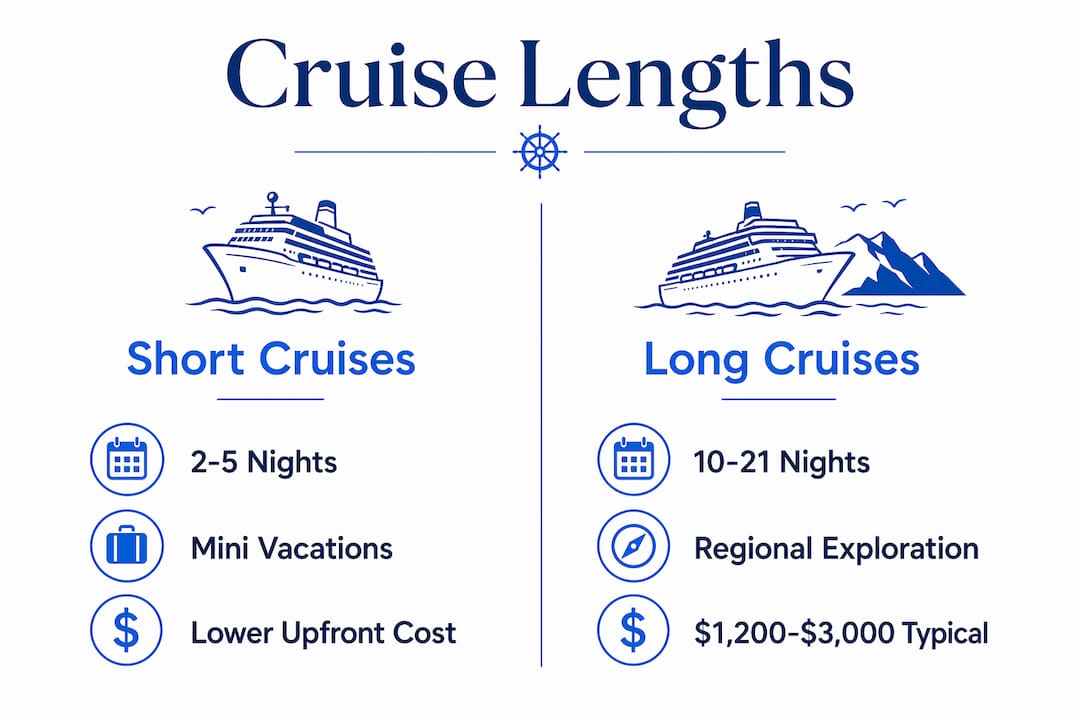
Short cruises (2–5 nights) work as mini-vacations or taster experiences. They cost less upfront, typically $400–$800 per person, and suit travelers who live within driving distance of a major port. The tradeoff is limited port variety and very few sea days. You spend a meaningful chunk of the trip getting settled on embarkation day, which leaves less time to actually enjoy the ship.
Medium cruises (6–9 nights) represent the classic cruise length. The 7-day cruise is favored by families and first-time cruisers because it delivers a balanced mix of port stops and sea days. You visit three to five destinations without feeling like you are constantly packing and unpacking. North American cruises average 6.71 days, which confirms this range as the industry sweet spot.
Long cruises (10–21 nights) offer deeper regional exploration. Pricing typically runs $1,200–$3,000 per person, and bookings for 14-plus-night sailings have grown by 15% over two years. That growth reflects a real shift: travelers want immersive experiences, not just a checklist of ports.
World cruises (90–120+ days) are in a category of their own. These sailings visit 30–50 ports across multiple continents. The total investment is high, but the per-day rate is often competitive with standard long cruises. World cruises attract retired travelers and remote workers who can commit to extended time at sea.
Duration | Nights | Best for | Typical cost per person |
Short | 2–5 | Port-adjacent travelers, first taste | $400–$800 |
Medium | 6–9 | Families, first-timers, balanced trips | $800–$1,500 |
Long | 10–21 | Immersive regional exploration | $1,200–$3,000 |
World | 90–120+ | Retirees, extended travelers | Varies widely |
How does cruise length affect onboard experience and pacing?
The ratio of sea days to port days changes everything about how a cruise feels. Short cruises often have one sea day or none at all. That means every morning involves getting off the ship, navigating a new port, and returning before departure. It is exciting for a day or two, but it compounds quickly into fatigue.
Sea days are essential for recovery, especially after consecutive port visits. A sea day is not filler. It is the day you actually use the pool, attend a cooking class, sleep in, or explore the ship’s amenities without a clock ticking. Travelers who skip sea days in favor of maximum ports often report feeling more tired at the end of a cruise than when they boarded.
Longer cruises naturally build in more sea days. A 14-night sailing might include five or six sea days spread across the itinerary. That pacing allows genuine rest between port-heavy stretches. The Lisbon sailing holiday guide for the Porto and Lisbon region shows how even a regional itinerary benefits from this kind of rhythm.
Pro Tip: Schedule at least one sea day after every two consecutive port days. That single recovery day dramatically improves how you feel for the rest of the trip.
Short cruises (2–5 nights): expect 0–1 sea days, fast port turnarounds, limited ship exploration
Medium cruises (6–9 nights): expect 2–3 sea days, a natural rhythm between ports and rest
Long cruises (10–21 nights): expect 4–7 sea days, deep ship familiarity, genuine relaxation
World cruises: sea days become a lifestyle, not a break from the itinerary
Understanding this pacing is especially relevant for first-time cruisers who often overestimate how much they want to be in port every single day.
How do you decide the right cruise length for your trip?
The single most useful framework for choosing cruise length is the travel-to-fun ratio. The rule is straightforward: plan at least three days onboard for every four hours of flight time to reach your departure port. Ignore this ratio and you risk spending more time traveling than actually vacationing.
Here is how that plays out in practice:
You live within two hours of a port. A 3-to-5-night cruise makes complete sense. Your travel overhead is minimal, so even a short sailing delivers strong value.
You have a four-hour flight to reach the port. A 7-night cruise is the minimum worth booking. Anything shorter and the math works against you.
You have an eight-hour international flight. A 14-night cruise is the logical choice. You need enough days onboard to justify the cost and fatigue of getting there.
You are traveling with children. Factor in the extra logistics of family travel and add at least two nights to whatever your baseline calculation suggests.
You have limited vacation days. A 7-night cruise is the most efficient use of a standard one-week break, especially when you account for embarkation and disembarkation days.
Travelers who drive to a port often prefer 3-to-5-day cruises, while those who fly in should target 5-to-7-plus-day trips. This is not a preference issue. It is a math issue. The cost and energy of getting to a cruise port is a fixed overhead. The longer you sail, the more that overhead gets spread across enjoyable days.
Pro Tip: Count embarkation day as a logistical day, not a vacation day. Embarkation day consumes significant time with check-in, safety drills, and settling in. Your real vacation starts on day two.
What are the cost and value differences across cruise lengths?
Short cruises carry a lower total price but a higher cost per day. A 3-night cruise at $600 per person works out to $200 per day. A 14-night cruise at $2,000 per person works out to roughly $143 per day. Longer cruises offer better per-day value despite the larger upfront number. That gap matters when you factor in all-inclusive pricing, which covers meals, entertainment, and most onboard activities.
The value equation also includes ports visited. A 7-night Caribbean cruise might stop at four destinations. A 14-night Mediterranean sailing might cover eight countries. More ports per dollar is a real advantage for travelers who prioritize destination variety. For those who want relaxation over sightseeing, the value of sea days and onboard amenities tips the calculation further toward longer sailings.
Booking trends confirm this shift. The 15% increase in 14-plus-night bookings over two years shows that travelers are moving away from the “quick getaway” model toward trips that justify the full cost of travel. Budget planning should account for flights, pre-cruise hotels, and port excursions, all of which favor longer sailings from a pure cost-efficiency standpoint. Comparing Lisbon boat tour pricing across different durations illustrates how this value curve plays out even on shorter regional sailings.
Key Takeaways
The right cruise length is determined by travel distance, vacation goals, and the balance between port days and sea days, not by price alone.
Point | Details |
Global average is 7 days | The CLIA 2026 report confirms 7.0 days as the worldwide average cruise duration. |
Short cruises suit local travelers | Travelers within driving distance of a port get strong value from 2–5 night sailings. |
Fly-in travelers need longer trips | The travel-to-fun ratio requires at least 3 onboard days per 4 hours of flight time. |
Sea days are not wasted days | Recovery sea days after consecutive port visits improve the overall cruise experience. |
Longer cruises cost less per day | A 14-night sailing typically delivers better per-day value than a 3-night equivalent. |
What I have learned from watching travelers get cruise length wrong
Most first-time cruisers make the same mistake: they book the shortest sailing available because it feels lower risk. I understand the logic. Committing to seven or fourteen days on a ship feels like a big leap when you have never done it before. But the math rarely works in their favor.
The travelers I see most satisfied are the ones who matched their cruise length to their travel effort. Someone who drove two hours to Lisbon and boarded a two-hour sailing tour with Lisbonbyboat had a genuinely complete experience. Someone who flew eight hours to reach a port and booked a four-night cruise spent more time in transit than on vacation.
Sea days are where I see the biggest mindset shift. Travelers who initially resist them come back saying the sea day was their favorite part. That is not a coincidence. It is what happens when you stop treating the ship as a vehicle and start treating it as the destination. The benefits of yacht cruises for relaxation are real, but only if the itinerary gives you time to actually experience them.
My honest advice: if you are flying to your departure port, do not book anything under seven nights. If you are local, a shorter sailing is a perfectly valid choice. And whatever length you choose, count embarkation day as overhead and plan your real vacation from day two onward.
— Lisbon
Sail Lisbon on your own schedule with Lisbonbyboat
Planning a cruise around Lisbon does not require committing to a week-long itinerary. Lisbonbyboat offers flexible private sailings on luxury yachts and catamarans, from two-hour tours to full-day experiences along the historic Lisbon coastline.
Whether you want a quick taste of the Tagus River or a full-day private sailing with expert guides explaining every monument and landmark, Lisbonbyboat builds the itinerary around your schedule. Explore luxury yacht options in Lisbon and find the duration that fits your trip, not the other way around.
FAQ
What is the average cruise duration?
The global average cruise duration is 7.0 days, with North American sailings averaging 6.71 days according to the CLIA 2026 State of the Cruise Industry Report.
How long should a first-time cruiser book?
Seven nights is the most recommended length for first-timers. It balances port variety with sea day recovery and gives you enough time to genuinely experience the ship.
Are short cruises worth it?
Short cruises (2–5 nights) are worth it if you live within driving distance of the port. If you are flying to reach the departure city, the travel overhead makes a longer sailing a better investment.
What is a sea day on a cruise?
A sea day is any day the ship does not stop at a port. Sea days are used for onboard activities, rest, and enjoying ship amenities. They are especially valuable after consecutive port-heavy days.
How do world cruises differ from standard sailings?
World cruises last 90–120+ days and visit 30–50 ports across multiple continents. They carry a high total cost but often deliver a competitive per-day rate compared to standard long cruises.
Recommended
Comments