

Differences in Boat Types: Your 2026 Buyer's Guide
- lisbonbyboat
- 2 hours ago
- 8 min read
TL;DR:
Boat types are defined by intended use, propulsion method, and hull form, which influence performance in different waters.
Matching the boat design to water conditions and activity needs is crucial for safety and satisfaction.
Boat types are defined by three core factors: intended use, propulsion method, and hull form. These three elements determine everything from how a vessel handles rough water to how much fuel it burns on a long coastal run. Understanding the differences in boat types before you buy or charter saves you from expensive regret. A pontoon built for calm lake afternoons will punish you on an open-coast swell. A deep-sea center console is overkill for a quiet river. The right match between boat design and water conditions is the single most important decision any buyer or sailing enthusiast makes.
How do hull shapes and designs affect boat performance?
The hull is the chassis of the boat, and hull design decides how the boat rides, handles, and performs in different waters. Unlike an engine, it cannot be swapped out after purchase. Get it wrong, and no amount of upgrades will fix the problem.
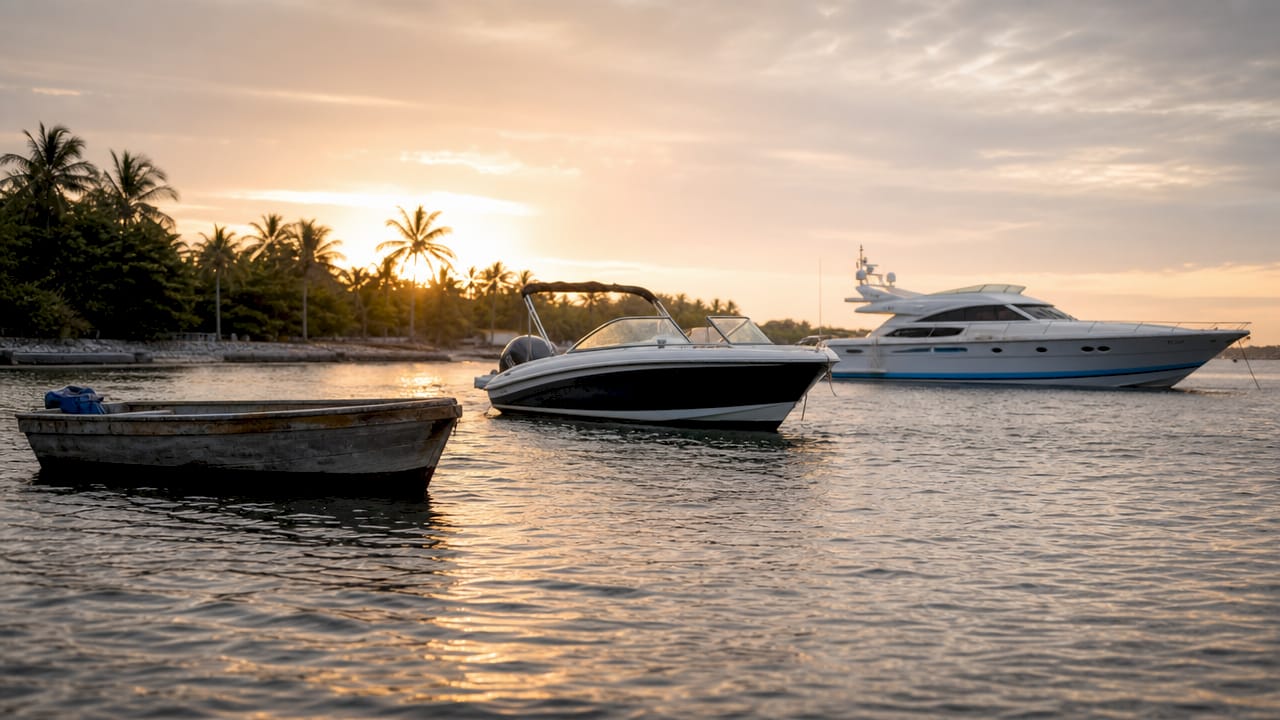
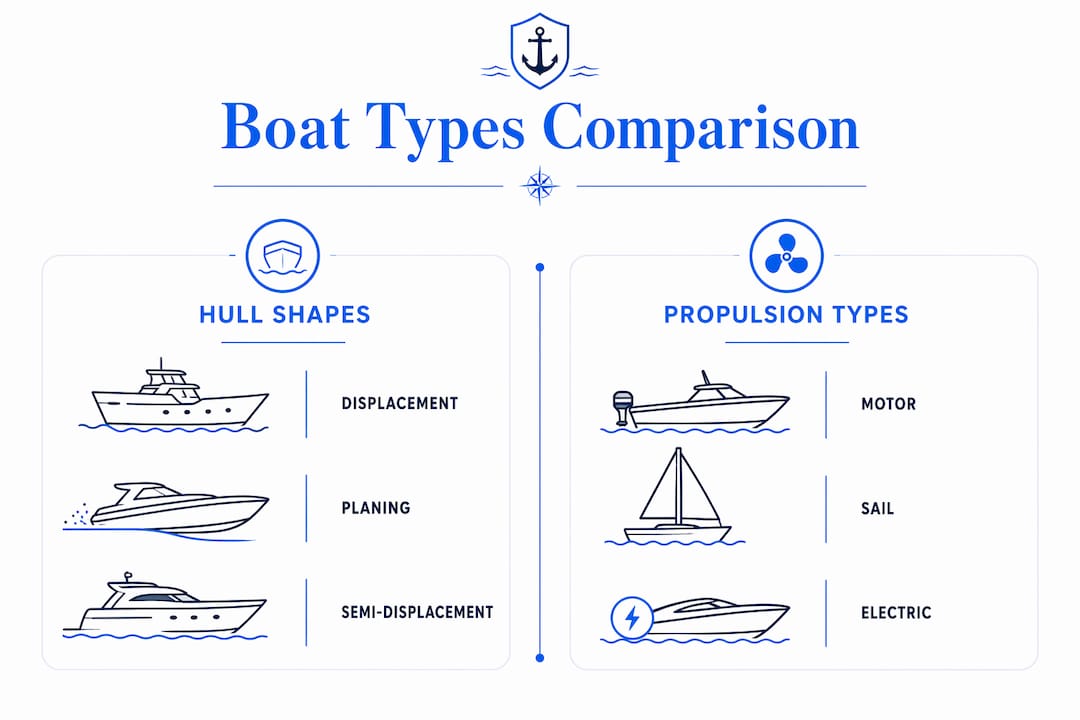
Three main hull categories exist: displacement, planing, and semi-displacement. Displacement hulls push water aside and move at slow, fuel-efficient speeds. They suit long-range cruising and trawlers. Planing hulls rise on top of the water at speed, making them ideal for watersports and fast day boats. Semi-displacement hulls combine features of both, offering moderate speed with better range than a pure planing design.
Within those categories, hull shape matters just as much as hull type. Here is how the most common shapes compare:
Hull shape | Best water conditions | Typical use |
Flat-bottom | Calm, shallow water | Jon boats, small fishing skiffs |
Deep-V | Rough, open water | Offshore fishing, sport cruisers |
Round-bottom | Open ocean, long passages | Sailboats, displacement cruisers |
Pontoon (twin tube) | Calm lakes and rivers | Family day boats, party platforms |
Flat-bottom hulls provide excellent stability on calm, shallow water but become uncomfortable and unsafe in even moderate chop. Deep-V hulls slice through waves, delivering a smoother ride in rough conditions at the cost of stability when stationary.
Pro Tip: Before choosing a hull shape, spend time on your local water body in different weather conditions. A boat that feels perfect on a glassy morning lake can become a nightmare in afternoon wind chop.
What are the main propulsion types and how do they influence boat choice?
Propulsion is the second pillar of any boat type comparison. The engine or sail system you choose shapes your maintenance schedule, operating costs, and the kind of boating experience you get.
The three main propulsion setups are:
Outboard motors. These bolt to the transom and are removable for servicing. They dominate small to mid-size boats, from jon boats to center consoles. Outboards are lighter, easier to maintain, and offer excellent fuel efficiency at moderate speeds.
Inboard and stern-drive engines. These sit inside the hull and power larger cruisers, cabin boats, and trawlers. They deliver more torque for heavier vessels and tend to last longer with proper maintenance, but servicing requires more access and skill.
Sail propulsion. Sailboats use wind as their primary power source. Most modern sailboats carry a small auxiliary diesel engine for maneuvering in marinas and calm conditions. Sailing demands more skill than motoring but rewards with lower fuel costs and a fundamentally different experience on the water.
The choice between motor and sail is not purely practical. Sailboats require learning to read wind, trim sails, and manage tacking. Motorboats offer point-and-go simplicity. For buyers who want to cover distance efficiently without the learning curve, a motorboat with an inboard diesel is the standard choice. For those drawn to the craft of sailing, the investment in skill pays off over years of low-cost passages.
Maintenance costs differ sharply between setups. Outboard motors are the easiest to service and replace. Inboard engines require professional access and more expensive parts. Sail rigs add rigging, sails, and mast maintenance to the annual cost list.
Which boat types suit specific activities and water conditions?
Boat types are categorized by intended use, and that category directly shapes every design decision from hull shape to deck layout. Matching the category to your activity is the fastest way to narrow your options.
Common boat categories by activity
Bowriders are open bow boats designed for family day trips and watersports. They seat 6–10 people comfortably and work best on lakes and calm coastal bays. The open bow seating makes them social and fun, but they offer no shelter from weather.
Pontoon boats are the undisputed kings of calm water entertaining. Pontoon boats hold 10–15 passengers on calm lakes, making them the top choice for group outings. They are stable, spacious, and easy to operate, but their flat-bottomed twin tubes make them unsuitable for open coastal water.
Center console boats are built around fishing. The open deck gives anglers 360 degrees of casting room. Center consoles carry 4–8 passengers offshore and handle moderate ocean swells well with a deep-V hull. They sacrifice shade and comfort for function.
Cabin cruisers cater to overnight travelers. They include sleeping quarters, a galley, and a head, making them self-contained for weekend trips. Speed and agility are traded for comfort and range.
Jon boats are aluminum flat-bottom workhorses. They are light, cheap to run, and easy to trailer. They excel in shallow freshwater rivers and marshes but have no place in open coastal water.
Freshwater versus saltwater design
The water type your boat lives in changes its required construction. Freshwater fishing boats tend to be lighter aluminum builds that are easy to trailer. Saltwater vessels use heavier fiberglass and marine-grade components for corrosion resistance. Using a freshwater boat in saltwater without constant rinsing causes severe galvanic corrosion within 6–12 months. Saltwater-rated vessels require marine-grade wiring and corrosion-resistant alloys to survive long-term coastal exposure.
What mistakes do new boat buyers make about boat types?
New buyers consistently make the same errors. Knowing them in advance saves thousands of dollars and years of frustration.
Ignoring local water conditions. Experts stress that evaluating your water body before selecting a hull is the most critical step. A buyer on a choppy coastal estuary who purchases a flat-bottom pontoon will resell it within two seasons.
Prioritizing amenities over hull design. Buyers fall in love with leather seating and entertainment systems. The hull and propulsion determine whether the boat is safe and enjoyable. Amenities are secondary.
Overestimating passenger capacity. Rated capacity overstates practical day-use capacity by 30–50% when you factor in gear, coolers, and safety equipment. A boat rated for 12 people comfortably carries 7 on a full fishing day.
Chasing an all-around boat. Boaters should prioritize primary use at 70–80% of their decision. Speed-focused boats sacrifice cabin comfort. Cruisers compromise agility. No single boat does everything well.
Skipping a test ride in real conditions. Calm marina demos hide how a hull actually performs. Always test a boat in the conditions you will actually use it in.
Pro Tip: Write down your three most common boating activities before you visit a single dealership. That list is your filter. If a boat does not serve at least two of those three activities well, walk away.
How do boat types apply to Lisbon’s coastal and inland waters?
Lisbon’s combination of coastal and calm inland waters calls for different boat types depending on where and how you plan to use them. The Tagus River estuary offers wide, sheltered stretches ideal for pontoon boats, catamarans, and sailing yachts. The open Atlantic coast just beyond Cascais demands deeper-V hulls and more powerful propulsion.
Key considerations for Lisbon’s waters include:
Calm estuary zones suit flat-bottom and pontoon designs for leisurely cruises and group entertainment.
Coastal Atlantic exposure requires deep-V fiberglass hulls with saltwater-rated components and reliable inboard or outboard engines.
Traditional vessels like the Lisbon tejo boats reflect centuries of design adaptation to local tidal and wind conditions.
Charter and tourism use favors sailing yachts and catamarans for their stability, capacity, and the experience they deliver to guests.
Accessibility needs influence boat selection for diverse groups. Wider beam boats and low-freeboard designs improve boarding ease for all passengers. Lisbonbyboat’s accessibility guide for Lisbon boats covers these considerations in detail.
Lisbonbyboat operates sailing yachts and catamarans on Lisbon’s waters, offering a direct way to experience how different boat designs perform in real local conditions before committing to a purchase.
Key Takeaways
Hull design, propulsion type, and intended use are the three factors that determine every meaningful difference between boat categories, and getting all three right is the only path to long-term satisfaction on the water.
Point | Details |
Hull type is permanent | Choose your hull shape based on local water conditions before anything else. |
Match boat to primary activity | Focus 70–80% of your decision on your most common use case, not an all-around ideal. |
Saltwater demands more | Saltwater boats require marine-grade materials; freshwater boats corrode rapidly in coastal use. |
Capacity ratings mislead | Real comfortable capacity runs 30–50% below the rated maximum once gear is loaded. |
Test in real conditions | Always demo a boat in the actual water and weather you plan to use it in. |
What I have learned from watching buyers get it wrong
After spending years on Lisbon’s waters and watching hundreds of boating decisions play out, the pattern is clear. Buyers who regret their purchase almost always made the same mistake: they chose the boat they wanted to own, not the boat that fits where they actually boat.
I have seen buyers fall hard for a sleek, speed-focused planing hull, only to discover their local estuary is too shallow and too calm to ever get the boat on plane. The boat sits at the dock looking beautiful and going nowhere useful. The opposite happens too. Someone buys a heavy displacement cruiser for weekend river trips and spends every outing frustrated by the fuel bill and the sluggish handling.
The buyers who get it right share one habit. They spend time on the water first, in different conditions, on different boat types, before they spend a dollar. Chartering or joining a sailing tour is not just a leisure activity. It is the most practical research you can do. Feeling how a catamaran handles a coastal breeze versus how a deep-V center console punches through chop tells you more than any spec sheet.
Amenities matter, but they are the last thing to evaluate. A boat with a stunning galley and uncomfortable hull is a floating disappointment. Get the hull right, get the propulsion right, and then choose your finishes.
— Lisbon
Lisbonbyboat: experience different boat designs on Lisbon’s water
Choosing the right boat type is easier when you have actually been on the water in the vessels you are considering. Lisbonbyboat offers daily sailing tours and private cruises on sailing yachts and catamarans along Lisbon’s historic coastline, giving you a direct feel for how these designs perform in real Atlantic and estuary conditions.
Whether you want a two-hour group tour or a full-day private charter, Lisbonbyboat puts you on board the exact types of vessels that suit Lisbon’s unique mix of calm inland stretches and open coastal water. Experienced guides explain the sights and the sailing, making each trip both memorable and genuinely informative. Explore luxury yacht options in Lisbon and find the boat type that fits your next time on the water.
FAQ
What are the main differences in boat types?
Boat types differ primarily in hull design, propulsion method, and intended use. These three factors determine speed, stability, capacity, and suitability for specific water conditions.
What hull type is best for rough water?
A deep-V hull is the best choice for rough or open-ocean conditions. It slices through waves rather than riding over them, delivering a smoother and safer ride.
Can I use a freshwater boat in saltwater?
Using a freshwater boat in saltwater without constant rinsing causes severe galvanic corrosion within 6–12 months. Saltwater use requires marine-grade materials and corrosion-resistant components.
How do I choose between a motorboat and a sailboat?
Choose a motorboat for simplicity, speed, and point-and-go operation. Choose a sailboat if you want lower long-term fuel costs and are willing to invest time in learning sailing skills.
What boat type suits Lisbon’s waters?
Lisbon’s Tagus estuary suits catamarans and sailing yachts for calm-water cruising. The open Atlantic coast near Cascais requires deep-V fiberglass hulls with saltwater-rated components for safe coastal operation.
Recommended
Comments