

Why Host Events on a Boat: A Planner's Guide
TL;DR:
Hosting events on boats creates a unique environment where guests share a mobile, scenic experience that enhances bonding and engagement. The vessel’s movement and waterfront scenery serve as natural decor, reducing costs and emphasizing exclusivity. Boat events outperform land venues in atmosphere, control, and guest memory, making them ideal for corporate networking and social gatherings.
Hosting events on a boat is defined by one core advantage no land venue can replicate: the moment guests board, the outside world stops. The vessel becomes the entire event environment, controlled, contained, and moving. Boat events, also called private charter events in the industry, deliver exclusivity through limited boarding access, social bonding through a shared journey, and dynamic waterfront scenery that replaces elaborate décor. Services like Untethered Voyages and operators such as Lisbonbyboat in Lisbon have built entire offerings around this format because planners keep returning to it. The reason is simple. A boat does not just host the event. It becomes the event.
Why host events on a boat instead of a traditional venue?
The single strongest reason to host on a boat is that the vessel creates the event’s story through movement and environment, engaging guests in ways a static ballroom or rooftop cannot. On land, the venue is background. On a boat, the venue is the experience. Guests are not standing in a rented room. They are moving through Lisbon’s harbor, watching the skyline shift, and sharing something genuinely uncommon.
Corporate planners who have used yacht charters in cities like New York and Lisbon consistently report that waterfront scenery and customizable formats deliver a “wow factor” that hotel conference rooms and restaurant buyouts simply cannot match. That impression matters. Clients remember how an event made them feel, and a moving vessel with open water views creates a feeling that sticks.
The benefits of boat events also extend to budget efficiency. The setting itself reduces the need for heavy floral arrangements, lighting rigs, or themed props. The water does the work.
How does a boat improve guest engagement and social connection?
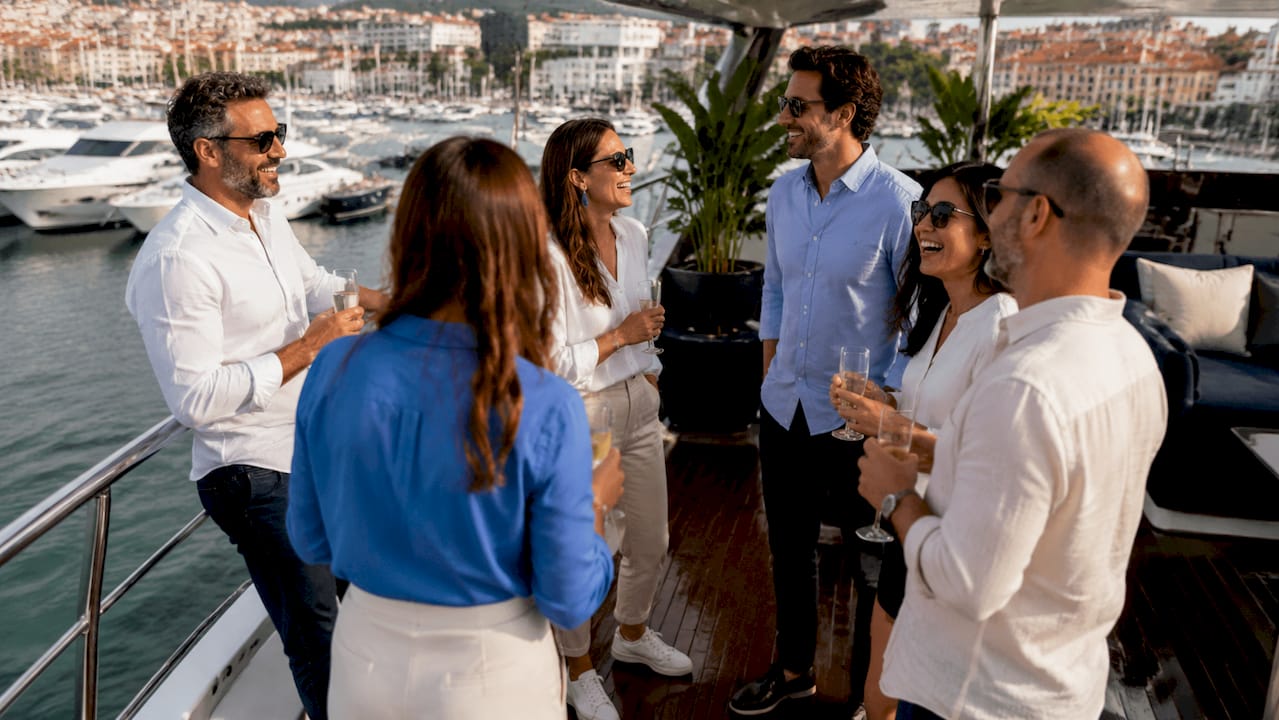
Shared experiences accelerate social bonding faster than any icebreaker activity. When guests board together, follow the same departure time, and watch the same coastline pass, they immediately have something in common. Coordinated boarding and the novelty of being on the water create a shared timeline that builds group cohesion from the first minute.
The novelty factor also lowers social barriers. Guests who might stay in their professional shells at a conference dinner tend to open up on a boat. The setting is unusual enough to prompt genuine curiosity and conversation without any forced team-building exercises.
Event format matters here. Cocktail-style layouts with open deck circulation encourage mingling far better than fixed seated dinners. Guests move naturally between the bow, the bar, and the stern, creating organic conversation clusters. Seated dinners work well for smaller, more formal groups where the scenery provides the atmosphere.
Cocktail format: best for networking events, product launches, and mixed-group socials
Seated dinner format: best for intimate corporate dinners, milestone celebrations, and client entertainment
Hybrid format: cocktail hour on deck followed by seated dinner below, maximizing both circulation and formality
Pro Tip: Design the event program to align with vessel movement. Schedule key toasts or presentations at moments when the boat passes a landmark. The scenery becomes part of the program, not just the backdrop.
What makes a boat a uniquely exclusive and private venue?
Boat-chartered events offer exclusivity through controlled access and clear boarding points that no hotel ballroom or restaurant can replicate. There is one gangway. Either you are on the guest list, or you are not on the boat. That physical reality creates a level of access control that event security teams at land venues spend significant effort trying to simulate.
Once the vessel departs, outside interruptions stop entirely. No uninvited guests walking through. No noise from adjacent event spaces. No strangers at the bar. The isolation is total, and for corporate clients especially, that focus translates directly into a more professional and impressive event experience.
Feature | Boat venue | Traditional venue |
Access control | Single boarding point, guest list enforced | Multiple entrances, harder to control |
Outside noise | Eliminated once underway | Ongoing risk from adjacent spaces |
Uninvited guests | Impossible after departure | Difficult to prevent entirely |
Privacy perception | High, guests feel exclusively hosted | Moderate, shared building with others |
Atmosphere control | Total, vessel defines the environment | Partial, décor-dependent |
For corporate clients, this exclusivity signals investment and intention. Booking a private charter communicates that the host took the event seriously. That perception shapes how guests receive everything else, the food, the conversation, and the agenda.
Pro Tip: When marketing a boat event to attendees, lead with the exclusivity angle. Phrases like “private charter” and “closed-deck event” signal premium value before guests even arrive.
How does waterfront scenery enhance the event experience?
Natural waterfront scenery shifts guest mood positively from the moment of boarding, reducing the need for heavy décor because the setting itself provides the ambiance. This is one of the most underestimated advantages of events on water. Planners who have worked both land and water venues consistently note that guests arrive on deck already relaxed and visually engaged, before a single decoration has registered.
The scenery is also dynamic. Unlike a hotel ballroom where the view never changes, a boat moves through Lisbon’s Tagus River, past the Torre de Belém, the 25 de Abril Bridge, and the Cristo Rei statue. Every fifteen minutes, the backdrop shifts. That constant visual change keeps guests present and attentive throughout the event.
Timing the event schedule around natural light creates additional impact without additional cost:
Sunset departures: golden light on the water creates natural photography moments guests share organically
Evening cruises: city lights reflecting on the river replace any need for ambient lighting installations
Midday cruises: bright open-sky views work well for product launches and daytime corporate events
The practical implication is real budget relief. A memorable boat rental experience relies on fewer, high-impact moments rather than complex décor schedules. Planners can redirect décor budgets toward catering quality, entertainment, or guest gifts.
What practical considerations should event planners know?
Capacity planning is the first operational decision. Large boats support groups up to 49 passengers across multiple decks with space for dining, dancing, and bar service. Smaller sailing yachts and catamarans work well for groups of 10–20 guests where intimacy is the goal. Matching vessel size to guest count is not optional. An undersized boat creates discomfort; an oversized one kills the atmosphere.
Safety is non-negotiable and shapes the entire logistics plan. Florida Fish and Wildlife Conservation Commission (FWC) data shows that boating fatalities frequently involve drowning where life jackets were not worn. Life jacket availability, sober operation, and pre-departure briefings are the three pillars every charter operator must confirm before guests board.
A pre-departure safety briefing also doubles as an engagement tool. Done well, it sets the tone, introduces the crew, and signals to guests that the event is professionally run.
Key operational steps for planners:
Confirm vessel capacity and layout match your guest count and event format
Verify the operator holds all required maritime licenses and insurance
Request a written safety briefing plan and life jacket inventory before signing contracts
Confirm the captain and crew are sober operators per maritime regulations
Schedule the event timeline around natural light and key scenic landmarks
Simplify décor planning by leaning on the venue’s natural features
Arrange a Lisbon boat capacity review with your operator before finalizing guest numbers
How do boat events compare with traditional venues?
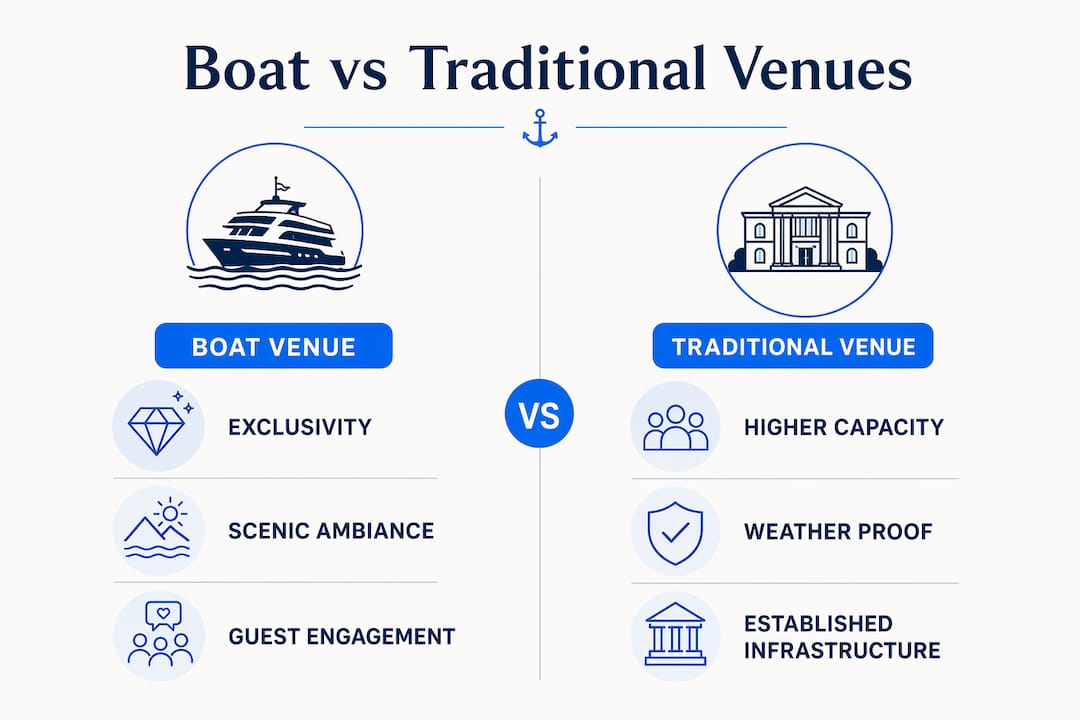
The comparison between boat events and traditional venues comes down to three factors: atmosphere, control, and guest memory. Boats win on all three for the right event type.
Factor | Boat venue | Traditional venue |
Ambiance | Dynamic, scenery-driven, naturally memorable | Static, décor-dependent |
Guest engagement | High, novelty and shared journey accelerate bonding | Moderate, familiar setting |
Exclusivity | Total once underway | Partial, shared building |
Logistics flexibility | Moderate, weather and capacity constraints apply | High, indoor control |
Cost efficiency | High, scenery reduces décor spend | Variable, décor costs add up |
Best for | Corporate networking, milestone events, product launches | Large conferences, weddings with complex setups |
Traditional venues remain the better choice when guest counts exceed vessel capacity, when weather risk is unacceptable, or when the event requires extensive audio-visual infrastructure. For corporate nautical events and social gatherings where atmosphere and exclusivity drive the brief, boats are the stronger choice in almost every scenario.
The key insight from corporate yacht planners is direct: avoid treating a boat like a floating restaurant. Schedule low-friction networking that aligns with guest circulation aboard the vessel. Let guests move, let the scenery work, and keep the program light enough that the environment remains the star.
Key Takeaways
Hosting events on a boat delivers exclusivity, guest engagement, and scenic ambiance that traditional venues cannot replicate, making it the strongest choice for corporate and social events where atmosphere drives the brief.
Point | Details |
Exclusivity through access control | A single boarding point enforces the guest list automatically, eliminating uninvited guests. |
Scenery replaces décor spend | Dynamic waterfront views reduce the need for elaborate decorations, freeing up budget. |
Shared journey builds social bonds | Coordinated boarding and a moving environment accelerate guest connection faster than land venues. |
Safety planning is non-negotiable | Life jacket availability, sober captains, and pre-departure briefings must be confirmed before any event. |
Format choice shapes the experience | Cocktail layouts maximize mingling; seated formats suit intimate or formal groups. |
What I’ve learned from watching guests board a boat for the first time
Every time I watch a group board for a private event, the same thing happens. The conversation volume drops for about thirty seconds. Guests look out at the water, take a breath, and then the energy shifts. That moment, before the music starts or the catering appears, is when the event actually begins. No land venue produces it.
The mistake I see planners make most often is over-programming the schedule. They fill every minute because they are used to land venues where silence feels like failure. On a boat, the movement and the views carry the event. A well-timed pause at the right landmark does more for guest mood than a perfectly scripted toast.
Safety practices are not a compliance checkbox. They are part of the event experience. A confident, well-briefed crew signals professionalism to every guest on board. When the captain runs a clear pre-departure briefing, guests relax. They trust the environment. That trust is the foundation everything else is built on.
The themed events on sailing boats that work best are the ones where the theme amplifies the vessel rather than fighting it. Nautical, sunset, and city-discovery themes all work because they align with what the boat naturally offers. Elaborate indoor-style themes that ignore the water tend to feel disconnected and waste the venue’s strongest asset.
— Lisbon
Plan your next event with Lisbonbyboat
Lisbonbyboat operates private yacht and catamaran charters on the Tagus River, with vessels suited for corporate dinners, social gatherings, and milestone celebrations. Events run from 2 hours to a full day, with routes passing Lisbon’s most iconic landmarks including the Torre de Belém and the 25 de Abril Bridge.
Private charters through Lisbonbyboat’s luxury yachts in Lisbon include crew, safety briefings, and flexible catering arrangements. Groups of 10–49 guests can be accommodated depending on vessel selection. Contact Lisbonbyboat directly to check availability, discuss event formats, and match the right vessel to your guest count and program.
FAQ
Why are boat events better for corporate networking?
Chartering a vessel turns the environment into an active engagement factor, accelerating guest interaction faster than static venues. The shared journey and novelty lower social barriers and create natural conversation starters.
Are boat events worth the extra planning effort?
Yes. The natural scenery and exclusivity reduce décor costs while delivering a guest experience that land venues cannot match. Most planners report that guests remember boat events longer than comparable land-based gatherings.
What safety measures are required for boat events?
Life jacket availability, a sober captain, and a pre-departure safety briefing are the three non-negotiable requirements. Confirm all three in writing before signing any charter contract.
How many guests can a boat event accommodate?
Vessel size determines capacity. Large charter boats accommodate up to 49 passengers across multiple decks. Smaller sailing yachts and catamarans work best for groups of 10–20 guests.
What event formats work best on a boat?
Cocktail layouts with open deck circulation work best for networking and social events. Seated dinners suit intimate corporate or milestone events. A hybrid format, cocktail hour on deck followed by a seated dinner below, combines the advantages of both.
Recommended
Comments