

Best Time for Sailing: Facts Every Enthusiast Should Know
TL;DR:
The best time for sailing depends on destination, weather, and skill level, with shoulder seasons offering the best value.
In the Mediterranean, late September to early October provides ideal conditions with fewer crowds and pleasant weather.
The best time for sailing is defined by steady winds, warm temperatures, and low storm risk. These three factors align most reliably during regional dry seasons and the shoulder periods around peak tourist months. Whether you are planning a Mediterranean cruise, a Caribbean adventure, or a coastal tour along Lisbon’s historic waterfront, knowing the optimal sailing season for your destination changes everything. This guide covers the key best time for sailing facts by region, wind conditions, and skill level so you can plan with confidence.
What are the best time for sailing facts by region?
The Mediterranean and Caribbean are the two most popular sailing regions in the world. Each has a distinct seasonal window, and confusing the two is one of the most common planning mistakes sailors make.
The Mediterranean sailing season runs from april through october, with june through august as peak months. Temperatures during this window sit between 21°C and 27°C, making conditions comfortable for both experienced sailors and first-timers. The Caribbean, by contrast, runs its prime season from november through april, driven by the dry season and reliable trade winds.
Knowing which region you are targeting is the first decision. Every other timing choice flows from that.
What defines optimal sailing seasons in the Mediterranean?
The Mediterranean’s sailing climate divides cleanly into four phases. Each phase suits a different type of sailor.
June through august is peak season. Marinas fill up fast, prices rise, and the social atmosphere is lively. Families and groups who want guaranteed sun and warm water favor this window. The trade-off is cost and crowds, particularly in popular spots like the Greek islands, Croatia’s Dalmatian Coast, and the Balearic Islands.
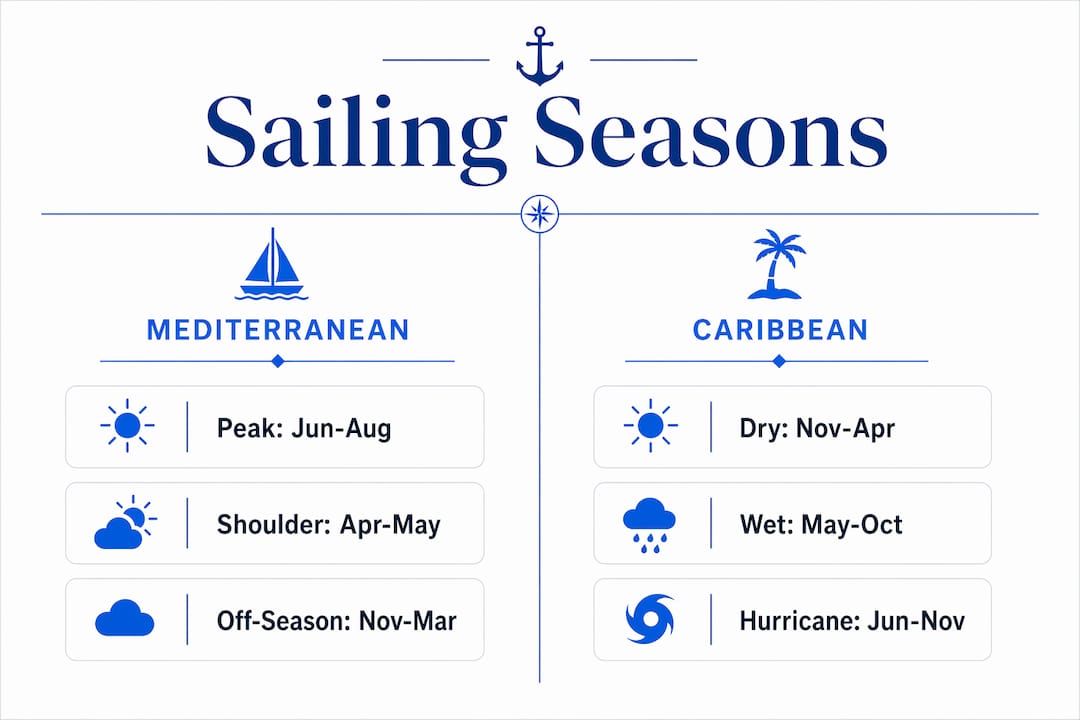
April through may and september through october are the shoulder seasons. Spring and fall bookings offer fewer crowds and better charter prices while temperatures remain pleasant. September in particular is a favorite among experienced sailors. The summer heat has faded, the meltemi winds in the Aegean ease off, and the sea is still warm enough for swimming. The Mediterranean wine harvest also runs through september and october, adding a cultural layer to any sailing itinerary.
Pro Tip: Book a Mediterranean charter in late september or early october. You get summer-quality weather, autumn pricing, and the added bonus of local harvest festivals and quieter anchorages.
November through march is the off-season. Rain increases, temperatures drop, and many marinas and charter companies reduce operations. This window is not recommended for leisure sailing unless you are an experienced offshore sailor with proper cold-weather gear.
Season | Months | Avg. Temp | Crowds | Charter Cost |
Peak | June–August | 24–27°C | High | High |
Shoulder (spring) | April–May | 18–22°C | Low | Moderate |
Shoulder (fall) | September–October | 20–24°C | Low–Moderate | Moderate |
Off-season | November–March | 10–16°C | Very Low | Low |
Shoulder season sailing around Lisbon follows this same pattern. The Tagus estuary and Atlantic coastline offer excellent conditions through october, with calmer winds and spectacular light.
When is the best time to sail the Caribbean?
The Caribbean’s prime sailing season runs from november through april. This is the dry season. Rain is minimal, skies are clear, and the northeast trade winds blow steadily. These conditions make the Caribbean one of the most reliable sailing destinations on the planet during this window.
The wet season, may through october, brings higher humidity, frequent afternoon showers, and the real concern: hurricanes. The official Atlantic hurricane season runs june 1 through november 30. The NOAA 2026 Atlantic outlook forecasts 8–14 named storms and 3–6 hurricanes, with a 55% chance of below-normal activity. That forecast is encouraging, but it does not eliminate risk. Sailors who choose to cruise the Caribbean in summer months must monitor conditions daily and have firm evacuation plans.
Skill level also shapes the ideal Caribbean timing. Beginners favor the earlier dry season months, november through february, when trade winds blow at a steady 15–20 knots. That range is manageable and predictable. Experienced sailors often prefer march through may, when winds strengthen to 20–25 knots and passages between islands become more technically demanding and rewarding.
Pro Tip: Always cross-check at least two marine weather sources before departing in the Caribbean. Conditions can shift within hours, and a forecast from the night before may not reflect morning reality.
Parameter | Nov–April (Dry) | May–Oct (Wet) |
Wind speed | 15–25 knots | Variable, gusty |
Avg. temp | 26–29°C | 28–32°C |
Rainfall | Low | High |
Hurricane risk | Minimal | June–November |
Best for | All skill levels | Experienced only |
How do wind speed and weather conditions affect when to sail?
Wind speed is the single most controllable variable in sailing timing. Getting it right separates a comfortable passage from a miserable one.
Optimal wind speeds for small to mid-sized boats sit between 8 and 12 knots. At this range, boats handle predictably, crew fatigue stays low, and the risk of accidental gybes or knockdowns is minimal. Veterans often seek 15 knots or more for the challenge and speed, but that range demands more active crew management.
Wave height gets most of the attention in weather planning, but swell period and sea state are equally critical. A 2-meter swell with a 12-second period is far more comfortable than a 1.5-meter swell with a 5-second period. Short, steep chop is what makes passages exhausting and potentially dangerous. American Sailing emphasizes that passage planning must account for sea state patterns, not just raw wave height numbers.
Marine weather changes fast. Checking forecasts immediately before departure is non-negotiable. Conditions that look stable at 6 a.m. can deteriorate significantly by noon. Cross-referencing multiple forecast sources, such as Windy, PredictWind, or NOAA’s marine forecasts, gives a more complete picture than any single source.
Key sailing weather factors to assess before departure:
Wind speed and direction: Confirm the forecast matches your boat’s capability and your crew’s experience.
Swell period: Short-period swells create uncomfortable, fatiguing conditions even at moderate heights.
Barometric pressure trends: A rapidly falling barometer signals deteriorating conditions within hours.
Visibility: Fog and rain reduce visibility and increase collision risk, especially in busy shipping lanes.
Port of refuge: Identify a safe harbor within reach if conditions worsen mid-passage.
Pro Tip: Before any offshore passage, identify a plan B port of refuge and brief your crew on the diversion route. Solid contingency planning is the mark of an experienced skipper, not a sign of pessimism.
What seasonal sailing facts should tourists and enthusiasts know?
Sailing seasons are not just about weather. They intersect with local culture, marine wildlife, and regional events in ways that can define the quality of your trip.
Regattas and sailing events create both opportunity and congestion. The Rolex Middle Sea Race in october draws hundreds of yachts through the Mediterranean. The BVI Spring Regatta in the British Virgin Islands runs in late march and early april, right at the tail end of the Caribbean dry season. Timing a trip around these events means either joining the spectacle or deliberately avoiding the marina crowds.
Marine wildlife follows seasonal patterns too. Whale watching off the Azores peaks from april through june. Dolphins are a near-daily sight along Lisbon’s Atlantic coastline from spring through fall. Sea turtles nest in the Caribbean from may through october, which overlaps with the wet season but adds a compelling reason for experienced sailors to venture out.
Shoulder seasons consistently deliver the best balance of weather, cost, and crowd levels across both major sailing regions. This is not a new insight, but most sailors still book peak season out of habit or convenience. The sailors who plan ahead for april, may, september, or october consistently report better experiences at lower cost.
Quick reference by sailor type:
Families with children: June through august in the Mediterranean for guaranteed warmth and calm seas.
Couples: September and october for privacy, lower prices, and cultural richness.
Beginners: November through february in the Caribbean for steady, gentle trade winds.
Experienced sailors: March through may in the Caribbean or april through june in the Mediterranean for stronger winds and fewer crowds.
Budget travelers: Shoulder seasons in either region cut charter costs significantly without sacrificing weather quality.
For sailors considering Lisbon, the seasonal sailing guide for the Portuguese coast shows that the city’s Atlantic position creates reliable afternoon winds from spring through fall, making it one of Europe’s most underrated sailing destinations.
Key Takeaways
The best time to sail depends on your destination, skill level, and tolerance for crowds, with shoulder seasons delivering the strongest overall value in both the Mediterranean and Caribbean.
Point | Details |
Mediterranean peak season | June–August offers warm temps but high costs and crowded marinas. |
Shoulder seasons win | April–May and September–October give better prices, fewer crowds, and solid weather. |
Caribbean dry season | November–April is the safest and most reliable window for all skill levels. |
Wind speed matters | 8–12 knots suits most sailors; stronger winds demand more experience and preparation. |
Always plan a backup | Identify a port of refuge before every offshore passage, regardless of forecast quality. |
What I’ve learned about timing a sailing trip
Most sailors treat the calendar like a rulebook. They book june because that is “sailing season” and accept the crowds and costs as part of the deal. That is the wrong approach.
The sailors I respect most treat the calendar as a starting point, not a destination. They look at the forecast window, the marina availability, and the cultural calendar together. A september charter in Croatia with a wine harvest dinner ashore beats a july charter in the same spot with three other boats anchored 20 meters away.
The other thing most guides understate is the importance of knowing when not to sail. Respecting a bad forecast is not weakness. It is the core skill that separates sailors who have long careers from those who have short ones. A plan B port of refuge is not a backup plan. It is the plan.
Lisbon’s coastline reinforces this lesson every season. The Atlantic can be generous and punishing within the same afternoon. The sailors who thrive here are the ones who read the conditions honestly and make decisions based on reality, not the itinerary they booked three months ago.
— Lisbon
Sail Lisbon with expert local knowledge
Timing your sailing experience well is half the work. The other half is choosing the right boat and the right crew.
Lisbonbyboat operates year-round along Lisbon’s historic coastline, matching each trip to the conditions and the season. From 2-hour guided sailing tours past the Belém Tower and the 25 de Abril Bridge to full-day private charters on luxury yachts and catamarans, every departure is planned around the day’s actual weather and wind. The Tagus estuary and the Atlantic approaches to Lisbon offer some of Europe’s most dramatic sailing scenery, and Lisbonbyboat’s local guides know how to read both the water and the monuments along the shore. You can also explore the full range of charter options to find the right format for your group and schedule.
FAQ
What is the best month for sailing in the Mediterranean?
September is the best single month for most sailors. Crowds thin out, charter prices drop, temperatures stay warm, and the summer winds ease to more manageable levels.
When should beginners sail the Caribbean?
Beginners should sail the Caribbean between november and february. Trade winds during this period blow at a steady 15–20 knots, which is predictable and manageable for less experienced crews.
How dangerous is Caribbean sailing during hurricane season?
Hurricane season runs june 1 through november 30. The NOAA 2026 outlook forecasts 8–14 named storms. Sailing during this period requires daily weather monitoring and firm evacuation plans.
What wind speed is best for recreational sailing?
8–12 knots is the ideal range for small to mid-sized recreational boats. This speed allows comfortable handling and good boat speed without demanding advanced crew skills.
Does wave height alone determine safe sailing conditions?
Wave height is not enough. Swell period and sea state determine actual comfort and safety. Short-period swells create rough, fatiguing conditions even when wave heights appear moderate.
Recommended
Comments