

Lisbon Books and Authors: Top 10 Literary Picks

TL;DR:
Lisbon’s literary history is embodied in authors like Pessoa, Saramago, and Lobo Antunes, each revealing different facets of the city. The city boasts historic bookstores such as Livraria Bertrand and hosts vibrant festivals like the Lisbon Book Fair, which celebrates contemporary and classic writing. Exploring Lisbon through its books and landmarks deepens visitors’ understanding, connecting literature, neighborhoods, and cultural heritage in a uniquely immersive way.
Few cities wear their literary history as visibly as Lisbon does. Lisbon books and authors have shaped an entire cultural identity, from Fernando Pessoa’s heteronyms wandering the Alfama to José Saramago’s Nobel Prize acceptance speech referencing his childhood library in Campo de Ourique. Whether you’re packing your carry-on before a trip or simply want to understand this city more deeply from your armchair, knowing which books and which authors matter here transforms how you see every cobblestone and café. This guide cuts through the noise and gives you the ten most essential entries in Lisbon’s literary world.
Table of Contents
Key takeaways
Point | Details |
Iconic authors define the city | Pessoa, Saramago, and Lobo Antunes capture Lisbon’s soul in ways no guidebook can match. |
Historic bookstores are destinations | Livraria Bertrand, the world’s oldest operating bookstore, is a must-visit landmark, not just a shop. |
Festivals keep literature alive | The Lisbon Book Fair runs late May through mid-June at Parque Eduardo VII every year. |
Reading before you visit pays off | Books set in Lisbon sharpen your eye for architecture, atmosphere, and neighborhood character. |
Literary tourism has a practical route | Tram 28 and self-guided walks connect major literary sites across the city’s historic districts. |
1. Lisbon books and authors: the three titans you must know
The literary legacy of Lisbon rests most heavily on three writers: Fernando Pessoa (1888–1935), Nobel laureate José Saramago, and António Lobo Antunes. Each one approached the city from a radically different angle, and reading all three gives you a triangulated view of Lisbon that no single author could provide alone.
Fernando Pessoa is the city’s unofficial patron saint of literature. His posthumously published The Book of Disquiet reads like an unfinished psychological map of Lisbon, written through his semi-heteronym Bernardo Soares, a bookkeeper working in the Baixa district. Pessoa invented over 70 fictional authors, each with distinct biographies and writing styles. That alone makes him one of the most singular literary figures of the 20th century.
José Saramago wrote The Year of the Death of Ricardo Reis as a direct homage to Pessoa, imagining one of Pessoa’s heteronyms returning to Lisbon after Pessoa’s death. Saramago’s prose is dense and requires patience, but the reward is a Lisbon rendered in precise, melancholic detail. António Lobo Antunes arrived from a different direction entirely: his Os Cus de Judas (South of Nowhere) draws on his experience as a military doctor in Angola and his return to a Lisbon marked by the end of empire.
Key works to know:
The Book of Disquiet by Fernando Pessoa
The Year of the Death of Ricardo Reis by José Saramago
Baltasar and Blimunda by José Saramago
South of Nowhere by António Lobo Antunes
The Natural Order of Things by António Lobo Antunes
Mensagem (Message) by Fernando Pessoa, his only book published in Portuguese during his lifetime
Pro Tip: Start with Pessoa’s The Book of Disquiet for atmosphere, then move to Saramago’s The Year of the Death of Ricardo Reis for historical context. Save Lobo Antunes for last. His fractured, stream-of-consciousness style lands harder once you understand the Lisbon those other two authors built.
2. Livraria Bertrand and the bookstores that shaped the city
You cannot talk seriously about Lisbon’s literary culture without spending time at Livraria Bertrand in Chiado. Founded in 1732, it holds the Guinness World Record for the world’s oldest operating bookstore. The original shop was destroyed in the 1755 earthquake that leveled much of Lisbon, and the bookstore relocated to its current address on Rua Garrett, where it has operated without interruption for nearly 270 years.
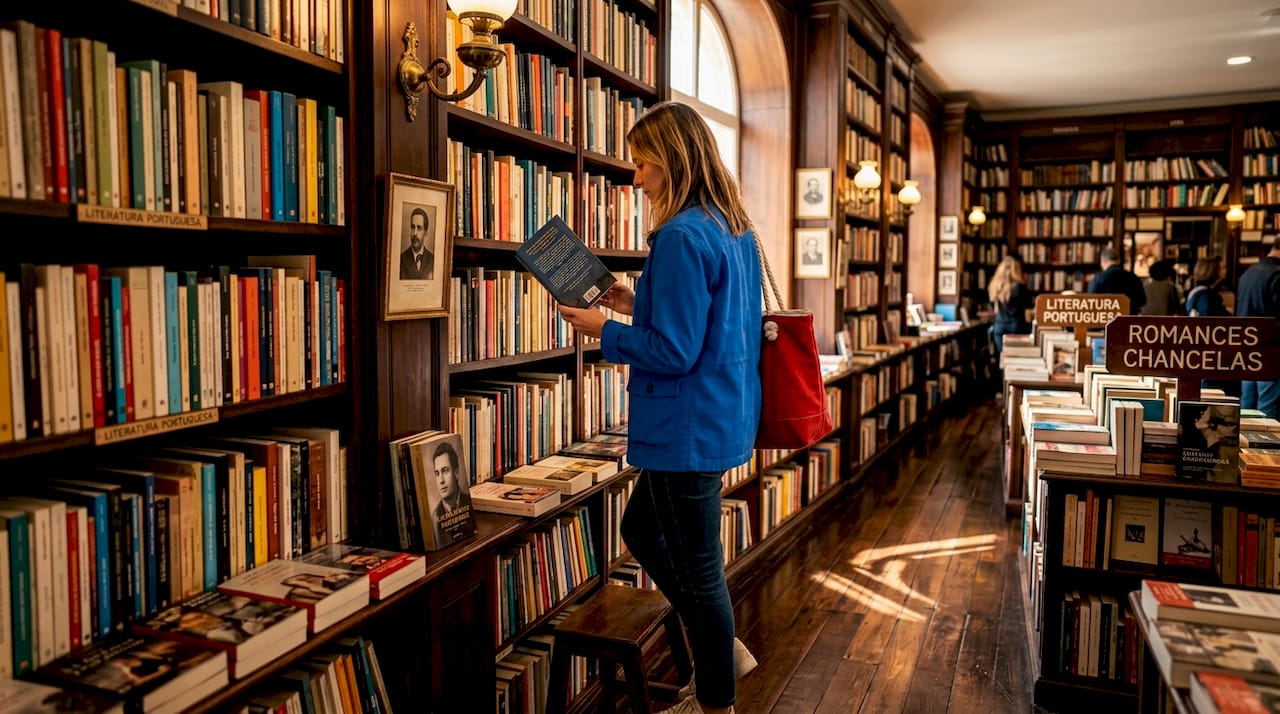
What makes Bertrand more than a retail space is its interior. The rooms are named after major Portuguese literary figures, including Eça de Queirós, José Saramago, Fernando Pessoa, and Alexandre Herculano. Walking through it feels like moving through chapters of Portuguese literary history. Portraits line the walls, first editions sit under glass, and the booksellers actually know the stock they’re selling.
Landmark | Location | Why it matters | Best for |
Livraria Bertrand | Rua Garrett, Chiado | World’s oldest operating bookstore, founded 1732 | Book purchases, literary atmosphere, author portraits |
Biblioteca Palácio Galveias | Campo de Ourique | Saramago learned to read here; hosts the José Saramago Room | Research, literary pilgrimage |
Casa Fernando Pessoa | Rua Coelho da Rocha | Pessoa’s final home, now a museum and cultural space | Pessoa studies, manuscripts, exhibitions |
Ler Devagar | LX Factory, Alcântara | Iconic independent bookstore inside a converted print factory | Independent titles, weekend events |
The Biblioteca Palácio Galveias in Campo de Ourique deserves its own pilgrimage. Saramago described this library as the place where his relationship with reading truly began, and the building now houses a room dedicated entirely to his work. It’s a public library, free to enter, and the Saramago Room contains first editions, correspondence, and photographs that you simply won’t find anywhere else.
Pro Tip: Visit Livraria Bertrand on a weekday morning before 11 a.m. Weekend afternoons bring tourist crowds that make browsing difficult. Ask a staff member to show you the oldest room in the back. Most visitors never find it on their own.
3. The Lisbon Book Fair and the city’s living literary festivals
Lisbon does not treat literature as a museum artifact. The city runs one of Europe’s most attended book fairs every year, and the 2026 Lisbon Book Fair returns May 27 to June 14 at Parque Eduardo VII. The 2024 edition featured 350 pavilions, 963 publishing brands, and over 3,000 cultural events, which gives you a sense of the scale. This is not a niche gathering. It draws hundreds of thousands of visitors across its three-week run.
Beyond the Book Fair, the festival Lisboa 5L plays a different but equally important role. As critic Pedro Mexia has observed, Lisbon’s identity as a literary city evolves continuously through living authors and cultural programming, with the city functioning as an active stage for ongoing creation rather than a monument to its past.
What to expect at the Lisbon Book Fair:
Author readings and signings across multiple pavilions each day
Publisher discounts that make this the best time to buy Portuguese literature in translation
Children’s programming running throughout the fair
Evening literary debates and panel discussions, often free to attend
Special themed days focused on specific genres or regions
Independent bookstores are equally critical to this ecosystem. As author Ana Margarida de Carvalho has noted, independent booksellers in Lisbon offer something market-centralized chains cannot: genuine literary expertise and a commitment to supporting local writers. Shops like Ler Devagar inside the LX Factory and Livraria do Mundo in Mouraria are worth building a day around.
4. Books set in Lisbon: a comparative reading guide
Choosing from the best books about Lisbon depends on what you want out of the experience. Some readers want historical sweep, others want atmosphere, and others want something that connects directly to specific neighborhoods they plan to visit. This comparison table helps you match the right book to your purpose.
Title | Author | Genre | Best for | City connection |
The Book of Disquiet | Fernando Pessoa | Literary fiction | Atmosphere and introspection | Baixa, Chiado, Alfama |
The Year of the Death of Ricardo Reis | José Saramago | Historical fiction | Lisbon between the wars | Bairro Alto, Rossio |
Queen of the Sea | Barry Hatton | Narrative history | Historical and cultural context | City-wide |
Two Nights in Lisbon | Chris Pavone | Thriller | Plot-driven contemporary Lisbon | Bairro Alto, riverfront |
The Maias | Eça de Queirós | Classic realism | 19th-century Lisbon society | Chiado, Príncipe Real |
A Small Death in Lisbon | Robert Wilson | Crime fiction | Atmospheric noir | Mouraria, Alfama |
Night Train to Lisbon | Pascal Mercier | Philosophical fiction | Salazar-era history and memory | City-wide, Alfama |
Reading Barry Hatton’s Queen of the Sea before your trip genuinely changes what you see in front of you. Hatton writes with a journalist’s precision about Lisbon’s relationship with its own past, and readers consistently report that the book sharpens their eye for architecture and neighborhood character in ways that standard travel guides never do.
Night Train to Lisbon by Pascal Mercier is perhaps the most useful novel for visitors who want to understand the emotional weight Salazar’s regime left on the city. The book follows a Swiss professor obsessed with the journal of a Portuguese resistance writer, and it provides a remarkable window into a Lisbon that still shapes the behavior and memory of older residents today.
5. Practical recommendations for literary tourists in Lisbon
Knowing the books and authors is one thing. Turning that knowledge into a real itinerary takes a bit more planning. The good news is that Lisbon’s literary geography is concentrated in a few distinct neighborhoods, which makes combining reading and sightseeing genuinely efficient.
A strong starting framework:
Begin your literary exploration in Chiado. Visit Livraria Bertrand in the morning, then walk to the Fernando Pessoa statue outside Café A Brasileira, where the poet famously spent hours at the outdoor tables.
Take Tram 28 through the historic neighborhoods featured across multiple Lisbon novels, but board early. By 10 a.m. the line grows quickly and the ride becomes uncomfortable.
Dedicate one afternoon to Campo de Ourique and the Biblioteca Palácio Galveias. This neighborhood feels completely different from the tourist center and gives you a genuine sense of residential Lisbon.
Cross the city to LX Factory on a Saturday or Sunday for Ler Devagar and its weekend book market. The converted industrial space has a literary atmosphere that Chiado can’t match.
For readers building a trip around the Lisbon Book Fair, the literary history of Lisbon makes for excellent pre-trip reading. Pairing that with a self-guided walking route lets you connect the authors you’ve read to the streets they actually walked.
Pro Tip: The Saramago Foundation at Casa dos Bicos near the riverfront hosts rotating exhibitions on Portuguese literature and frequently runs free evening events. Check their schedule before you arrive. The building itself, with its diamond-shaped stone facade, is worth visiting even if no event is running.
My honest take on Lisbon as a literary city
I’ve spent years exploring cities through their books, and Lisbon does something that very few other cities manage. It makes you feel the literature in the architecture before you’ve even read a page. Walking through the Alfama and knowing that Pessoa mapped these same narrow streets through his fictional alter egos creates a feedback loop between reading and place that I’ve only found in one or two other cities in the world.
What surprises most visitors is how contemporary the literary scene actually is. People expect a city living on its past glories. What they find instead is a community of writers, booksellers, and translators actively building something new. The independent bookstores that have opened in the last decade, particularly in neighborhoods like Mouraria and Intendente, signal a genuine shift in how younger Lisbonites relate to their literary heritage.
My only frustration is that so little of this work reaches English-language readers in time. Saramago won the Nobel in 1998 and his backlist is well-translated. But many of the exciting contemporary voices being discussed in Lisbon right now won’t appear in English translation for another five years, if at all. If you want the full picture, starting even basic Portuguese will open doors that no guidebook or translation can.
The city rewards patience. Read deeply before you go. Walk slowly when you’re there. And accept that Lisbon will give you more questions than answers, which is exactly what the best literature does anyway.
— Lisbon
See Lisbon’s literary landmarks from a completely different angle

The neighborhoods that shaped Portuguese literature, from Pessoa’s Baixa to Saramago’s Alfama, look entirely different from the water. Lisbonbyboat runs daily sailing tours along Lisbon’s historical coastline, with guides who explain the monuments and cultural landmarks that connect directly to the city’s literary history. If you want to combine your love of Lisbon’s books and authors with an unforgettable view of the city, a luxury yacht experience on the Tagus River puts everything in perspective. Private cruises run from two hours to a full day and can be tailored to your interests. Explore the full tour options and book your place on the water.
FAQ
Who is the most famous author from Lisbon?
Fernando Pessoa is widely considered Lisbon’s most iconic literary figure. Born in 1888, he spent most of his life in the city and created over 70 fictional author identities, leaving behind a literary legacy that still defines how the world reads Lisbon.
What is the best book to read before visiting Lisbon?
The Book of Disquiet by Fernando Pessoa is the most atmospheric choice, but Barry Hatton’s Queen of the Sea offers essential historical and cultural context that makes the city’s architecture and neighborhoods far more legible to first-time visitors.
Where is the world’s oldest bookstore?
Livraria Bertrand in Chiado holds the Guinness World Record as the world’s oldest operating bookstore, founded in 1732 and located on Rua Garrett after relocating following the 1755 earthquake.
When does the Lisbon Book Fair take place?
The Lisbon Book Fair runs from late May through mid-June at Parque Eduardo VII. The 2026 edition runs May 27 to June 14, featuring hundreds of publishing brands and thousands of cultural activities across three weeks.
Are literary tours in Lisbon worth doing?
Yes, particularly for readers who want to connect specific texts to physical places. Tram 28 passes through neighborhoods featured in multiple Lisbon novels, and a local guide can dramatically deepen the experience by adding context that self-guided maps often miss.
Recommended
Comments