

History of boat excursions: Lisbon's maritime story
TL;DR:
Lisbon’s boat tours primarily showcase authentic vessels and landmarks, emphasizing storytelling over ancient routes. The typical cruise lasts around two hours and features genuine historical sites like Belém Tower and Commerce Square. The evolution of leisure cruising globally has influenced Lisbon’s offerings, transforming water trips into immersive cultural experiences.
Lisbon sits on the edge of the Tagus River with a waterfront that has shaped civilizations, launched explorers, and now draws visitors from every corner of the world. But here is what surprises most people who book a “historic” boat tour in this city: the history of boat excursions here is far less about ancient continuous routes and far more about extraordinary vessels, sharp storytelling, and a river whose very banks carry centuries of meaning. If you want to experience Lisbon the way it deserves, understanding what you are actually stepping onto makes all the difference.
Table of Contents
Lisbon’s historic boat excursions: vessels and routes that tell a story
The global evolution of leisure cruising and its impact on Lisbon’s boat tours
Choosing and enjoying Lisbon’s historic boat excursions: tips and what to expect
Rethinking Lisbon’s historic boat excursions: separating myth from meaningful experience
Key Takeaways
Point | Details |
Historic vessels matter | Lisbon’s river tours gain historic appeal mainly by using authentic traditional boats with verifiable maritime heritage. |
Typical tour format | Most historic sightseeing cruises last about two hours, with live commentary, departing near central Lisbon waterfront locations. |
Leisure cruising evolution | Modern leisure boat excursions evolved post-1950s after air travel reduced ocean liner demand, shifting toward shorter pleasure voyages. |
Marketing vs history | Be aware many ‘historic’ claims in tours are narrative marketing unless tied to museum-inscribed vessels or documented service periods. |
Choose tours wisely | Select boat excursions based on vessel authenticity, commentary quality, and route highlights to ensure an enriching Lisbon experience. |
Origins of boat excursions: from commerce to leisure tours
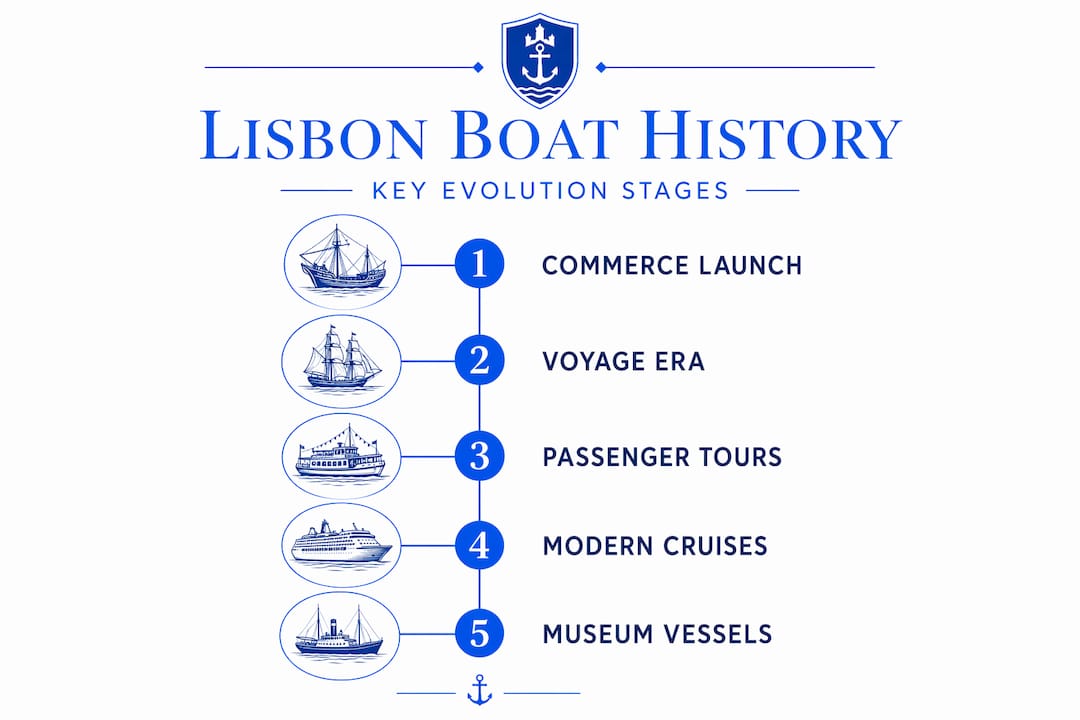
For most of human history, boats were tools. They moved grain, fish, salt, and soldiers. Nobody paid money to ride one for fun. The shift from working vessel to leisure experience happened gradually over centuries, and it did not follow a single script in any city.
The clearest pattern in boat tour history runs like this:
Rivers and harbors served as primary commercial corridors for trade and transport.
Industrial growth and later aviation reduced the necessity of water-based cargo movement.
Cities with historic waterfronts began repackaging their idle maritime infrastructure for tourism.
Formal leisure cruises emerged, initially for the wealthy, then broadening to mass tourism.
Storytelling and vessel authenticity became the products, replacing raw utility.
“A commonly repeated ‘boat excursion history’ pattern shows boats first served commerce, later converted to tourist cruises, as seen in cities like Paris and Lisbon.” The Seine river history documents this shift clearly: formal tourist cruises on the Seine launched in 1950, repurposing the same river that once moved the lifeblood of French commerce.
Lisbon followed a strikingly similar path. The Tagus was the launchpad for Vasco da Gama’s 1497 voyage to India and Pedro Álvares Cabral’s 1500 expedition to Brazil. These waters were not scenic backdrop. They were engine rooms of empire. When cargo traffic declined and Lisbon’s economy diversified, the river transformed into a stage for tourism, and the development of maritime excursions here built directly on that inherited prestige.
What makes the Lisbon case distinct is how the discovery of Lisbon’s boat history connects visitors to monuments that are not reconstructions or replicas. The Tower of Belém, the Jerónimos Monastery, and Commerce Square are exactly where history left them, visible from the water.
Lisbon’s historic boat excursions: vessels and routes that tell a story
When tourists say they want a “historic” Lisbon boat tour, they often picture something ancient. The reality is more interesting and more honest than that framing.
The deepest source of authenticity in Lisbon’s boat excursions is the vessels themselves. Only seven traditional 1947 cargo boats remain in operation, all inscribed in the Navy Museum, and these are the boats used on the Tagus sightseeing cruises. A boat built in 1947 is not ancient, but it is genuine. You are boarding something with a real documented history, not a themed reproduction.
The typical route on these cruises covers:
Commerce Square (Praça do Comércio): The grand riverside plaza where ships once unloaded goods directly from the Tagus.
São Jorge Castle: Visible from the water, sitting above the Alfama district, a Moorish fortress that predates Portugal as a nation.
Belém Tower: Built in the early 16th century to guard the entrance to Lisbon’s harbor and ceremonially send off explorers.
Monument to the Discoveries: A modern tribute to Portugal’s Age of Discovery, but placed exactly at the water’s edge where those journeys began.
25 de Abril Bridge and Cristo Rei: Framing the river’s far view with a visual that makes the Tagus feel genuinely vast.
Landmark | Historical period | Viewed from the water |
Belém Tower | 16th century | Yes, iconic river view |
Commerce Square | 18th century rebuild | Yes, riverfront plaza |
São Jorge Castle | Moorish, pre-12th century | Yes, hilltop sightline |
Monument to the Discoveries | 1960 | Yes, waterfront monument |
Jerónimos Monastery | 16th century | From near-shore proximity |
Pro Tip: A guided sailing cruise on the Tagus typically lasts about 2 hours, departing near Cais do Sodré. That duration hits a practical sweet spot: long enough to see everything meaningful, short enough that it never becomes exhausting. Request live commentary in your language before you book.
The commentary on these tours is not background noise. It is the product. A knowledgeable guide turns a pretty river into a timeline. When a guide points at Belém Tower and explains that Vasco da Gama departed from this very riverbank in 1497, that tower stops being architecture and starts being a witness. That transformation is what separates a boat ride from a top sightseeing cruise.
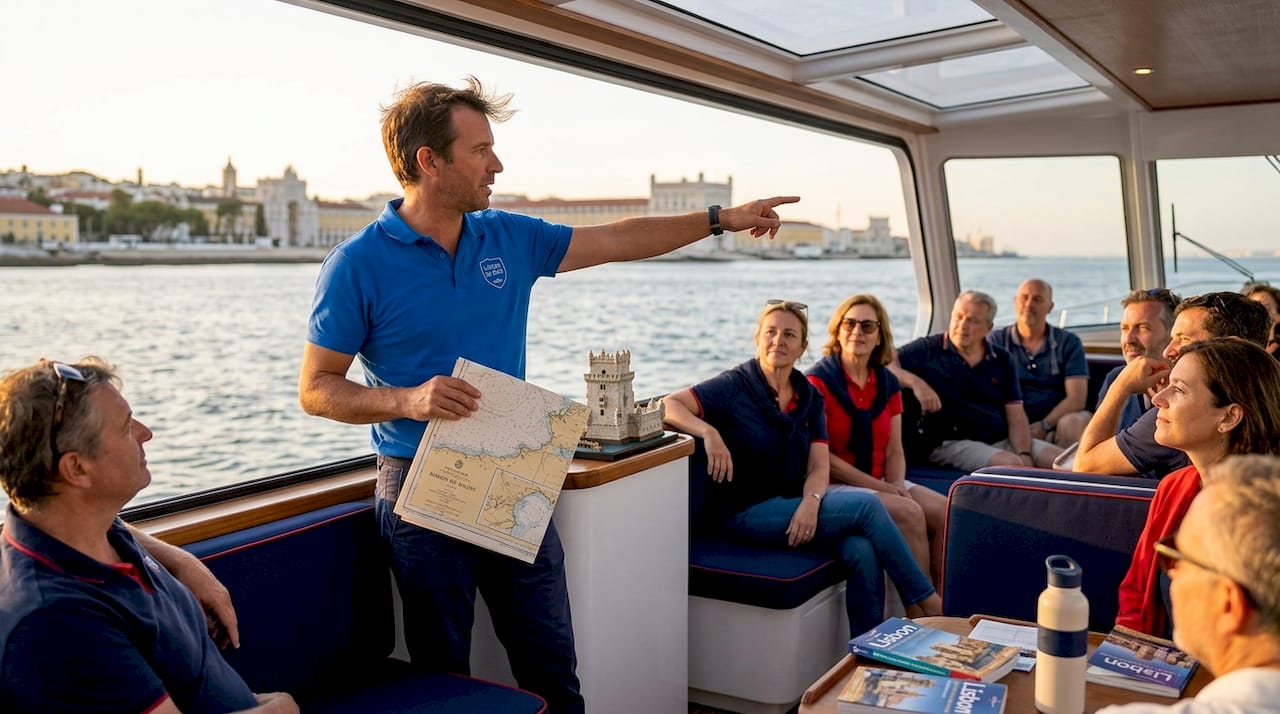
The best way to prepare for those stories is to read up on what to expect on daily boat tours so none of the key moments catch you unprepared.
The global evolution of leisure cruising and its impact on Lisbon’s boat tours
Lisbon’s river cruise scene did not develop in isolation. It rode a global wave in the evolution of boat rides that reshaped how people think about water travel entirely.
The pivot point came after World War II. Aviation expanded rapidly in the 1950s and early 1960s, and the transatlantic ocean liner lost its primary purpose. People no longer crossed the Atlantic by ship because they had to. The great cruise lines faced a choice: retire their fleets or reinvent their product.
They reinvented. Leisure cruising evolved post-1950s as airlines made ocean liner travel obsolete for transportation, which pushed cruise companies to market shorter pleasure voyages focused on destinations and onboard experience rather than transit. This shift fundamentally changed what a “boat journey” meant to the average traveler.
The cultural tipping point came in 1977. The TV series “The Love Boat” sparked a cruising boom by making cruises feel glamorous, accessible, and fun for middle-class Americans, not just the wealthy. The 1980s saw explosive growth in the cruise industry as a direct result.
Here is why this matters for Lisbon’s boat tours specifically:
The global normalization of leisure cruising made “scenic boat ride” a recognized tourism product category, which helped river cruise operators everywhere attract bookings.
The shift to experience over transport gave smaller operators permission to market a 2-hour Tagus cruise as a complete, worthwhile activity on its own.
The emphasis on storytelling and destination immersion, which became standard across cruise marketing, reinforced what Lisbon operators were already doing with their heritage-rich routes.
Era | Dominant boat use | Tourism impact |
Pre-1900 | Commerce and transport | No leisure cruises |
1900 to 1950 | Ocean liners for travel | Wealthy-only cruising |
1950 to 1980 | Transition to leisure focus | Short pleasure voyages emerge |
1980 to present | Experience and destination cruising | Mass market river and sea tours |
The overview of Lisbon river cruises shows how this global history plays out locally: the options range from traditional vessel sightseeing to private luxury charters, each serving a different version of the same core desire to see a great city from the water.
Choosing and enjoying Lisbon’s historic boat excursions: tips and what to expect
Knowing the history changes how you shop for a tour. Here is a practical framework:
Verify the vessel. Look for tours explicitly operating on the registered 1947 traditional cargo boats inscribed in the Navy Museum. A certified historic vessel carries a verifiable pedigree. Many tour marketing pages use the word “historic” loosely, so ask directly or check for museum inscription status.
Check departure logistics. Most departures are from Cais do Sodré or Praça do Comércio. Both are centrally located and easy to reach. Know your exact boarding point because the Tagus waterfront covers several distinct docking areas.
Confirm the commentary format. Live, on-board narration in your language is not guaranteed on all tours. A recorded audio guide is a workable substitute, but a live guide who can answer your questions during the tour adds significantly more value.
Plan for about 2 hours. Most Tagus sightseeing cruises run approximately 2 hours, which is the right amount of time to cover the main landmarks without rushing or dragging. Build this block into your Lisbon itinerary without squeezing it between other timed activities.
Match the tour type to your interest. A traditional vessel sightseeing cruise suits history-focused visitors. A private yacht or catamaran charter suits those who want a scenic, relaxed experience with flexible stops and timing.
Pro Tip: Book sightseeing cruise essentials in the morning when the light on the Tagus is cleaner and crowds at departure points are smaller. The Belém Tower in particular looks dramatically different in morning light compared to midday.
The past boat travel experiences that visitors remember most are almost never about the boat alone. They remember the moment the guide explained something they did not know, or when the scale of the Tagus suddenly made Lisbon’s Age of Discovery feel real rather than academic. The vessel is the setting. The story is the experience.
Rethinking Lisbon’s historic boat excursions: separating myth from meaningful experience
Here is an uncomfortable truth the tourism industry rarely states plainly: most of what gets marketed as “historic” on a boat tour is narrative packaging, not unbroken historical continuity.
No sightseeing cruise in Lisbon has been operating the same route since 1497. The significance of boat tours here is not that they replicate ancient voyages. It is that they use genuine landmarks, occasionally authentic vessels, and well-researched storytelling to make history tangible for people who would otherwise walk past a tower and see a tower.
Many “history” claims on tour pages are marketing narratives unless the vessel and its history are verifiable and museum-inscribed. That does not make those tours bad. It means you should adjust what you are looking for. The real value is in choosing a tour where the landmarks are explained with accuracy and depth, not just pointed at.
The Tagus itself carries genuine maritime significance that no amount of marketing can inflate or deflate. This is the river that connected Europe to Asia, Africa, and the Americas. Standing on its water and looking at Belém Tower is a legitimately powerful experience regardless of whether your boat was built in 1947 or last year.
What makes the difference is whether the person guiding you understands the weight of what you are looking at. A knowledgeable, passionate guide turns a 2-hour cruise into something you will reference in conversations for years. A disengaged one turns it into a scenic boat ride you vaguely remember.
We have seen this play out in tourist satisfaction data consistently: visitors who felt informed and genuinely connected to what they saw rate their experience dramatically higher than those who felt like they were just checking a box. The boat is the vehicle. The knowledge is the destination.
Explore Lisbon’s waters with authentic boat experiences
If this article has changed how you think about Lisbon’s boat tours, you are already better equipped to choose the right one.
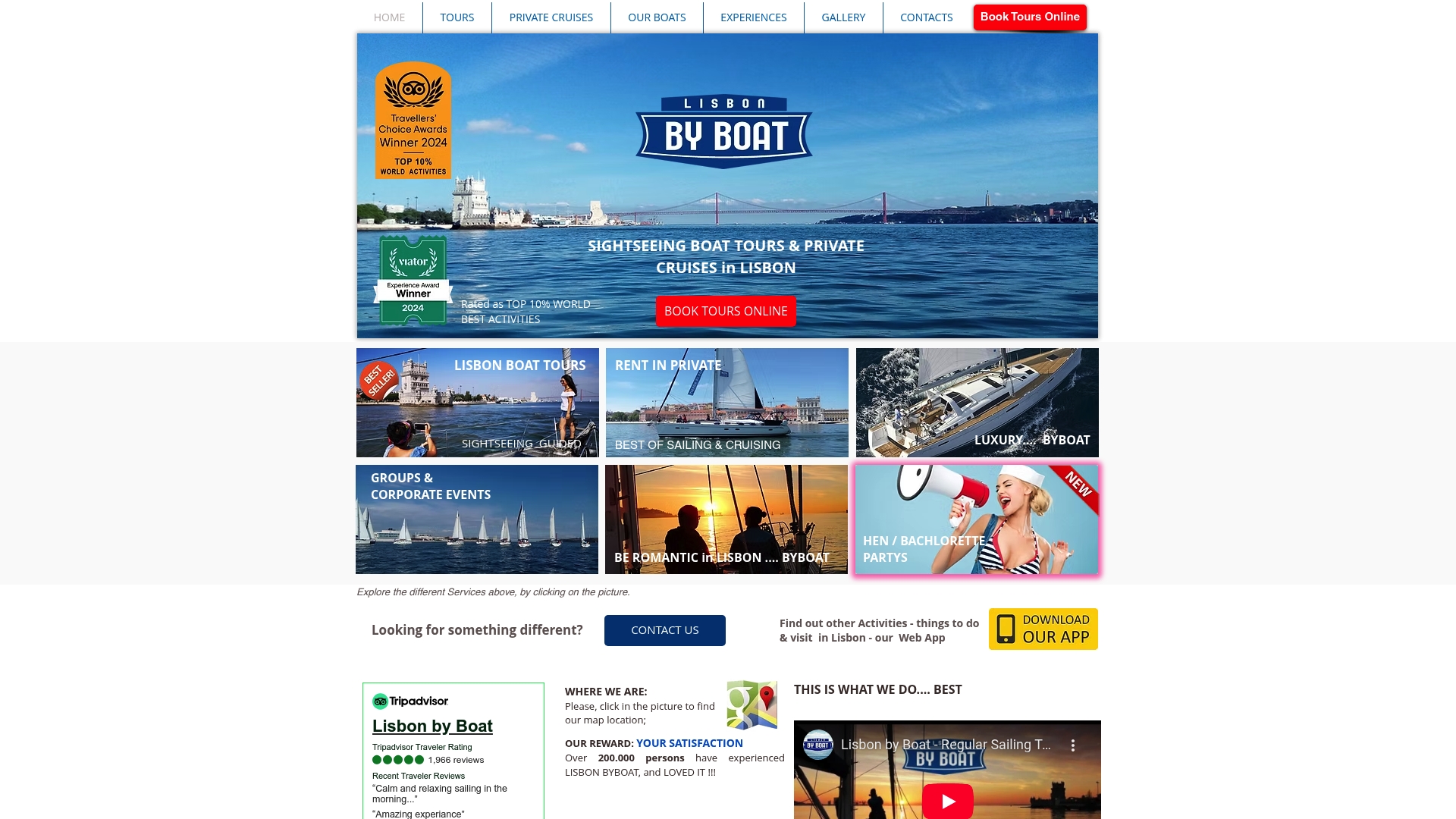
We run daily sailing tours on the Tagus that last exactly 2 hours, with knowledgeable guides who connect every landmark to the stories that make them matter. For visitors who want something more personal, our luxury yacht options in Lisbon offer private sailing experiences on yachts and catamarans ranging from 2 hours to a full day. Every option is designed to give you Lisbon from its best angle, the water. Explore our full range of yacht charter options in Portugal or start planning your trip directly on the Lisbon By Boat website.
Frequently asked questions
What makes a Lisbon boat excursion “historic”?
Lisbon boat excursions earn the “historic” label primarily through traditional vessel authenticity and narrative framing around maritime landmarks rather than through centuries-old uninterrupted route history. The 1947 cargo boats inscribed in the Navy Museum are the clearest marker of genuine heritage.
How long are typical Lisbon river boat tours?
Most Lisbon sightseeing river cruises run approximately 2 hours, striking a balance between covering all major landmarks and keeping the experience relaxed rather than rushed.
Where do most Lisbon boat excursions depart from?
The majority of Lisbon’s historic and sightseeing boat tours depart near Cais do Sodré or Praça do Comércio, both central waterfront locations easily accessible from most parts of the city.
How did “The Love Boat” TV series affect cruising as a leisure activity?
The 1977 series sparked a cruising boom by making cruise vacations feel attainable and appealing to middle-class travelers, not just the wealthy, which directly triggered the rapid industry expansion seen through the 1980s and beyond.
Recommended
Comments