

Cover a 24 Hour Lisboa Card, or Trade a Museum Day for a Tagus Cruise

The Lisboa Card is worth it if you front-load paid museums and monuments and ride public transport daily. It is not worth it if your trip is slow, food-focused, or light on paid attractions. The math tips fast: free entry to Jerónimos Monastery and Belém Tower, plus the included suburban train to Sintra and Cascais, can cover the card’s cost inside one intensive day. Everything below shows exactly when that happens and when it doesn’t.
TL;DR:
The Lisboa Card’s value hinges on visiting Jerónimos Monastery and Belém Tower early, as their combined prices nearly cover a 24-hour pass.
The card includes free suburban train rides to Sintra and Cascais, but palace entries in Sintra require separate paid tickets and advance booking.
To maximize savings, activate the card at the start of your busiest sightseeing morning and front-load expensive attractions, especially in Belém.
The card is less beneficial for leisurely trips focused on food, long-stay itineraries with few paid attractions, or if most sites are free or discounted elsewhere.
Booking timed attractions ahead is essential, as the card offers no priority access beyond skipping the ticket line, with limited refunds once activated.
Table of Contents
What the Lisboa Card Actually Covers
The card bundles two things: unlimited public transport and free or discounted entry to a long list of attractions. Transport coverage includes the metro, city buses, trams (including the touristy Tram 28 route), funiculars, the Santa Justa Lift, and, critically, the CP suburban trains that run out to Sintra and Cascais. That train inclusion alone is worth flagging early, because a lot of visitors buy the card for museums and only discover the transport perk once they’re standing at Rossio station wondering why the turnstile just let them through for free.
On the attractions side, the card gives free entry to somewhere between 30 and 52 museums and monuments, depending on which season’s partner list is active, plus percentage discounts at dozens of other sites, restaurants, and shops. The free list and the discount list are not interchangeable, and confusing the two is the single fastest way to overestimate how much you’re saving.
Here’s what typically falls into each bucket:
Free with the card: major Belém monuments, several city museums, the Santa Justa Lift, and select smaller sites.
Discount only: big-ticket draws like the Oceanário and the Sintra palaces, where you get a reduced price but still pay something.
Transport: unlimited rides on metro, bus, tram, funicular, and the Sintra/Cascais commuter trains.
Activation matters more than most buyers realize. The clock starts the moment you validate the card at your first metro turnstile, museum entrance, or tram ride, not at the moment of purchase. Validate it at 2:00 p.m. on a 24-hour card and you’ve already burned half a sightseeing day before you’ve seen anything. This single detail is worth planning around, and we’ll come back to it.
Lisboa Card Prices for 24, 48, and 72 Hours
Prices shift by season and by which official channel you buy through, so treat any number here as a planning estimate, not a locked-in price. Published 2026 roundups generally put adult pricing in a similar band across tiers, with some variation between sellers. Confirm the live rate at checkout before you commit to a duration.
The word “rolling” does real work here. Validity counts in hours from your first tap or scan, not from midnight to midnight on the calendar. A 48-hour card activated at 10:00 a.m. Tuesday runs out at 10:00 a.m. Thursday, not at the end of the Wednesday you might expect. Buying online ahead of your trip usually beats waiting to buy at a kiosk, both for convenience and because it skips the line at the airport counter where every other tourist off your same flight is standing. Refunds and exchanges are limited once a card is activated, so pick your duration based on your actual itinerary, not a rough guess.
Free Vs. Discount Attractions: The Split That Decides Value
This is the split that makes or breaks the card’s value, and it trips up more visitors than any other detail. Free means free. Discount means you still pay, just less.
The headline free attractions on most seasons’ lists include:
Jerónimos Monastery (standalone ticket around €18)
Belém Tower (standalone ticket around €15)
National Tile Museum
National Coach Museum
Santa Justa Lift (round-trip fare otherwise a few euros)
Jerónimos and Belém Tower together run close to typical standalone prices for entry, which by itself gets you most of the way to covering a 24-hour card. That pairing is a well-known fast break-even case in the Lisboa Card system, and it’s why many value guides recommend starting your card day in Belém.
The discount-only side looks very different. The Oceanário de Lisboa typically gives around 15% off, not free entry, and you still queue for and pay a real ticket price. Sintra’s palaces, including Pena Palace and Quinta da Regaleira, work the same way: a discount on the entry fee, never a free pass. Worse, several of these sites now run timed-entry systems, meaning your Lisboa Card discount doesn’t exempt you from booking a specific arrival slot in advance. Show up without a timed ticket at Pena Palace in July and the card in your pocket won’t get you past the gate any faster.

This is the gap that catches people off guard: a card that says “includes Sintra” in marketing copy is talking about the train ride, not the palace door. Keep that distinction straight and your math stays honest.
How to Use the Card for Maximum Value
Getting real savings out of the Lisboa Card is less about which attractions you visit and more about the order and timing you visit them in.
Activate on your busiest sightseeing morning. Start the clock the moment you first tap into the metro or scan into a museum on the day you plan to hit the most paid attractions. Starting at 2:00 p.m. wastes half your window on a rolling-hour card.
Front-load your most expensive entries. Visit Jerónimos Monastery and Belém Tower early, ideally back to back, since that pairing alone often nearly covers a 24-hour card’s cost.
Save Sintra for your last card day. The train ride is free, so schedule it when you’ve already banked savings elsewhere and just need the transport perk to close out the trip.
Book timed attractions before you land. Pena Palace and similar sites sell out entry slots well ahead of peak season, and the card’s discount doesn’t unlock a walk-up spot.
Skip-the-line is the most oversold phrase in city-pass marketing, and the Lisboa Card is no exception. What it actually does is let you bypass the ticket-purchase line, since you already hold valid entry. What it does not do is bypass security screening or timed-entry capacity limits, and at high-traffic sites like Jerónimos Monastery, physical queues can still form regardless of what card is in your hand.
Pro Tip: Book Pena Palace and any other timed-entry site the moment you know your travel dates, not the week before. Peak-season slots for Sintra’s palaces routinely sell out days in advance, card discount or not.
Worked Break-Even Examples for 24, 48, and 72 Hours
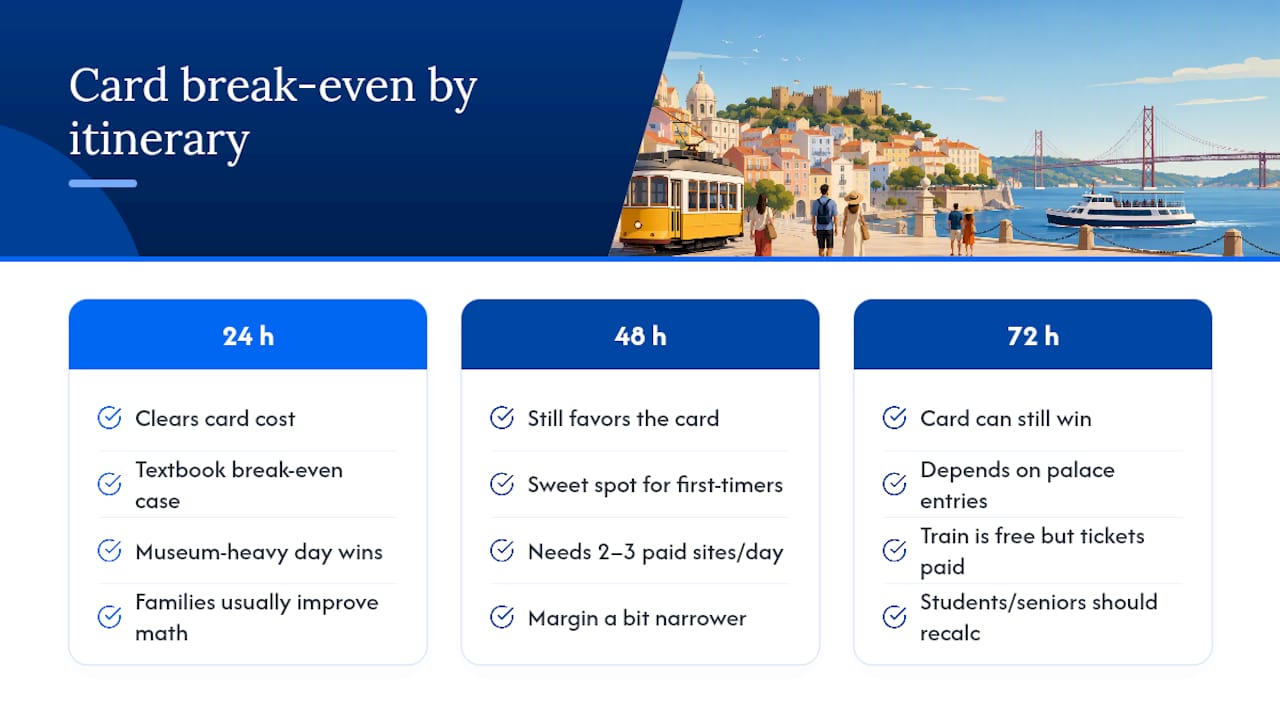
Numbers convince better than adjectives, so here’s how the math actually plays out across three realistic itineraries. Assume adult pricing and standard standalone ticket costs; families and travelers with student or senior discounts should adjust downward, since those discounts often narrow the card’s advantage.
24-hour itinerary: intensive Belém plus a city afternoon
Even with only four stops, this itinerary clears the card’s cost with room to spare. This is the textbook break-even case that makes the 24-hour tier an easy call for anyone doing a museum-heavy single day.
48-hour itinerary: downtown sightseeing plus a Belém day
The margin narrows a bit compared to the 24-hour case, but it stays comfortably in the card’s favor as long as you’re actually hitting two or three paid sites per day rather than one. Guides that run this scenario generally land on the 48-hour tier as the sweet spot for a first-time visitor splitting time between downtown and Belém.
72-hour itinerary: adding a full Sintra day
This is where a lot of the marketing hype gets ahead of reality. The Sintra train is free, which helps, but the palace tickets themselves stay mostly out of pocket, just discounted. The card still wins on total value here because the transport savings and free city attractions carry the weight, but the margin depends heavily on which palaces you actually pay to enter, not on the train ride alone.
A few adjustment notes: families traveling with children get a reduced child rate on the card itself, which usually preserves or improves the math since kids’ standalone museum tickets are often cheap or free anyway. Students and seniors with independent discount cards should run their own numbers, since stacking discounts sometimes makes pay-as-you-go competitive with the card, particularly on the 72-hour tier.
When the Lisboa Card Is Not Worth It
The card loses its edge fast for a specific kind of traveler, and it’s worth naming that profile plainly so you don’t buy a card that sits mostly unused in your wallet.
Slow, food-and-stroll trips. If your plan is long lunches, wine bars, and wandering Alfama’s streets rather than checking off museums, you won’t rack up enough free entries to cover the price.
Heavy rideshare or guided-tour use. If you’re taking taxis or Ubers everywhere and your tours already bundle entry fees, the transport and attraction perks both go unused.
Trips with fewer than three paid attractions total. Below that threshold, the standalone ticket math rarely clears even the 24-hour card price.
Long stays with sightseeing spread thin. A 10-day trip with two museum visits total won’t benefit from a 72-hour card the way a compressed 3-day itinerary will.
Travelers who already qualify for other discounts. Students, seniors, and EU residents sometimes get reduced or free entry at sites the card only discounts, which can undercut the card’s value on its own math.
If two or more of these describe your trip, skip the card and pay individual entry fees as you go. You’ll likely spend less and won’t feel obligated to visit places just to “use up” the pass.
Sintra and Day-Trip Caveats You Need to Know
Sintra is where Lisboa Card expectations and reality diverge the most, so it deserves its own clear-eyed look. The card includes the CP suburban train from Rossio station to Sintra, and separately to Cascais, as part of its unlimited transport coverage. That’s a genuine perk since round-trip train fare to Sintra runs a real cost that the card simply erases.
What the card does not include is entry to Sintra’s palaces. Pena Palace, Quinta da Regaleira, and most other paid sites in Sintra fall into the discount-only category, meaning you’ll pay a reduced ticket price, not zero.
The train ride itself is fully covered, no separate ticket needed.
Pena Palace requires a timed-entry ticket that commonly sells out in peak season, card discount or not.
Budget the palace entry as a real, separate expense when planning your day, even with the card in hand.
Cascais, the other town on this train line, has fewer paid attractions than Sintra, so its day-trip math leans almost entirely on the free transport rather than any bundled entry savings.
Treat the Lisboa Card as your free Sintra train ticket, not your Sintra day pass, and book Pena Palace ahead of your trip rather than assuming you can walk up and use the card’s discount on arrival. Scheduling Sintra as your last card day also means you’re not wasting rolling hours on a train ride you could take on a non-card day if your timing gets tight.
Where to Buy and Activate Your Card
Buying online before your trip beats waiting until you land, both for time saved and because some booking channels post slightly better rates than in-person kiosks.
Purchase through the official Lisboa Card website or an authorized reseller ahead of arrival to skip the airport queue entirely.
Physical pickup points include the airport tourism desk and the Ask Me Lisboa kiosk at Praça do Comércio, both useful if you didn’t buy ahead.
Activate the card only when your sightseeing actually begins, not the moment you land, since the rolling-hour clock starts at first use.
Refunds are limited or unavailable once a card is validated, so double-check your duration and child/discount eligibility before you activate.
Confirm the current price at checkout. Published figures shift by season, and the gap between guides can run several euros per tier.
For a broader look at how city passes stack up against paying per attraction, our guide on maximizing value from Lisbon sightseeing passes walks through the comparison in more detail, and our Lisbon public transport guide covers fare types if you’re weighing the card against buying individual tickets.
A Local Alternative Worth Considering: Trading a Museum Day for the Tagus
Not every hour in Lisbon needs to go toward a ticket line. A guided sailing tour along the Tagus offers views of Belém Tower, the Monument to the Discoveries, and the Lisbon skyline from the water, providing a relaxed sightseeing alternative. For visitors weighing whether to cram in one more paid attraction or trade it for something more relaxed, a guided sightseeing cruise offers a concentrated, high-satisfaction alternative to a heavy museum afternoon.
This fits neatly into a Lisboa Card itinerary rather than competing with it. On a 48-hour plan, swap your second afternoon’s third museum stop for a two-hour cruise instead, since you’ll have already banked your Belém savings that morning. On a 72-hour plan built around a Sintra day trip, a cruise the evening before or after makes a natural change of pace from castle stairs and palace crowds.
A 2-hour cruise slots easily into a half-day window on any of the three card durations.
Views of the Belém monuments from the water complement, rather than duplicate, the ground-level visits the card already covers for free.
For travelers who’d rather have one memorable outing than a fourth ticket stub, the tradeoff often favors the boat.
We hear from visitors that a relaxed hour or two on the water, with commentary explaining what they’re looking at, often lands as the highlight of the trip. That’s not a knock on museums. It’s just a reminder that “sightseeing” doesn’t have to mean another line.
Quick Recap and a 3-Question Checklist
The Lisboa Card earns its cost fast when your trip includes real museum visits and daily transport use, and it stalls out when your days are loose and low on paid stops. Run these three questions before you buy:
Will you visit Jerónimos Monastery and Belém Tower? If yes, you’re most of the way to a 24-hour break-even already.
Are you taking the train to Sintra or Cascais? If yes, the transport savings alone push the 72-hour tier toward worthwhile, even before palace tickets.
Do you have three or more paid attractions planned? If yes across the board, buy the card matched to your trip length. If mostly no, skip it and pay per entry instead.
— Lisbon
Another Way to See Lisbon: A Cruise Instead of a Card
Lisbonbyboat isn’t a museum pass, and it doesn’t compete with one. It’s the option for travelers who’d rather trade one packed sightseeing block for a single, relaxed experience on the water. Our daily two-hour sailing tours cover Lisbon’s historic coastline with live commentary on the monuments you’d otherwise be reading about on a plaque, and unlike a museum circuit, there’s no queue, no timed-entry slot to chase down weeks in advance.
For travelers who want more than the standard sightseeing run, we also offer private charters on sailing yachts and catamarans, from two-hour outings to full-day trips, with beverages and snacks included. If your itinerary has room for one memorable afternoon instead of another ticket line, check available dates and book a Tagus cruise directly through Lisbonbyboat before your trip fills up.
Where to Check Current Prices and Inclusions
Prices and attraction lists shift with the season, so verify details close to your travel dates rather than relying on any single guide, including this one.
The official Lisboa Card comparison breakdown covers current inclusions and transport coverage in detail.
Euro Landmarks’ 2026 review tracks published price tiers across sellers.
The Lisbon Trip break-even analysis walks through additional worked itineraries beyond the ones covered here.
Sources
FAQ
When does the Lisboa Card’s validity clock actually start?
It starts at your first validation, whether that’s a metro turnstile or a museum entrance, not at the time of purchase or activation date you select online.
Is the Oceanário included free with the Lisboa Card?
No.
Do I need a separate ticket for Pena Palace if I have the Lisboa Card?
Yes. The card only discounts the palace entry price, and Pena Palace runs timed-entry tickets that often sell out, so book ahead regardless of the card.
Which duration should most first-time visitors choose?
The 48-hour tier suits most travelers doing two museum-heavy days in the city, while the 72-hour tier pays off best when a Sintra or Cascais day trip is part of the plan.
Can I get a refund if I don’t end up using the Lisboa Card?
Refunds are limited or unavailable once the card has been activated, so confirm your itinerary and duration before validating it for the first time.
Recommended
Comments