

Inclusive sailing tours in Lisbon: options for every traveler
- lisbonbyboat
- Apr 28
- 9 min read
TL;DR:
Lisbon’s sailing tours are becoming more accessible, accommodating diverse physical, sensory, and cognitive needs.
The chain of accessibility ensures every step, from booking to disembarkation, meets inclusive standards.
Choosing private or modern vessels, asking specific questions, and assessing staff training enhance the inclusive experience.
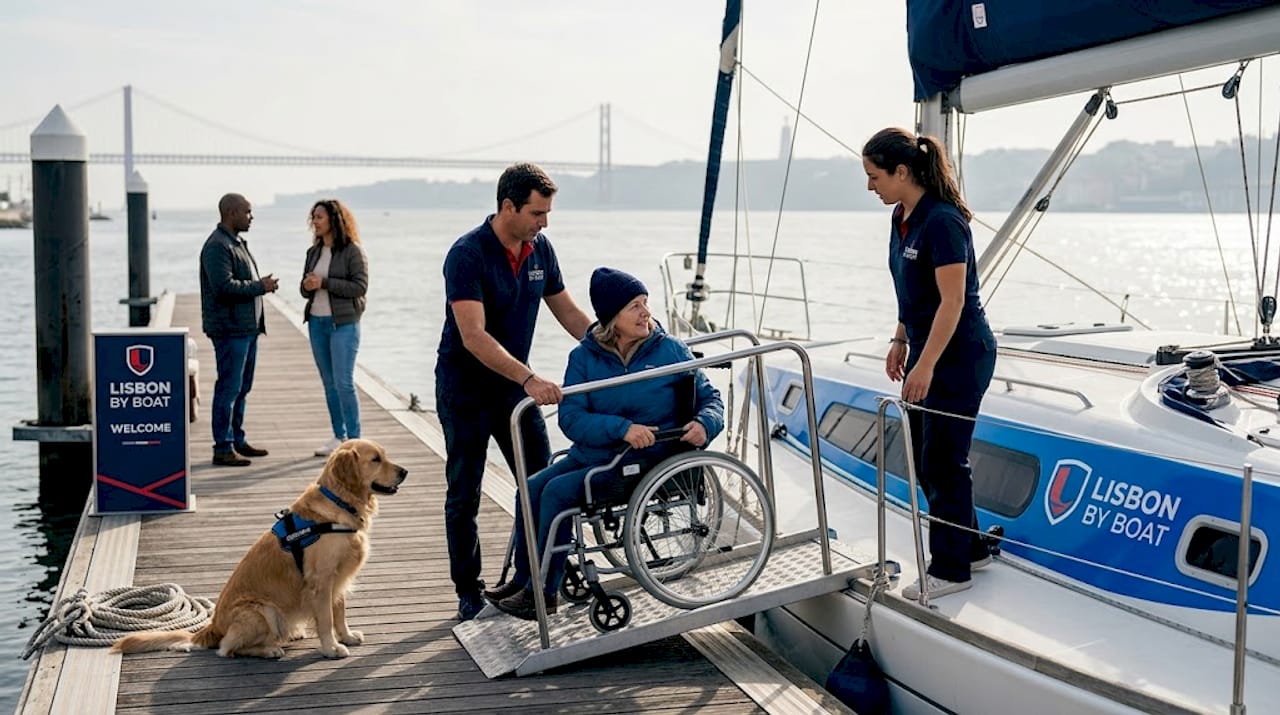
Sailing tours in Lisbon carry an unfair reputation. Many travelers assume these experiences are built exclusively for the young, the physically fit, or the wealthy. That’s simply not true anymore. Inclusive tourism is designed to accommodate physical, sensory, cognitive, and economic needs, and Lisbon’s sailing scene is catching up fast. Whether you use a wheelchair, travel with young children, have a visual impairment, or simply want a quieter, more personalized experience on the Tagus River, there are real options available. This guide breaks down what inclusive sailing actually looks like on the water, which tours deliver it well, and how to make the most of your time in Lisbon.
Table of Contents
Key Takeaways
Point | Details |
Universal accessibility | Inclusive sailing tours in Lisbon focus on universally designed experiences that support all needs, not just mobility. |
Comparing options | Travelers can compare tour types and amenities to find the best fit for their accessibility and independence requirements. |
Features to expect | Key features include adaptive equipment, trained staff, accessible routes, and communication support onboard. |
Booking guidance | Effective booking and communication help ensure the right accommodations and an enjoyable experience for everyone. |
What is inclusive tourism? End-to-end accessibility explained
Inclusive tourism is not just a feel-good phrase. It is a structured approach to travel that removes barriers so that every person, regardless of ability, age, or background, can participate fully in tourism experiences. The goal is not charity. It is equal access.
Inclusive tourism emphasizes universally designed environments and the “chain of accessibility.” That phrase is the key to understanding why some tours feel genuinely welcoming and others fall short despite good intentions.
The chain of accessibility refers to the idea that a trip is only as accessible as its weakest link. A beautiful, fully ramped sailing vessel means nothing if the taxi service to the dock has no wheelchair-accessible vehicles. A perfectly adapted onboard restroom is useless if the booking website cannot be navigated by a screen reader. Every single step of the experience must work together.
Here are the main need categories that inclusive tourism addresses:
Physical needs: Mobility limitations, wheelchair use, difficulty with stairs or uneven surfaces
Sensory needs: Visual impairment, hearing loss, or hypersensitivity to noise and light
Cognitive needs: Developmental differences, memory conditions, or anxiety disorders
Economic needs: Access to affordable options without compromising dignity or quality
For sailing tours specifically, the chain of accessibility looks like this:
An accessible website with clear booking processes
Transport options from your hotel to the marina
A vessel with appropriate boarding solutions (ramps, lifts, or gangways)
Adequate onboard space for mobility aids
Accessible restrooms where trips exceed a certain duration
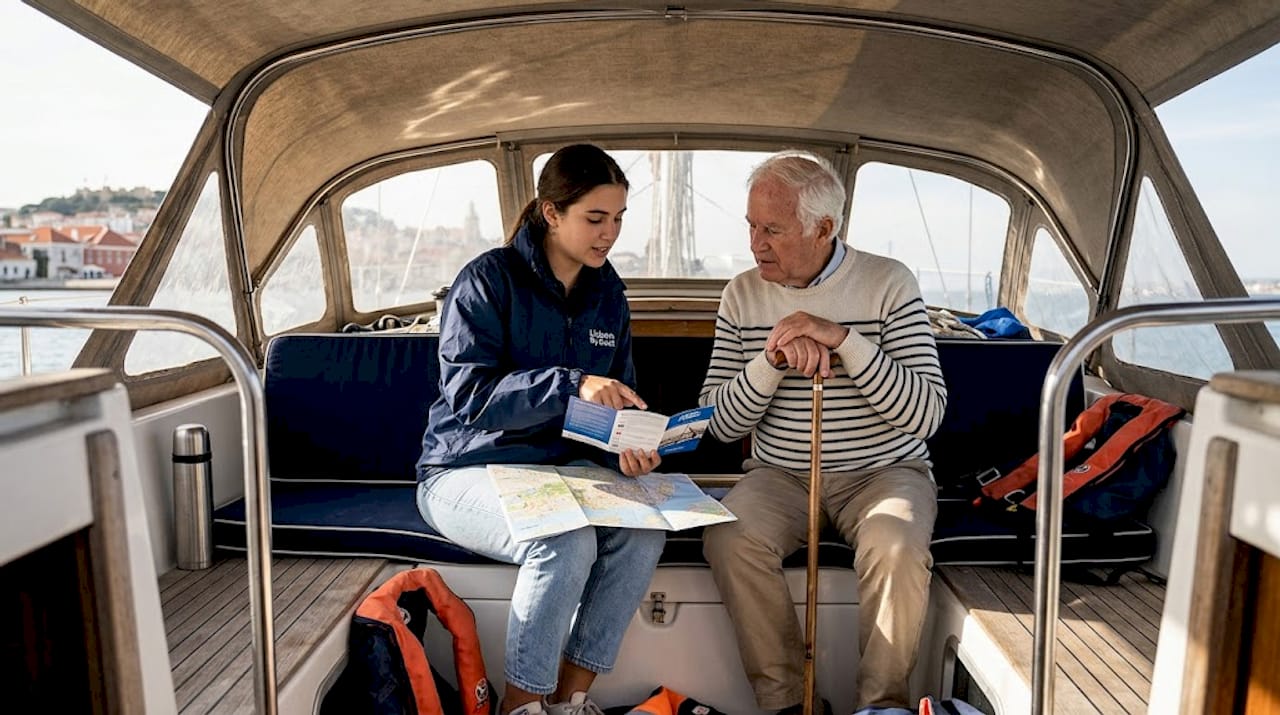
Knowledgeable guides who can adapt communication styles
Clear, calm disembarkation procedures
“When one link in the chain breaks, the whole experience can collapse for a traveler with access needs. Operators who understand this design every step with care, not just the parts they control.”
To understand the boat accessibility principles that apply specifically to Lisbon’s fleet, it’s worth looking at how vessels are being retrofitted and designed to meet these standards. The shift is happening. The key is knowing which operators are ahead of the curve.
Mapping inclusive sailing tour options in Lisbon
Lisbon offers a surprisingly wide range of sailing experiences, and the level of accessibility built into each type varies considerably. Knowing the differences helps you find the right fit before you ever reach the dock.
Accessible tourism creates trips that are usable, inclusive, and empowering for all travelers, but the experience depends heavily on how operators implement accessibility in practice. Let’s break down the main tour types you’ll encounter.
Tour types and how they compare
Tour type | Typical duration | Accessible boarding | Adapted restroom | Small group option | Guide support |
Shared group tour | 2 hours | Often partial | Varies | No | Standard |
Private yacht charter | 2h to full day | Often available | Usually yes | Yes | Personalized |
Catamaran tour | 2 to 4 hours | Generally better | Usually yes | Sometimes | Standard/custom |
Themed cruise | 2 to 3 hours | Varies | Varies | Sometimes | Themed |
Eco sailing tour | 2 to 4 hours | Improving | Sometimes | Yes | Educational |
Private tours tend to offer the strongest accessibility because the entire vessel, the timeline, and the crew attention are dedicated to your group. If someone in your party uses a power wheelchair or needs extended boarding time, a private charter is usually the most dignified and comfortable option.
The Lisbon boats accessibility guide provides more detail on how different vessel types handle boarding and onboard movement. It is genuinely useful reading before you commit to a booking.
For travelers who are open to luxury options, the good news is that many premium experiences actually have better accessibility infrastructure. Larger, more modern vessels tend to have wider deck spaces, smoother surfaces, and proper onboard facilities. The best luxury experiences in Lisbon increasingly incorporate universal design as a selling point, not an afterthought.
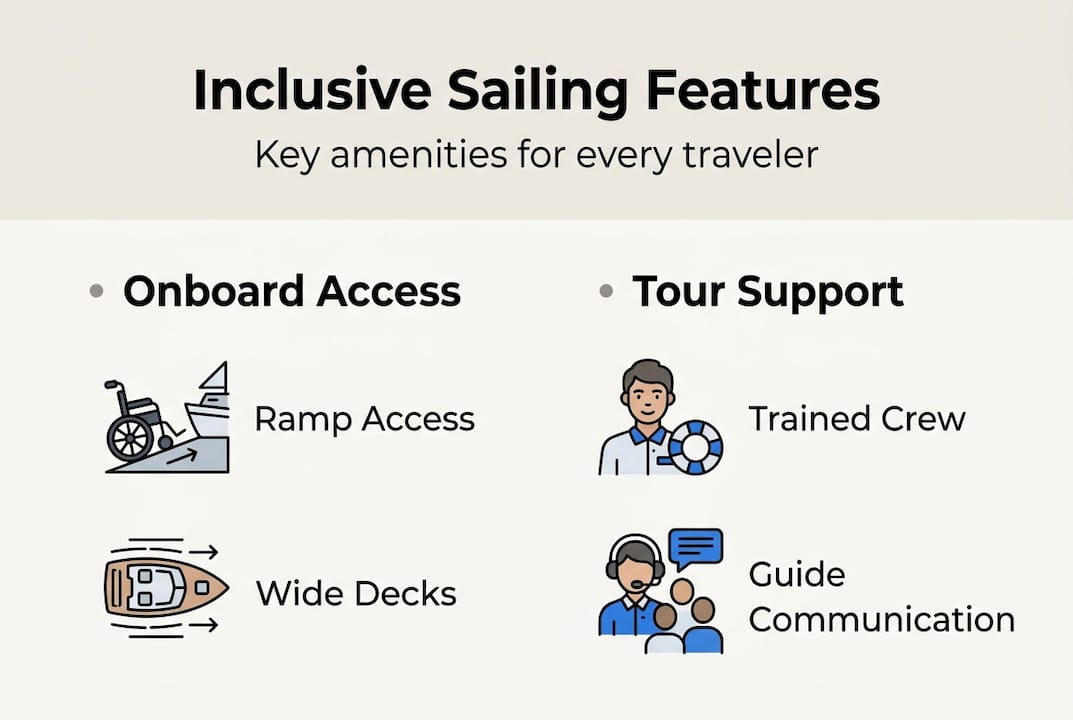
Key accessibility features to look for across all tour types:
Boarding ramps or gangplanks with non-slip surfaces
Deck space that can accommodate wheelchairs or mobility scooters
Onboard seating with proper back support and stability
Clear, written or visual itineraries shared ahead of time
Staff with disability awareness or first aid training
Communication aids such as hearing loops or visual displays
Pro Tip: When contacting a tour operator to book, ask specific questions rather than general ones. Instead of “Is your tour accessible?” try “Do you have a ramp that can accommodate a manual wheelchair with a 65 cm width?” Specificity gets you accurate answers, and it signals to the operator that you are a prepared, informed traveler who knows what they need.
Features that make sailing tours truly inclusive
Understanding the philosophy is one thing. Recognizing what to look for in practice is another. Let’s walk through the features that separate genuinely inclusive sailing tours from those that only claim to be.
Universally designed products, services, and environments must support dignity and independence, not just provide access. That distinction matters more than it might seem. A vessel with a single steep ramp checked off a list is not the same as one designed from the ground up so that a traveler with limited mobility can move around confidently without needing constant help.
What to look for: a feature comparison
Feature | Basic compliance | Genuinely inclusive |
Boarding access | One fixed ramp | Adjustable ramp or lift with crew support |
Deck surfaces | Mostly flat | Fully flush, non-slip throughout |
Seating | Fixed benches | Movable, padded, with armrests |
Restroom | Standard | Wide-door, grab-bar equipped, accessible |
Communication | Verbal narration | Written materials, visual aids, hearing loop |
Staff training | General hospitality | Disability awareness, first aid certified |
Itinerary | Fixed pace | Flexible, adaptable to group needs |
Here is a practical numbered checklist you can use when evaluating any inclusive sailing tour in Lisbon:
Check the vessel specs. Ask for deck width, ramp gradient, and restroom door clearance before booking.
Confirm staff training. Ask directly whether crew have received disability awareness training.
Request a pre-tour briefing. A good operator will offer this. It sets everyone up for a smoother experience.
Review the boarding process. Ask how long boarding typically takes and whether there is a quiet period before other guests board.
Ask about communication support. If you or a fellow traveler has a hearing or visual impairment, find out what tools are available.
Verify the cancellation policy. Life with a disability involves unpredictability. A flexible policy is a sign of a respectful operator.
Look at reviews from travelers with similar needs. These are often the most honest source of information about how accessibility features actually function in practice.
For travelers who are older adults or have mobility concerns, the tours for seniors section of Lisbon ByBoat’s site covers practical details specific to that audience. Similarly, if sustainability matters to you alongside inclusivity, exploring eco tour features shows how environmental awareness and accessibility can work together on the same vessel.
The onboard experience itself should feel natural, not medicalized. The best inclusive tours in Lisbon look and feel like premium experiences for everyone on board. The only difference is that the design makes them usable by a much wider range of people.
Tips for booking and enjoying an inclusive sailing tour in Lisbon
Preparation is what turns a good accessible tour into a great one. The process starts before you ever set foot in Lisbon.
Inclusivity starts from the first interaction to the onboard experience, supporting dignity and independence at every stage. Here’s how to make sure that first interaction works in your favor.
Before you book:
Research operators specifically, not just tours. Look at how they describe their accessibility, and look for language that is specific rather than vague.
Call or email ahead. A written record of what an operator promises about accessibility is useful if something goes wrong.
Confirm transport to the marina. Ask whether the operator can recommend or arrange accessible transport from your accommodation.
Check the tide schedule. This affects how level or steep boarding ramps will be. Morning departures often have better water levels for smoother boarding at many Lisbon marinas.
Read the fine print on physical requirements. Some tours list a minimum physical capability. If you see this and it is unclear, ask for clarification.
Preparing for the day:
Bring any necessary medical documentation or medications in a clearly labeled bag.
Dress in layers. Conditions on the Tagus River can shift quickly, and temperature regulation matters for many travelers with health conditions.
Arrive early. This gives you time to board at a comfortable pace without feeling rushed.
Inform your companions of your needs. If you are traveling with a group, make sure everyone understands the pace you need so no one feels left behind or impatient.
Pro Tip: Ask the operator to save a specific seat for you before you board. The best seats on an accessible sailing tour are not always the most obvious ones. A spot closer to the center of the vessel tends to have less rocking, which is important for travelers with vestibular sensitivities or those who are prone to motion sickness.
For a broader picture of traveling thoughtfully in Lisbon, the sustainable tourism tips guide offers useful context about how responsible operators think about the relationship between tourism, the city, and the communities it serves.
Common mistakes to avoid:
Assuming accessibility features are automatically available. Always confirm.
Booking tours only based on price. The cheapest option rarely invests most heavily in accessibility infrastructure.
Skipping the pre-tour briefing. Even 10 minutes on the phone with the operator can prevent major problems on the day.
Not mentioning all relevant needs at booking. You do not need to share your full medical history, but operators need enough information to prepare properly.
What most guides miss about inclusive sailing in Lisbon
Most guides on inclusive tourism in Lisbon treat accessibility as a checklist. Does the boat have a ramp? Yes. Does it have an accessible bathroom? Yes. Approved. But that framing misses something important: the difference between access and genuine belonging.
We have been taking travelers out onto the Tagus for years, and the feedback that stays with us is never about ramps or restroom dimensions. It is about the moment someone who assumed sailing was not for them realizes it actually is. That shift happens when crew members speak directly to the traveler, not to their companion. When a guide naturally adjusts pace. When nobody makes a fuss about the extra five minutes boarding took.
Accessibility infrastructure is the foundation. But the human element is what makes a tour feel truly inclusive. Train your staff well, and you can compensate for imperfect facilities. Have perfect facilities and untrained staff, and the experience still feels exclusionary.
There is also a tendency in travel to separate luxury from accessibility, as if they are opposites. They are not. In fact, luxury meets inclusivity most naturally when operators stop thinking about adaptation as a cost and start thinking about it as an investment in a richer, wider guest experience. A beautiful yacht that everyone can board is more beautiful because of it.
The most empowering thing a tour operator can do is treat accessibility not as a special accommodation, but as the standard expectation for every guest who comes aboard.
Discover accessible sailing experiences with Lisbon ByBoat
At Lisbon ByBoat, we believe that the Tagus River belongs to everyone. Our daily 2-hour sailing tours cover the historical coastline that defines this city, with guides who bring the monuments and stories to life for every traveler onboard.
Whether you are booking one of our inclusive ByBoat tours for a group, exploring our luxury accessible yachts for a private experience, or arranging a full-day adventure through our charter accessible yacht service, we are ready to talk through your specific needs before you book. Reach out to our team directly. We would rather answer ten questions before your trip than leave one detail to chance on the day.
Frequently asked questions
What makes a sailing tour in Lisbon truly inclusive?
A truly inclusive sailing tour addresses accessibility across booking, transport, onboard amenities, and support for various physical and cognitive needs, making the entire chain of the experience accessible, not just individual components.
How can I check if a tour operator provides accessibility features?
Review the operator’s website, contact them directly with your specific needs, and ask for details on ramps, accessible restrooms, adaptive equipment, and staff training. Accessible tourism should be usable, inclusive, and empowering in practice, not just on paper.
Are luxury sailing tours in Lisbon also accessible?
Many luxury sailing tours now offer accessible features such as adaptive seating and onboard support, but you should inquire ahead about specifics. Universally designed environments are increasingly a feature of premium vessels rather than an exception to them.
Can I join an inclusive sailing tour if I have sensory or cognitive needs?
Yes. Many inclusive tours accommodate sensory or cognitive needs with guidance, communication support, and tailored amenities. Inclusive tourism designs environments for physical, sensory, and cognitive needs, and a good operator will discuss your requirements before you board.
Recommended
Comments