

Yacht vs. Catamaran: Choosing Your Lisbon Adventure
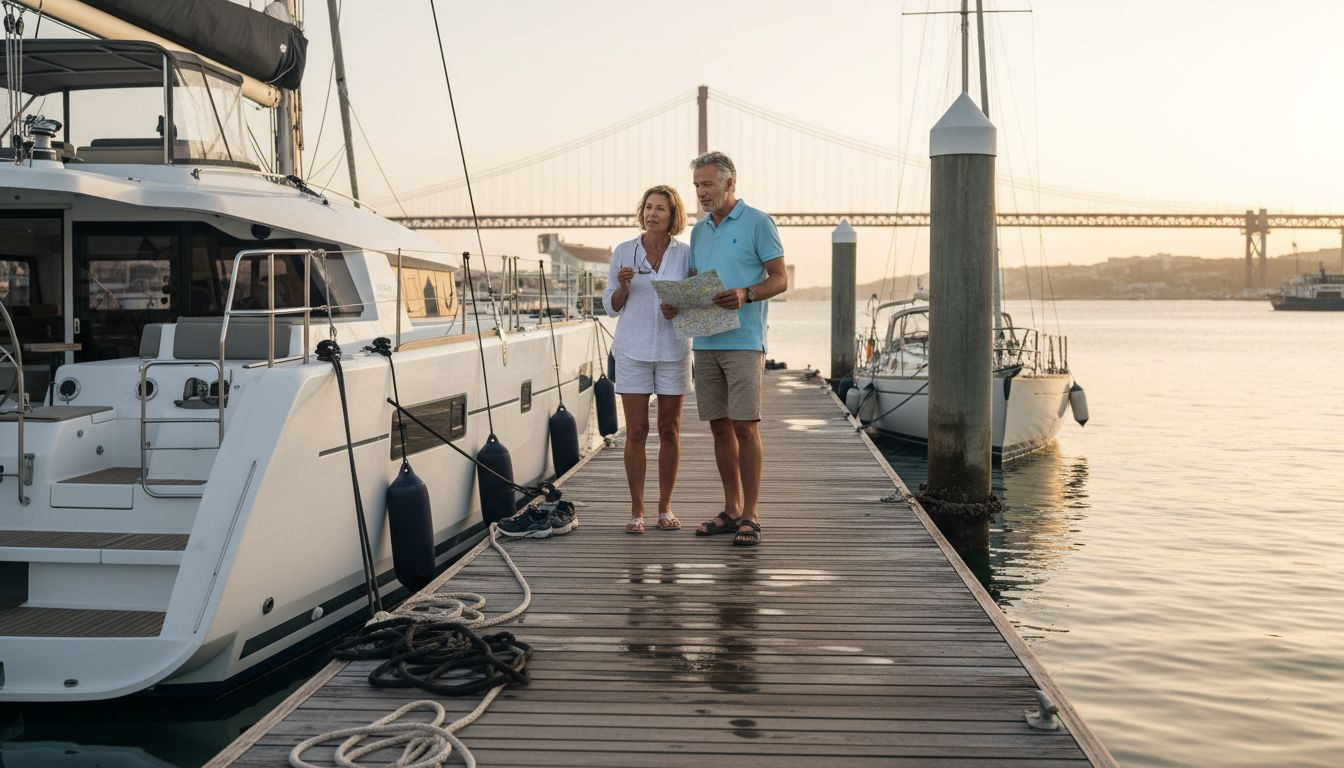
Choosing between a yacht and a catamaran for your Lisbon private sailing tour can feel confusing, especially with so many options promising luxury and comfort. The difference matters more than you might expect, impacting not just how the vessel looks but how your entire day unfolds on the water. From stability and spaciousness to speed and the ability to explore Lisbon’s hidden coves, understanding what sets a catamaran apart with its twin parallel hulls versus a traditional yacht’s single hull is the first step in making your cruise unforgettable.
Table of Contents
Key Takeaways
Point | Details |
Vessel Differences | Catamarans have twin hulls providing stability and space, while monohull yachts have a single hull, offering a more traditional sailing experience. |
Comfort and Motion Sensitivity | If your group includes anyone prone to seasickness, a catamaran is a better choice due to its smoother motion. |
Space and Social Experience | Catamarans offer larger decks and living spaces, making them ideal for group gatherings and social interaction. |
Touring Suitability | For leisurely sightseeing and coastal exploration in Lisbon, catamarans are preferred for their shallow draft and stable performance. |
What Defines a Yacht and a Catamaran?
When you’re planning a private sailing experience along Lisbon’s coastline, you’ll quickly hear the terms “yacht” and “catamaran” used somewhat interchangeably. But these vessels are actually quite different beasts, and understanding those differences matters when choosing your ideal adventure. At their core, a yacht is any recreational boat or ship designed for leisure, cruising, or racing. It’s a broad umbrella term that can encompass various hull designs. A catamaran, on the other hand, has a very specific defining feature: twin parallel hulls that sit side by side. This dual hull design is what makes a catamaran distinctly different from a traditional monohull yacht, and it fundamentally changes how the vessel behaves on the water.
The distinction gets more interesting when you realize that a catamaran can absolutely be a yacht. A catamaran qualifies as a yacht when it meets certain criteria: typically a size over 33 feet, a purpose centered on leisure and cruising rather than commercial fishing or transport, and amenities built for comfort. Think of it this way. A catamaran is a specific type of yacht, just like a sedan is a specific type of car. Not all yachts are catamarans, but catamarans are definitely a category within the yacht world. This matters for your Lisbon cruise because the type of vessel you choose affects your actual experience on the water. You’ll feel different motion, have access to different spaces, and encounter different handling characteristics depending on which one you select.
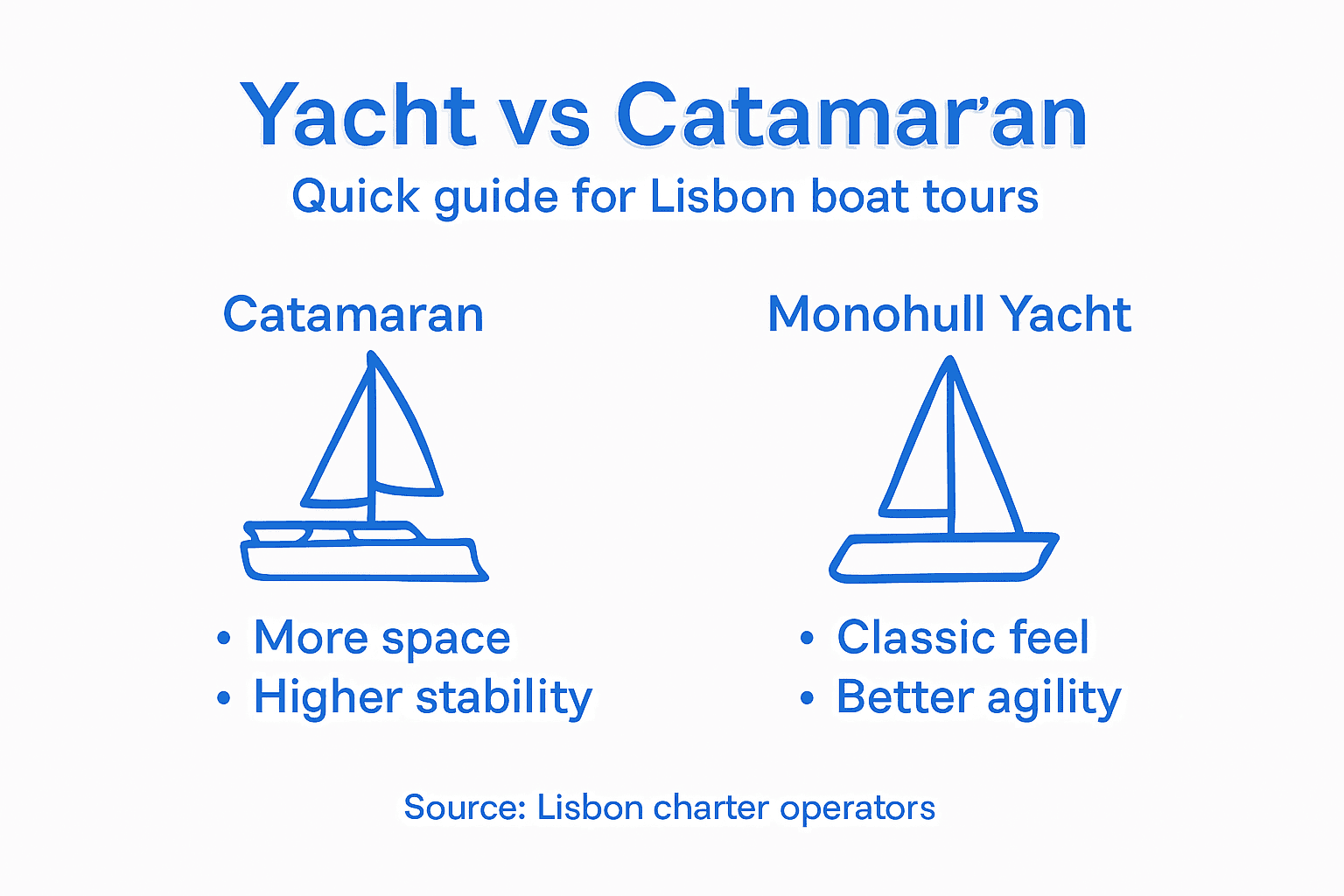
What really sets catamarans apart are the practical benefits built into that twin hull design. Because of their parallel hull structure, catamarans offer roughly double the living space compared to a monohull yacht of similar length. They provide exceptional stability without heeling, which means far less tilting and rolling as waves pass underneath. The motion through water feels smoother and more comfortable, making them ideal if anyone in your party feels even slightly sensitive to seasickness. Additionally, catamarans can access shallower waters than their monohull cousins, opening up more intimate coastal exploration opportunities around Lisbon. The living spaces feel more like houses on water, with generous cabins, proper bathrooms, kitchens, and spacious outdoor areas perfect for groups of friends or families wanting to relax together.
A traditional monohull yacht, by contrast, features a single hull and typically offers a narrower interior layout. These vessels have a classic sailing feel and often deliver more responsive handling in certain conditions, but they heel over (tilt) when the sails catch wind, which some people find exhilarating and others find uncomfortable. Monohulls can feel more intimate and nimble, while catamarans feel more stable and spacious. Neither is objectively better. The choice depends entirely on what kind of experience you want during your private Lisbon sailing tour.
Here’s a clear comparison of catamarans and monohull yachts to help you choose the best fit for your Lisbon cruise:
Category | Catamaran Advantage | Monohull Yacht Benefit |
Stability & Comfort | Minimal roll, ideal for groups | Traditional sailing sensation |
Living Space | Wider decks, multiple cabins | Cozier, vertical layout |
Shallow Water Access | Can reach hidden coves easily | Limited by deeper draft |
Sailing Performance | Fast in calm waters | Superior in tough conditions |
Social Experience | Spacious for larger parties | Intimate, classic ambiance |
Pro tip: If your group includes anyone who experiences motion sensitivity or prefers maximum onboard comfort and space, a catamaran is almost always the better choice for your Lisbon adventure, regardless of other factors.
Designs and Features: Key Distinctions
The physical design of a vessel determines almost everything about how it performs and feels on the water. Yachts, particularly traditional monohulls, feature a single elongated hull that tapers at both ends, creating the sleek profile most people picture when they think of classic sailboats. This single hull design emphasizes sailing performance and has been refined over centuries. Catamarans take a completely different approach with two parallel hulls connected by a bridging superstructure that sits above them. Imagine two tubes running alongside each other with a deck platform spanning between them. This fundamental architectural difference ripples through every aspect of the vessel, from how it moves through water to where you can stand and relax during your Lisbon sailing tour.
The hull configuration creates distinct performance characteristics that directly impact your experience. A catamaran’s dual hull design provides exceptional lateral stability, meaning the vessel resists heeling (tilting) even in moderate wind. The two hulls generate minimal rolling motion, creating a smoother, more comfortable ride through waves. This design also reduces hydrodynamic drag compared to single hull vessels, allowing catamarans to achieve faster speeds while using less fuel. Additionally, catamarans have a shallow draft, meaning they don’t need to sink as deep into the water, allowing them to navigate closer to shore and access areas where traditional yachts cannot venture. When you’re exploring Lisbon’s coastline, this capability opens up hidden coves and shallower anchorage spots that a deeper hulled monohull yacht simply cannot reach.
Monohull yachts, meanwhile, excel in different ways. The concentrated weight in their single keel creates a responsive, dynamic sailing experience that many traditionalists consider the authentic way to sail. These vessels often generate more heel when under sail, which some sailors find exhilarating and which was actually the standard of nautical tradition for generations. The monohull design prioritizes sailing performance and fine handling, allowing for more aggressive maneuvers and tighter control. Many monohull yachts emphasize luxury interior design within their narrower footprint, creating intimate, sophisticated cabin spaces. The trade off is reduced onboard space compared to a catamaran of the same length and generally deeper drafts that limit coastal exploration.
Deck Layout and Living Space
The structural differences translate into radically different onboard experiences. Catamarans offer wide, open deck spaces that span the full width between the two hulls. There is nowhere for the boat to heel, so people can safely move around the deck without worrying about sudden tilting. The cabin areas feel spacious and airy, with multiple large windows allowing sunlight to flood through. Kitchen facilities, bathrooms, and sleeping quarters all benefit from the width between hulls. Monohull yachts concentrate all their living space into a narrower profile, creating more vertical layouts where cabins stack down below deck. This can feel cozy and luxurious but requires navigating narrow corridors and lower ceilings in many areas.
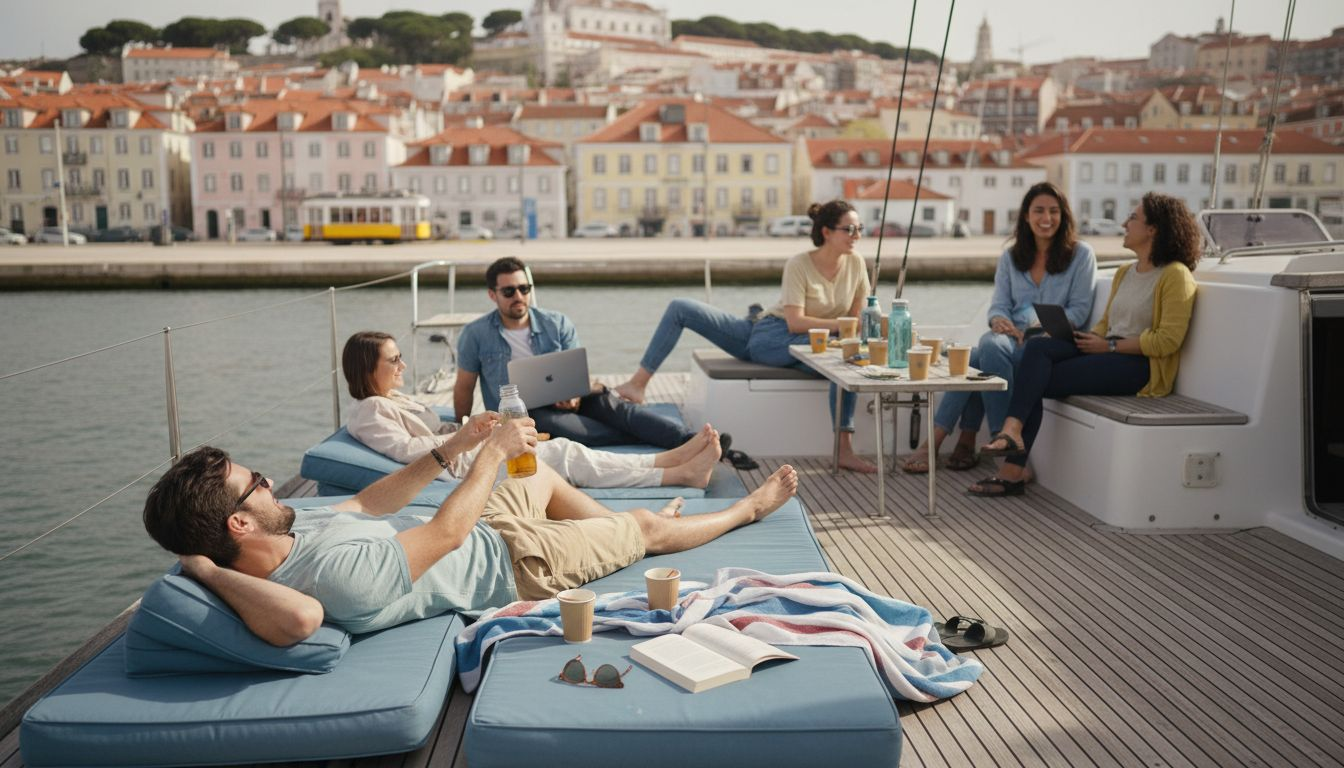
When choosing between these vessels for your private Lisbon cruise, think about how your group actually spends time on the water. Do you plan to relax on deck with family, enjoying the coastline and maritime views? A catamaran’s expansive deck space and stability make this effortless. Do you prefer active sailing with classic yacht handling? A monohull delivers that traditional experience. Do you want to explore shallow water areas and hidden spots along the Lisbon coast? The catamaran’s shallow draft gives you access that monohulls cannot match.
Pro tip: Request a vessel tour before committing to your booking, and pay special attention to how much usable deck space exists and whether the cabin layouts match what your specific group needs for comfort during your tour duration.
Comfort, Stability, and Onboard Experience
Imagine spending a full day on the water with your family or a group of friends. Your comfort during those hours matters profoundly, and this is where the yacht versus catamaran choice becomes deeply personal. Catamarans excel at providing a comfortable, stable platform for leisure. Their twin hull design practically eliminates the heeling motion that characterizes traditional monohull sailing. When a catamaran moves through waves, the two hulls work in tandem to distribute weight and momentum evenly, resulting in minimal lateral roll and motion. For someone lounging on deck, reading a book, or enjoying a meal with others, this stability is transformative. There is no sudden tilting, no need to brace yourself against railings, no worry that your drink will slide across the table. The vessel simply glides smoothly through the water, making the experience feel almost stationary despite constant movement.
Most importantly, this stability dramatically reduces seasickness. Motion sickness happens when your inner ear and eyes send conflicting signals to your brain about movement and orientation. The gentle, consistent motion of a catamaran in waves minimizes these conflicting signals in a way that traditional yachts simply cannot replicate. If you have anyone in your group who experiences even mild motion sensitivity, the catamaran becomes not just preferable but potentially the difference between an enjoyable day and a miserable one. You get to actually experience Lisbon’s historic coastline from the water rather than spend the time below deck recovering. The spacious design of catamarans includes proper cabins, full kitchens, and bathrooms that feel genuinely comfortable, not cramped. Everything is accessible at the same level, with generous headroom and natural light flooding through large windows. The open deck areas span the full width between hulls, giving everyone plenty of room to spread out, move around, and find their favorite spot to watch Lisbon’s monuments glide past.
Monohull yachts deliver a fundamentally different experience. When under sail, these vessels heel over in the wind, tilting up to 15, 20, or even 30 degrees depending on wind conditions and sail configuration. Some sailors find this exhilarating. The dynamic motion, the sense of working with the elements, the technical skill required to sail responsively. This appeals to purists who want the authentic traditional sailing experience. But this same heeling motion can make relaxation difficult. Sitting on a tilted deck, holding onto railings to stay upright, constantly adjusting your body position. If your goal is social time, relaxation, and leisurely sightseeing along Lisbon’s coast, the constant compensation required becomes exhausting rather than enjoyable.
Living Space and Social Experience
The difference in onboard space profoundly affects how your group interacts. Catamarans offer significantly more usable living and deck space compared to monohull yachts of similar length. The cabin areas feel spacious, with multiple sleeping quarters that provide genuine privacy and comfort. The galley (kitchen) has room for people to move around together. The bathrooms feel like actual facilities rather than cramped compartments. Most importantly, the large deck areas create natural gathering spaces where your entire group can be together comfortably. Monohull yachts concentrate their living space vertically, with cabins stacked below deck accessed by narrow companionways. The social space feels more limited. You end up choosing between being in your cabin or on a narrower deck where there is less room for everyone to lounge simultaneously.
For a private Lisbon sailing tour lasting several hours or a full day, these differences accumulate. Your group will spend most of the time on deck, watching Lisbon’s waterfront unfold. A catamaran’s stability and spaciousness make this genuinely enjoyable. People can move freely, take photographs, point out landmarks, and have conversations without worrying about balance or motion. A monohull offers a more traditional sailing aesthetic and responsive handling, appealing to those who specifically want that classic yacht experience. But if your priority is group comfort, leisure, and making memories together, the catamaran’s superior stability and space win the day.
Pro tip: If anyone in your group takes motion sickness medication or has mentioned feeling uncomfortable on boats before, inform the booking company immediately and request a catamaran specifically, as the difference in comfort can be genuinely transformative for their experience.
Sailing Performance and Suitability for Tours
When you book a private sailing tour along Lisbon’s historic coastline, the vessel’s sailing performance directly shapes what you experience. Catamarans and monohull yachts achieve fundamentally different things on the water, and understanding these differences helps clarify which vessel truly matches your tour goals. Catamarans typically achieve faster speeds than monohull yachts because their lighter weight and dual hull design reduce hydrodynamic resistance. In calm to moderate sea conditions, which describes most favorable sailing days around Lisbon, catamarans will outpace comparable monohulls. This speed advantage means you cover more coastal territory during your tour, seeing more of Lisbon’s monuments and hidden anchorages. However, speed comes with a tradeoff. The catamaran’s wide stance and stability make it less nimble. Turning requires more planning and deliberation than a responsive monohull. If your tour captain needs to maneuver quickly or tack frequently against the wind, a monohull’s responsiveness becomes an advantage. But for a leisurely sightseeing tour where you want to cruise along Lisbon’s waterfront and explore specific areas, the catamaran’s combination of smooth ride and steady speed works perfectly.
Monohull yachts excel in different conditions. When the wind picks up and seas become rough, traditional single hull vessels outperform their catamaran counterparts. The concentrated keel weight provides directional stability in challenging conditions, and the responsive handling allows skilled captains to angle through waves with precision. Monohulls also perform better when sailing windward, meaning when the desired destination lies toward where the wind is coming from. They can point higher toward the wind and tack more efficiently. However, this performance advantage rarely matters for Lisbon’s tour market. Most private sailing tours happen during favorable weather windows with moderate winds and reasonable sea states. Rough conditions typically cancel tours rather than occur during scheduled departures. The specialized performance advantages of monohulls simply don’t apply in the typical Lisbon tour context. More importantly, catamarans are ideal for shallow waters and coastal cruising, making them significantly better suited for the actual work of tourism. They can anchor in shallower spots, navigate near rocky outcroppings, and access protected coves where monohulls cannot venture.
Touring Suitability and Passenger Experience
The real determining factor for a Lisbon tour isn’t raw sailing performance but rather how the vessel delivers what tourists actually want: a memorable, comfortable experience viewing the city from the water. Catamarans dominate this category because their characteristics align perfectly with tour requirements. The dual hulls offer faster speeds and a smoother ride in moderate conditions, which means passengers spend less time queasy and more time enjoying the scenery. The spacious deck areas allow tour groups to move around freely, take photographs from multiple angles, and experience Lisbon’s monuments without feeling crowded or constrained. Multiple passengers can comfortably view the same sight simultaneously without jostling for position.
Monohull yachts present practical complications for tour operations. The heel created by wind pressure means passengers sitting on windward side of the deck are tilted upward at angles that make photography awkward and comfortable seating difficult. The narrower deck space restricts how many people can simultaneously be topside. The more sensitive steering requires constant attention and adjustment from the captain, which can make the experience feel less relaxed. None of these factors prevents a good tour on a monohull. Many excellent captains operate monohull vessels and provide wonderful experiences. But the vessel’s characteristics require more compensation, more active management, and more adjustment from passengers to maintain comfort.
Consider this practical scenario: your tour company wants to motor sail along Lisbon’s Tejo River toward Belem Tower, then return along the north bank past various historic sites. A catamaran accomplishes this mission smoothly, efficiently, and comfortably for passengers. The vessel glides at steady speed, maintains level position despite wind, and allows passengers to cluster on deck without balance concerns. A monohull accomplishes the same mission but requires passengers to brace themselves more frequently, limits how many people can be comfortably topside, and delivers a more dynamic motion that some find exhilarating and others find distracting from the sightseeing. For tour operations where comfort, accessibility, and passenger satisfaction drive success, catamarans simply perform better. They are the preferred platform for coastal and island tour operations worldwide, and Lisbon’s tourism market benefits from this proven suitability.
Pro tip: When booking your private tour, ask your operator which vessel type they are using and inquire specifically about how stable it remains when anchored off popular sightseeing locations, as this is when passenger comfort matters most for photography and relaxation.
Making the Right Choice for Lisbon Cruising
By now you understand the fundamental differences between yachts and catamarans. Both offer legitimate paths to experiencing Lisbon’s waterfront, but one will almost certainly align better with what you actually want from your private sailing adventure. The decision comes down to a few concrete factors that matter specifically to your situation. Start with your group composition and comfort priorities. If you are traveling with families, children, elderly relatives, or anyone prone to motion sensitivity, the choice becomes straightforward: a catamaran delivers significantly better comfort and accessibility. The stability, spacious deck areas, and smooth motion transform the experience from something potentially uncomfortable into something genuinely enjoyable. Conversely, if your group consists of experienced sailors or people specifically seeking that classic sailing sensation, a monohull yacht provides the authentic experience you want. But be honest about this. Many people think they want the traditional sailing aesthetic until they are actually on a tilted deck trying to enjoy a meal or take photographs.
Consider next what you plan to actually do during your cruise. Are you interested in exploring various river cruises and group activities along the Tejo River, visiting shallow anchorages, and accessing protected coves? A catamaran’s shallow draft becomes invaluable here, opening coastal areas that monohulls cannot reach. Are you seeking distance and speed, wanting to cover maximum ground along Lisbon’s extended coastline? The catamaran’s faster speeds and lighter motion make this appealing. Are you primarily interested in leisurely sightseeing with time to relax, photograph landmarks, and enjoy social time with your companions? Again, the catamaran’s stability and spacious deck areas create the optimal platform. There are genuinely few scenarios where a monohull’s specific advantages matter for Lisbon’s tourism market. The specialized sailing performance benefits of monohulls apply to offshore voyages, competitive racing, or challenging ocean conditions. Lisbon tours happen in coastal waters during favorable weather windows. The monohull’s performance advantages simply don’t activate in this context.
Practical Decision Framework
Make your decision by working through these questions systematically. First, is anyone in your group sensitive to motion or prone to seasickness? If yes, catamaran. Second, what is your group size? Larger groups benefit from the catamaran’s additional deck space and multiple comfortable cabin areas. Third, have you specifically requested to experience traditional sailing techniques and sailing instruction? If no, catamaran. Fourth, what is your budget? Catamarans often cost more to operate due to their premium positioning in the market, though this varies by operator. Fifth, choosing between catamarans and yachts for cruising in Lisbon ultimately depends on your priorities regarding comfort, stability, and desired itinerary. If comfort and stability rank highest, catamaran wins decisively. If you are seeking elegance and prefer the traditional sailing aesthetic, a yacht offers that specific experience.
The reality is that catamarans have become the dominant choice for Lisbon’s tourism market for excellent reasons. They deliver what most tourists actually want: comfort, stability, spacious surroundings, and the ability to explore coastal areas thoroughly. Monohull yachts absolutely have their place for specific clientele who genuinely prioritize sailing tradition and performance. But if you are uncertain, or if any member of your group values comfort over sailing aesthetics, the catamaran is the safer and frankly superior choice. You will not regret choosing a catamaran. You might regret choosing a monohull if someone in your group experiences motion discomfort or if you were hoping to relax fully on deck.
Ultimately, think about the actual outcome you want from your Lisbon sailing adventure. You want memories of beautiful coastal scenery, quality time with your companions, comfortable surroundings, and the freedom to move around and experience the boat fully. You want to feel good during the entire experience, not manage discomfort or brace yourself against motion. You want your photographs to be clear and well composed, not blurred from instability or taken at awkward angles. A catamaran delivers all of this consistently. It is the vessel designed specifically for exactly what modern tourists value about a Lisbon sailing tour.
Review these key decision factors before booking your Lisbon sailing experience:
Decision Factor | Catamaran Recommendation | Yacht (Monohull) Recommendation |
Group Size | Best for families, large groups | Suited for couples or small parties |
Motion Sensitivity | Strongly preferred for sensitive guests | Only consider if everyone is comfortable |
Sightseeing Focus | Allows relaxed photography, easy movement | May limit movement or comfort onboard |
Sailing Education | Less hands-on traditional skills | Excellent for active sailing instruction |
Budget Considerations | May be priced higher due to amenities | Sometimes more budget-friendly |
Pro tip: Request specific details from your booking company about the exact vessel model, its amenities, and passenger capacity to ensure the catamaran or yacht you select matches your group’s size and comfort expectations before finalizing your reservation.
Find Your Perfect Sailing Experience in Lisbon Today
Choosing between a yacht and a catamaran can feel overwhelming when planning your private Lisbon cruise. The article highlights key challenges like motion sensitivity, group size, and comfort versus traditional sailing thrills. You want a smooth, spacious, and memorable adventure without worrying about seasickness or cramped spaces. Our daily and private sailing tours on both yachts and catamarans offer tailored solutions to meet those exact needs. Whether you prioritize stability and wide decks for family relaxation or the classic dynamic feel of a monohull, we ensure your experience matches your expectations.
Explore our private daily cruises on sailing Yachts and catamarans designed for groups of all sizes and preferences. Our expert guides will help you discover Lisbon’s historic coastline comfortably and beautifully. Don’t wait to make your dream sailing adventure a reality. Visit Lisbon by Boat now to choose the vessel that fits your style and book your unforgettable journey today.
Frequently Asked Questions
What is the main difference between a yacht and a catamaran?
A yacht is a broad term for recreational boats designed for leisure, while a catamaran specifically refers to a vessel with two parallel hulls. A catamaran can be considered a type of yacht when it has amenities for comfort and leisure.
Which vessel is better for comfort during a sailing tour?
Catamarans are generally better for comfort due to their stability and spaciousness. They experience minimal heeling and provide smoother rides, making them ideal for those sensitive to motion.
What type of vessel is suitable for larger groups?
Catamarans offer more living space and deck areas, making them more suitable for larger groups. They allow family and friends to socialize comfortably without feeling cramped.
Can a catamaran access shallower waters compared to a monohull yacht?
Yes, catamarans have a shallow draft, which allows them to navigate closer to shore and access shallow waters that monohull yachts cannot reach. This feature makes them ideal for coastal exploration.
Recommended
Comments