

What Is a Tour Narration? Guide for Tourists & Planners
TL;DR:
Effective tour narration transforms sights into memorable stories by weaving history, sensory detail, and curiosity. It engages visitors emotionally, improves recall, and enhances satisfaction while creating shareable experiences. Skilled guides adapt stories in real-time, using a clear structure and ethical, inclusive language to connect deeply with diverse audiences.
Tour narration is interpretive, story-driven verbal commentary that transforms sights into meaningful experiences. Instead of reciting dates and facts, a skilled narrator weaves historical context, local legend, and sensory detail into a living story that visitors actually remember. Freeman Tilden, whose foundational principles still shape heritage interpretation today, argued that provoking curiosity matters more than delivering information. That idea sits at the heart of every effective narration.
Three things happen when narration is done right:
Visitors stay emotionally engaged rather than passively scanning the scenery
They leave with a coherent story they can retell, not a list of disconnected facts
Organizers see higher satisfaction and stronger word-of-mouth
Table of Contents
What is a tour narration, really?
Interpretive narration shifts a tour from fact recitation to immersive, story-driven connection. The guide acts as a cultural mediator, translating what visitors see into personal meaning. That is a different job than simply pointing at a monument and reading its Wikipedia entry.
Core purposes narration serves:
Context: anchors a sight in its historical and cultural moment
Emotional engagement: creates a reason to care about what you’re looking at
Orientation: tells visitors where they are in the story, not just on the map
Sensory prompts: invites visitors to notice sounds, smells, and textures
Call to action: sparks curiosity that outlasts the tour itself
Heritage-tourism research frames guides as experience brokers who broker physical access, emotional empathy, and cognitive understanding simultaneously. That framing captures why narration is the core skill, not a nice extra.
Why does narration matter for visitors and organizers?
Narration increases recall and emotional attachment. Storytelling in cultural-heritage tours improves destination image, visitor satisfaction, and the likelihood that visitors share the experience afterward. That last point matters to organizers as much as to guides.
For visitors:
Meaning: a story gives the sight a reason to exist in their memory
Curiosity: a good hook sends them home wanting to read more
Orientation: narration reduces the cognitive load of navigating an unfamiliar place
For organizers:
Higher satisfaction scores tied directly to guide storytelling quality
Shareable moments that generate organic social content
A distinctive experience that competitors cannot easily copy
The role of historical context in tours is one of the clearest differentiators between a forgettable trip and one guests recommend to friends.
What formats does tour narration come in?
Format | Best for | Key advantage | Watch out for |
Live guide (walking/boat) | Small groups, interactive sites | Real-time adaptation, Q&A | Scalability, voice fatigue |
Audio guide | Museums, self-paced routes | Multilingual, consistent delivery | No interaction, pacing gaps |
Guided vehicle/boat | Larger groups, scenic routes | Covers distance, captive audience | Wind/noise interference |
Multimedia/AR guide | Tech-forward venues, youth audiences | Layered content, visual depth | High production cost |
Scripted recorded tour | Remote sites, low-staffing contexts | Always available, low ongoing cost | No adaptability |
Live narration wins when interaction and adaptability matter. Recorded formats win on scale and consistency. For most event planners, a live guide backed by a short recorded fallback covers both needs.
What are the core elements of effective narration?
Cultural heritage research is clear: storytelling is a performance craft. Body language, wit, and personal anecdotes carry as much weight as historical accuracy.
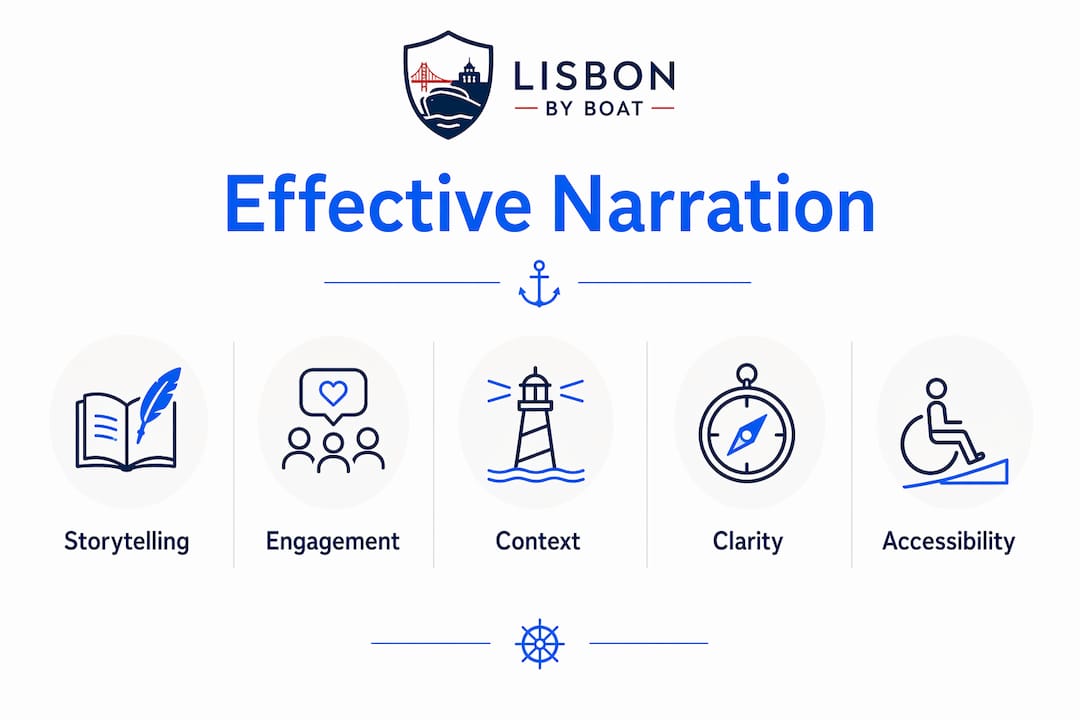
Historical context: grounds the story in real events and gives it stakes
Narrative arc: a beginning, tension, and resolution that holds attention
Sensory detail: what did it smell like? What sounds filled the square?
Pacing: silence and pauses are as powerful as words
Vocal variety: pitch, speed, and volume shifts signal what matters
Body language: gesture, eye contact, and positioning reinforce the story
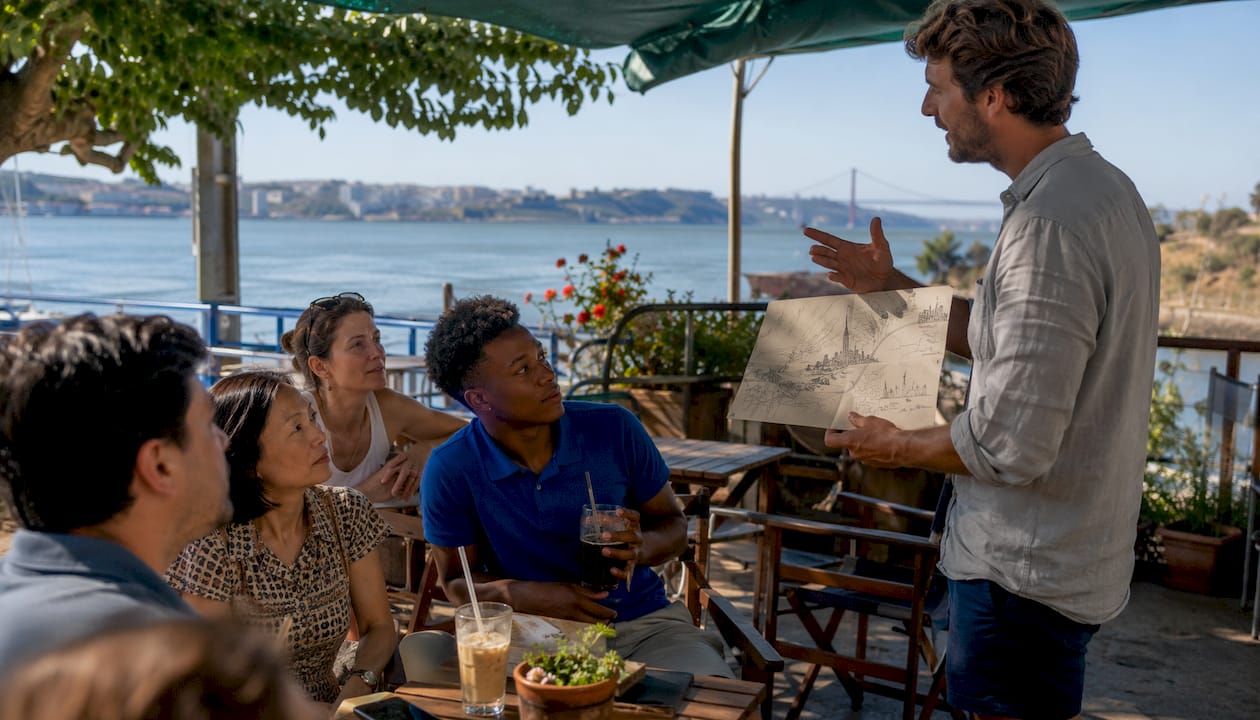
Interactivity: a question or a moment of participation resets attention
Adding background explanation and narrative increases information depth and visitor-oriented expression, which is the research-backed case for going beyond bullet-point commentary.
Pro Tip: Never read from a manuscript. Visitors hear the difference between a guide who knows the story and one who is reciting it. Prepare an “intro + core + verdict” structure for each stop, then speak it conversationally.
How do you structure a narration stop?
Practitioner guidance recommends three reliable narrative arcs: origin, conflict-and-transformation, and character arc. At each stop, use a micro three-act structure.
The micro-stop structure:
Set the scene (20% of stop time): one vivid sentence that places visitors in the moment. “Picture this harbor in 1755, three weeks after the earthquake.”
Core story (40%): the tension, the character, the event that makes this spot worth stopping at.
Meaningful wrap-up (40%): a resolution plus an invitation. Connect it to something the visitor already knows, or tease what comes next.
Stop element | Time allocation | Goal |
Scene-setting | 20% | Orient and hook |
Core story | 40% | Emotional engagement |
Wrap-up/invitation | 40% | Memory anchor + curiosity |
Total stop length | 2–5 minutes | Optimal attention window |
What to avoid:
Dense jargon or academic language mid-story
Reading verbatim from notes
Stopping longer than five minutes without an interactive moment
Skipping the wrap-up because you’re running late
Sample narration excerpt: “That tower wasn’t built for defense. It was built to be seen from the sea, a signal to every arriving ship: power lives here. Stand where you are and look back at the water. That’s exactly what the king wanted sailors to see.”
How should planners brief and evaluate narration?
Briefing checklist:
Audience profile: age range, cultural background, mobility needs
Timing: total duration, stop count, transition time between stops
Desired tone: educational, entertaining, ceremonial, or a mix
Safety and route notes: hazards, restricted areas, emergency exits
Accessibility needs: hearing loops, pace adjustments, descriptive language
Call to action: what should guests do or feel at the end?
Interview questions for evaluating a guide:
Tell me the story of one stop on a tour you’ve led. (Tests narrative instinct.)
How do you handle a guest who challenges a historical claim? (Tests adaptability.)
What do you do when the group loses focus? (Tests audience management.)
Red flags: over-reliance on printed scripts, absence of sensory language, no natural pause for questions, inability to summarize a stop in under 90 seconds.
Metrics to track: post-tour satisfaction ratings tied specifically to guide commentary, qualitative prompts (“What’s one thing you’ll remember?”), and observational checks during a trial run (group attention, laughter, spontaneous questions). For team events, narration supports team-building objectives by creating shared reference points the group carries forward.
How should guides handle sensitive or contested topics?
Authenticity and empathy come first. Guides who prioritize emotional authenticity over rigid political framing maintain stronger relationships with visitors and with the places they interpret.
Ethical principles to follow:
Transparency: acknowledge when the historical record is incomplete or disputed
Multiple perspectives: name whose story is being told and whose is missing
Trigger awareness: flag emotionally heavy content before entering it, not during
Avoid definitive moralizing: present context, not verdicts
Phrases that work in practice: “Historians disagree on this point, and here’s why both views matter.” Or: “This site carries different meanings for different communities. I’ll share what the records show, and you can draw your own conclusions.” These phrasings keep the guide credible without shutting down conversation.
What makes narration accessible and inclusive?
Accessibility is not an afterthought. It shapes whether a tour works for the full group or just part of it.
Speak clearly and at a pace that allows non-native speakers to follow
Describe visual content in words when guests cannot see it directly
Offer captioning or transcripts for any recorded segments
Provide multilingual support options where feasible
Avoid idioms or cultural references that require insider knowledge
Build in an optional Q&A at each stop so quieter guests can engage on their terms
Use sensory prompts that don’t assume prior cultural familiarity (“Notice the texture of these stones” works for everyone)
Plan for assistive technology: hearing loops, large-print route cards, and wheelchair-accessible stop positions are reasonable accommodations that most venues can arrange with advance notice. Tailoring commentary for diverse audiences is one of the clearest markers of a professional guide.
What does narration look like on a narrated boat tour?
Nautical settings demand shorter stops, stronger sensory cues, and safety-first phrasing. Wind, engine noise, and moving scenery compress the window for attention. A guide on the water cannot rely on a landmark staying in view for five minutes.
Applied tips for boat narration:
Adjust volume and projection for wind; face the group, not the sight
Rotate three micro-stories: a narrative hook, a local anecdote, and a sensory prompt
Integrate photo tips at key moments (“Right now, with the castle behind you, is your shot”)
Keep each stop to 90 seconds of narration, then open for questions or silence
Sample narration for a Lisbon coastline stop: “The tower you’re looking at, the Torre de Belém, stood at the edge of the known world in the 16th century. Every explorer who left for the Americas or India sailed past it. Some of them never came back. Feel the wind right now. That’s the same Atlantic they were heading into.”
Lisbonbyboat guides bring this craft to every sailing tour along Lisbon’s historical coastline. The local legends and anecdotes woven into each route are what turn a scenic cruise into a story worth telling when you get home.
Key Takeaways
Tour narration is interpretive, story-driven commentary that turns sights into memorable experiences by combining historical context, sensory detail, and a clear narrative arc at every stop.
Point | Details |
Core definition | Tour narration is interpretive verbal commentary, not fact recitation — it creates meaning, not just information. |
The 20/40/40 rule | Structure each stop as 20% scene-setting, 40% core story, and 40% wrap-up/invitation, within a 2–5 minute window. |
Planner checklist | Brief guides on audience profile, tone, timing, accessibility needs, and the desired call to action before any tour. |
Ethics and sensitivity | Acknowledge contested history with transparency and multiple perspectives; avoid definitive moralizing. |
Lisbonbyboat in practice | Lisbonbyboat’s narrated sailing tours along Lisbon’s coastline demonstrate these techniques live, with guides adapting stories to wind, scenery, and group energy. |
The craft behind the commentary
The guides who stay with you are the ones who treat each stop as a small story with stakes, not a caption. The priority every day is clarity first, then a curiosity hook that makes the group lean in, then adapting on the fly when the wind picks up or someone asks a question that reframes everything. Dense scripts are the enemy of that. The best narration sounds like a knowledgeable friend talking, not a textbook being read aloud. Public-speaking and narration skills are trainable, but the instinct to read the group and shift gears is what separates a competent guide from a memorable one.
Hear narration in action on the water
Reading about tour narration is one thing. Hearing it work on the water, with Lisbon’s skyline moving past you and a guide who knows every stone of the coastline, is something else.
Lisbonbyboat runs daily narrated sailing tours along Lisbon’s historical coastline, with guides who cover the major monuments and the stories behind them. For event planners, a two-hour public tour is a practical trial run before booking a private cruise for your group. Private options range from half-day catamaran trips to full-day luxury yacht experiences for clients who want the full treatment. Check availability and book a narrated tour to see the craft in practice.
Further reading and training resources
Narrating History in Guided Tours — peer-reviewed research on the guide’s role as experience broker and cultural mediator
The Role and Power of Tour Guides as Storytellers in Cultural Heritage Tourism — research synthesis on storytelling, destination image, and visitor satisfaction
A Comparative Analysis of Tour Guide Explanation Styles — study on how narrative depth affects visitor engagement
Guide narration and sensitive contexts — research on authenticity and ethics in politically sensitive sites
The Art of Walking: Crafting Engaging Tour Narratives — practitioner guide covering micro-stop structure, the 20/40/40 rule, and narrative arcs
Crafting a Compelling Tour Narration: Beyond the Basics — practical advice on avoiding manuscript-style delivery
The role of storytelling in guided tours explained — industry practitioner perspective on storytelling techniques
Audio tour overview — background on recorded and app-based narration formats
Starting points by reader type: Tourists curious about what makes a tour memorable should start with the storytelling research links. Aspiring guides should go straight to the practitioner guides on micro-stop structure and manuscript avoidance. Planners briefing a guide for an event will find the comparative explanation-styles study and the sensitive-contexts research most directly useful.
Recommended
This page focuses on a short launch timeline: pick a template, adjust the content, and publish. The template-based publishing option may appeal to small organizations that want to establish an online presence without a long technical setup.