

Lisbon From the Tagus: Perspectives From the River

The best perspective on Lisbon is from the middle of the Tagus. From the water you see the city the way arriving sailors always did: seven hills rising from the north bank, the old waterfront in one sweep, the great red bridge overhead and a giant Christ figure with open arms on the far shore. Belém Tower and the Monument to the Discoveries sit exactly where they were meant to be seen, at the river’s edge. This guide walks you through that view stretch by stretch, explains how it differs from the miradouros on land, and helps you choose the right outing.
TL;DR
From the river, landmarks that feel scattered on land join into one continuous waterfront, from Alfama and the castle to Belém.
The classic route heads west along the north shore, passing São Jorge Castle, the 25 de Abril Bridge, the Monument to the Discoveries and Belém Tower, with Cristo Rei on the south bank.
Our standard sailing tour lasts 120 minutes and costs €45 per person. The sunset version starts from €60 per person.
Private yachts start from €400 per yacht, and we also run group and corporate outings on larger vessels.
Table of Contents
Why the river changes how you see Lisbon
Lisbon is a city of viewpoints, and most of them look down on the river. The river looks up at the city. That reversal matters. On land you see one angle at a time, framed by a terrace railing or a street corner. On a boat the angle keeps moving, so a monument slowly turns from a silhouette into a shape, and then into a detail.
One travel writer who watched Cristo Rei from a ship describes how the perspective changes as the vessel moves, with the river, the bridge and both banks all feeding into one scene. That is exactly what you notice on a sailing tour: a landmark you photographed from a hillside suddenly has context.
The geography also becomes clearer. Seen from the water, the city rises above the northern bank with its hills as a backdrop, and buildings that seem unrelated on land become part of the same waterfront. Belém Tower was built in direct relationship with the river, and the Padrão dos Descobrimentos was designed to face it. You only feel that connection when you are on the water looking back.
The official tourism board describes the Tagus as a river where past and future meet, with historic monuments alongside modern buildings, river beaches, regattas and traditional boat navigation. On a sailing day you see all of it at once.
The view stretch by stretch
Most sightseeing sails head west from the central waterfront toward Belém and the mouth of the river, staying close to the north shore where most of the scenery sits. A typical cruise passes St. George’s Castle, the 25 de Abril Bridge, the Monument of the Discoveries and Belém Tower. Here is what to look for at each point.

Alfama and São Jorge Castle
The oldest quarter of Lisbon is a jumble of terracotta roofs tumbling down the hill toward the water, crowned by the castle walls. From the deck you can read the hill as a whole: the castle on top, the church domes and viewing terraces partway down, and the narrow lanes of Alfama packed in between. Visit Lisboa lists São Jorge Castle among the old landmarks that offer privileged views along the Tagus Route, and from the river you see the castle from the angle its builders worried about, the one facing the water.
Look for the contrast between the dense, low-rise older quarters and the more open lines of the downtown grid beside them. It is the clearest way to understand why Lisbon’s districts feel so different.
Praça do Comércio and the Ribeira das Naus
The great arcaded square opens directly onto the river, and from a boat you see why: it was designed as the city’s front door. The stretch of promenade beside it is the Ribeira das Naus, and its history is worth knowing as you glide past. It was an industrial complex that built ships for the India fleets, with a launching capacity that placed it at nearly twice the scale of the kingdom’s other active shipyards.
Today it is a landscaped riverside promenade. The regeneration of the central riverfront between Santa Apolónia and Cais do Sodré took almost fifteen years, and the Ribeira das Naus phases opened in March 2013 and July 2014. From the water you see people sitting on the steps where ships were once launched.
The 25 de Abril Bridge
The bridge is the visual anchor of every river photograph. It was completed in 1966, closely modeled on San Francisco’s Golden Gate, and renamed after the 1974 revolution (it was previously named for Salazar). Sailing beneath it is one of the moments guests talk about most: the deck traffic hums overhead, the steel towers loom, and the scale of the river becomes obvious.
It also frames the next sight. Looking south through its span you find Cristo Rei.
Cristo Rei on the south bank
The statue of Christ the King stands on the southern bank in Almada, arms open, looking over the whole city. It resembles Rio de Janeiro’s Corcovado monument and was built as a thanksgiving memorial after World War II for Portugal being spared the war’s destruction. From the Lisbon side it is a distant white figure on a hill. From the middle of the river it is much closer and sits above the water in a way no terrace on the north shore can match.
Belém Tower
Belém Tower is the highlight for many first-timers. A sixteenth-century Manueline fort built to protect the city’s port, it appears from the Tagus as a small castle floating on the riverfront. It is a UNESCO World Heritage Site together with the nearby Jerónimos Monastery. On land, you walk up to it and the setting is partly hidden by the promenade. On the water, you see it as sailors did, an outpost on the edge of the river.

The Monument to the Discoveries
The Padrão dos Descobrimentos is built to face the river, and from a boat you see why. At its base, sculpted figures of discoverers line a stylized prow jutting over the Tagus, led by Prince Henry the Navigator. Seen from the side it is a tall oblong, and head on it looks like a giant sword and cross. The permanent version, 56 metres (184 feet) tall, was inaugurated in August 1960 to mark 500 years since Henry the Navigator’s death.
The design makes sense once you are on the water: the monument is a ship ready to depart down the Tagus into the Atlantic, and from the river you are the one looking back at it.
River view versus viewpoint view
Both are worth your time, and they complement each other. Here is how they differ in practice.
From a riverside or hilltop viewpoint | From a boat on the Tagus | |
Angle | Fixed, looking down or across | Constantly changing, looking at the city from the water |
What you see | A frame of rooftops, river and bridge | The full waterfront, hills behind it, and both banks |
Cristo Rei | A distant figure across the water | Close enough to see the open arms and the pedestal |
Belém and the Discoveries monument | Up close but from the shore | Their relationship to the river is visible |
Effort | Climbing hills and stairs | Sitting on deck while the scenery moves |
The hilltop terraces give you the best sense of the rooftops. From the top of the Arco da Rua Augusta, for example, a 360° view takes in Praça do Comércio, the river, the south bank, Cristo Rei, the 25 de Abril Bridge and the Pombaline downtown. Our suggestion: do one or two of those by foot and then see the same places from the river, so that you recognize each one from the other side.
The waterfront promenade between Praça do Comércio and Belém is another option on a different day. Many guides put it at around 6 km, flat, and about 90 minutes at a relaxed pace. It is pleasant, but it runs along the shore, so you still see the city only from the bank. If you want to see how the city looks from where its history began, the water is the answer.
Planning a longer trip? You can compare Lisbon city trip deals before you fix your dates, then build your river outing around the days with the best weather.
Perspective
We have spent our working lives on the Tagus, and we still take guests to the same spot on the river for a first look at the city: a little west of Praça do Comércio, with the bridge ahead and the hills behind. What we see is guests putting their phones down. They arrive with a list of monuments and discover that the real subject is the relationship between them: a castle on a hill, a square that opens onto the water, a tower and a monument that face the river as they were meant to. That is why our tours are guided and live. A guide who can say what a building was for, and why it sits where it does, turns a scenic sail into an explanation of the city. Our sailing yachts are spacious, so you can move from the bow to the stern and follow the view as it changes, and our crews look after guests with the attention of people who love this river. If you have only one afternoon in Lisbon, we would spend two hours of it on the water. Lisbon
When to go: daylight, sunset and the seasons
The river looks different at every hour. A morning or midday sail gives clear, even light, which is best for photographing details such as the tower’s stonework or the Discoveries monument’s sculpted figures. Late afternoon turns the north bank gold and puts the sun behind you as you sail west toward Belém.
Sunset is the most popular choice. As the light drops, the water turns amber, Cristo Rei spreads its arms on the south bank and the bridge glows red, and Belém Tower sits at the river’s edge. Our sunset sailing tour runs 120 minutes and starts from €60 per person. If you want to read more before choosing, our guides to sunset boat tours in Lisbon and the best viewpoints from the water go into detail.
A few practical points that apply in any season:
Bring a light jacket. It is often breezier on the river than in the streets, even on a warm day.
Sit on the north side for the city and the Alfama hillside, and move around to catch Cristo Rei on the south.
Wear shoes with grip, since a sailing deck moves.
Charge your phone before boarding, because you will take more photographs than you expect.
Choosing your outing
The right boat depends on who is coming and what you want from the view.
Outing | Duration | Price | Best for |
Lisbon Sailing Tour | 120 min | €45 per person | First-time visitors who want the full guided view |
Sunset Sailing Tour | 120 min | From €60 per person | Golden light and the bridge at dusk |
Dolphin Watching Tour | See the tour page | €50 to €65 per person | Visitors who want wildlife as well as sights |
Romantic Sunset Sailing | See the tour page | €390 per yacht | Couples and proposals |
Private Tour | See the tour page | From €400 per yacht | Families and friends who want their own boat |
All of our tours include live commentary, beverages and snacks. On the shared sailing tours, our guides explain the major monuments and sights as you pass them. On a private yacht you set the pace and decide how long to linger at each landmark. Private outings can run from two hours up to a full day.
If you are deciding between spots to see, our article on historical sights along the Lisbon river and our list of famous landmarks to discover by boat pair well with this one.
See the Tagus with us
Our daily sailing tour covers the historic coastline in two hours, with a guide explaining each monument as it comes into view. If you want the river to yourselves, we also offer private sailing yachts, catamarans and a luxury rigid inflatable boat, with durations from two hours to a full day.
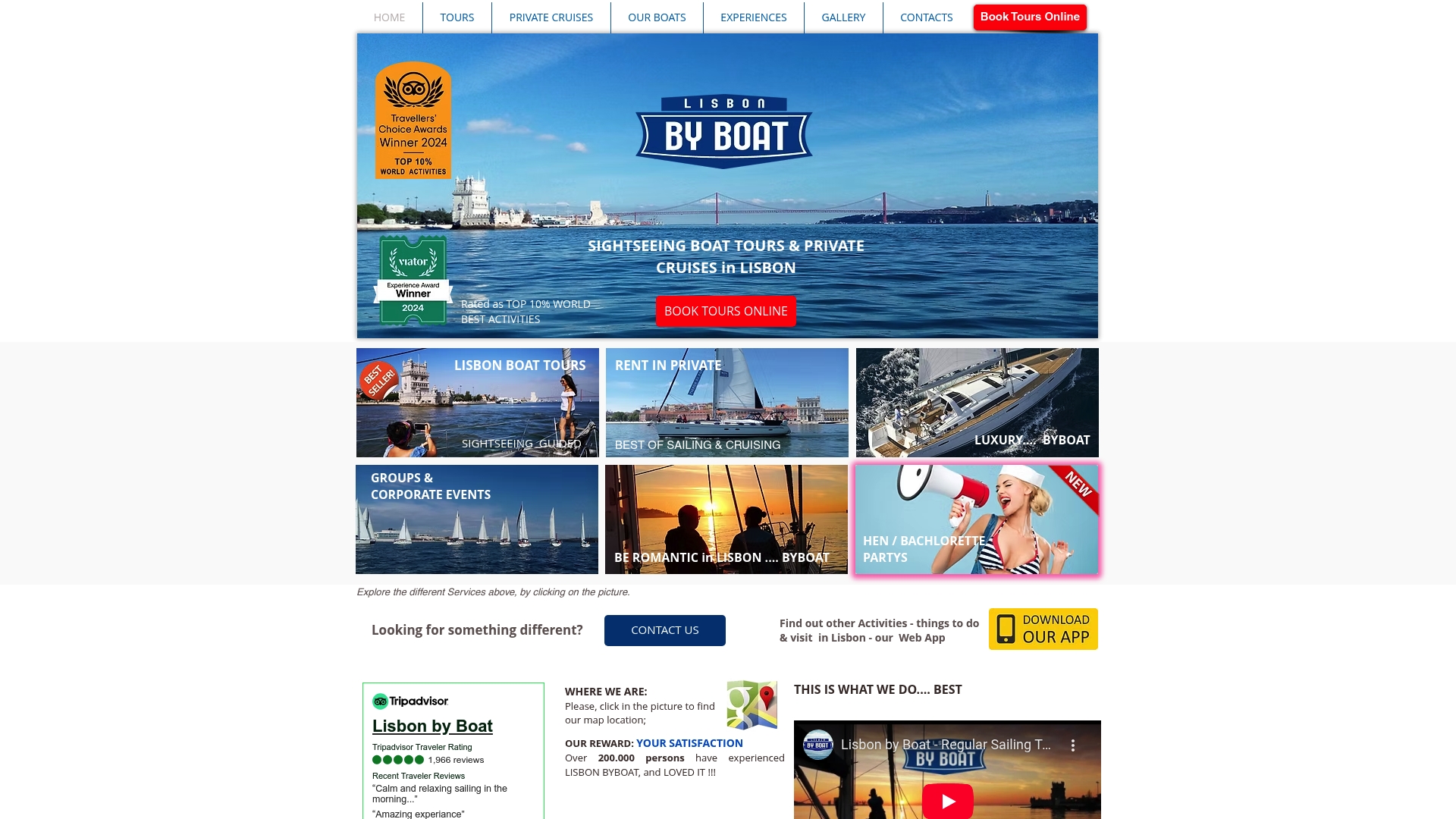
Browse the shared and private options on our Lisbon boat tours page, or look at our private yachts and catamarans if you want to plan your own route. Couples can see our romantic sunset sailing program.
Groups, teams and celebrations
The river view works for groups as well as for couples. A shared boat gives colleagues or friends something to talk about that is not work or the schedule, and the setting, with the whole city drifting past, does the rest.
We organize outings for corporate teams, event planners and celebrations. Our group fleet ranges from speedboats for groups of up to 120 guests, to sailing yacht regattas for up to 130, tall ships for up to 200 and a motor ship for up to 340. Programs and prices depend on group size, vessel and duration, so our group activities page is the place to start. For hen parties, we run a hen sailing cruise with an optional speed boating element.
For team building, a sailing regatta gives everyone a role on deck, which works well when you want people from different departments to work together. For a more relaxed corporate event, a guided sightseeing sail with drinks and snacks lets the guests mingle while the city goes by.
When planning, think about:
Headcount and vessel. Match the boat to the group size so everyone has room on deck.
Time of day. Late afternoon sailing with a sunset finish suits most corporate groups.
Mix of activity and sightseeing. Decide whether you want a racing element or a guided tour.
Catering. Tell us early about beverage and snack preferences.
Language. If your group is international, mention it when booking so we can plan commentary accordingly.
Make the most of your day in Belém
Belém is where the river view gets close. Many visitors pair their sail with time on land in the same neighborhood: Belém Tower, the Jerónimos Monastery and the Monument to the Discoveries are within a short walk of one another. The monument’s viewing level offers a reverse perspective: the Tagus spreads west toward the Atlantic, with the bridge, Cristo Rei and the tower all in view.
See the places from the water first, then walk to them. When you stand under the tower after sailing past it, you already know how it sits in the river. Belém Tower had a long renovation, so check the official visitor information for current opening hours and booking rules before you plan to go inside.
For more on why the water gives the best view of the whole city, read our guide on why to cruise the Tagus, and see our seven best views of Lisbon for ideas about what to combine with your sail.
A short history of arriving by river
Part of the pleasure of the Tagus view is knowing how many people have arrived this way. The river mouth has welcomed Phoenicians, Romans and, in 1499, Vasco da Gama, who returned having found the sea route to Asia. Seen from the river, the Ribeira das Naus, the Belém fort and the Padrão all belong to that same story of ships leaving and returning.
That is also why the Tagus view feels different from other waterfront cities. The monuments were not built for tourists on a promenade. They were built for the people sailing past them.
FAQ
What is the best way to see Lisbon from the river?
A guided sailing tour is the most direct way. You pass the old quarters, the bridge, Cristo Rei, Belém Tower and the Discoveries monument in about two hours, with commentary explaining each one. Our standard sailing tour is 120 minutes and costs €45 per person.
What can you see from a boat on the Tagus?
You can see the Alfama hillside and São Jorge Castle, Praça do Comércio, the 25 de Abril Bridge, Cristo Rei on the south bank, Belém Tower and the Monument to the Discoveries. The view changes as the boat moves, so each landmark appears in a new setting.
Is sunset or daytime better for a river tour?
Both are good. Daytime gives even light for photographs of detail, while sunset gives warm color on the bridge, the statue and the tower. Our sunset sailing tour starts from €60 per person, and our daytime sailing tour is €45 per person.
Can I book a private boat for a small group or a company?
Yes. We offer private tours on sailing yachts from €400 per yacht, plus catamarans and a luxury RIB, with durations from two hours to a full day. For larger groups and corporate events, we have vessels that carry up to 340 guests.
Sources
Recommended
Comments