

Historical Points of Interest Along Lisbon's Tagus River

Lisbon’s river has three kinds of history on its banks: the monuments of the Age of Discoveries in Belém, the royal waterfront around Praça do Comércio, and the 20th-century icons, the 25 de Abril Bridge and Cristo Rei. All of it is visible from the water in one sweep, which is why a guided sailing is the easiest way to understand how they fit together. On our 2-hour Lisbon sailing tour, our guides explain the major monuments and sights as they pass by.
This guide lists the landmarks, tells you what each one is, and explains what you can recognize from the river and what you can’t.
TL;DR
Belém Tower, Jerónimos Monastery and the Monument to the Discoveries are the core of Lisbon’s riverside history, all on the Tagus’s north bank.
Praça do Comércio is the formal “front door” of the city on the water, built where the royal palace stood.
The 25 de Abril Bridge (1966) and Cristo Rei (1959) are modern landmarks, but they define the skyline.
St. George’s Castle and the Cathedral sit up the hill: you see them as part of the skyline, with fuller views from the castle itself.
Seeing all of this by boat takes about two hours, with a guide naming each sight as it appears.
Table of Contents
How the landmarks are ordered along the river
The river runs east to west through Lisbon toward the Atlantic. Think of it as a timeline that moves from the old city center to the age of exploration, then to the modern era.
Visit Lisboa’s Tagus Route page says the Tower of Belém, the Monument to the Discoveries and Jerónimos Monastery stand on the river’s banks. It adds that St. George’s Castle, the Triumphal Arch of Rua Augusta, Ribeira das Naus and Cristo Rei offer privileged views of the water.
Area | Main sights | What it represents |
Downtown waterfront | Praça do Comércio, Ribeira das Naus, Rua Augusta Arch | Royal Lisbon and its shipyards |
Hillside above | St. George’s Castle, Lisbon Cathedral | Medieval and Moorish Lisbon |
Bridge and south bank | 25 de Abril Bridge, Cristo Rei, Almada Naval Museum | 20th-century Lisbon and shipbuilding memory |
Belém | Belém Tower, Jerónimos Monastery, Monument to the Discoveries | The Age of Discoveries |
A typical sightseeing cruise heads toward Belém near the river mouth, where the Atlantic comes into view, and then turns back, so you get a second look at the icons, as The West Australian’s travel correspondent describes.
Belém: the monuments of the Age of Discoveries
Belém is where Portugal’s maritime story is told in stone. Three monuments stand close together, and the river is the reason all three exist.

Belém Tower
The tower was built between 1515 and 1521 under King Manuel I on a small outcrop at the edge of the Tagus. According to one Belém history, its purpose was to cross fire with a tower on the southern side of the estuary and keep enemy ships out. Its lower bastion has 17 cannon openings.
From the water this makes sense in a way it never does on land. Smarthistory notes that as you walk from the monastery toward the river, the tower seems to rise from the water on the horizon. From a boat you see that effect directly, along with the Manueline limestone detail. Argophilia’s guide describes it as Manueline in style and part of a UNESCO World Heritage complex with the Hieronymites Monastery since 1983.
Jerónimos Monastery
The monastery was founded in 1499 to honor Vasco da Gama’s sea route to India, according to the same Belém history. The article puts its facade at 300 meters, with a south portal 32 meters high. Navigators used to pray here before expeditions, and the monastery holds the tombs of Vasco da Gama and Luís de Camões, according to Argophilia.

The monastery sits back from the water behind a park, so from the river you see its long profile rather than the cloister. That’s a good reason to treat the boat as the overview and a land visit as the close-up. Smarthistory calls the tower and the monastery together one of the main symbols of Portugal’s global expansion that began in the mid-to-late 15th century.
Monument to the Discoveries
This monument, the Padrão dos Descobrimentos, stands prominently on the right bank. Visit Lisboa says it was erected in 1940 to honor figures of the Portuguese Discoveries, a joint work of architect Cottinelli Telmo and sculptor Leopoldo de Almeida. It is shaped like the prow of a ship, so it reads clearly from the water. Argophilia lists the figures it honors, among them Magellan, Vasco da Gama, Luís de Camões and Nuno Gonçalves, and mentions a nearby monument to the first flight across the South Atlantic, from Lisbon to Rio de Janeiro.

Downtown waterfront: where Lisbon meets the river
Praça do Comércio
The square was formerly called Terreiro do Paço, after the royal palace that stood there for roughly two centuries. Visit Lisboa’s points-of-interest page gives its size as about 36,000 square meters, makes it one of Europe’s largest squares, and says it is bounded by 79 arches. Its open side faces the Tagus, which tells you how the city once received visitors: you arrived by water and stepped into the square.
Ribeira das Naus and the shipyards
Ribeira das Naus is the waterfront promenade west of the square. Visit Lisboa lists it among the privileged viewpoints on the river. The name refers to the ships built here: the Tagus route story says Lisbon’s shipyards were reputedly the best in the world in their day. When you look at this stretch from the water, you are looking at the place where the ships of the Discoveries were once made.
The bridge and the statue: Lisbon’s modern landmarks
Two of the most photographed sights on the river are younger than many visitors assume. According to The West Australian:
The 25 de Abril Bridge was unveiled in 1966 as the Salazar Bridge, and renamed after the revolution of 25 April 1974.
Cristo Rei is a Catholic shrine on the Almada cliff, inaugurated in 1959. A Lisbon cardinal’s visit to Rio de Janeiro in the 1930s inspired it.
Argophilia gives Cristo Rei’s dimensions as a 28-meter statue on an 82-meter pedestal on the Almada side, and notes that the bridge is one of Europe’s largest suspension bridges and looks much like the Golden Gate Bridge. If you are an American visitor, that comparison helps: the bridge’s red-orange span is easy to spot, and sailing under it is one of the highlights of any river trip.
Historic sights near the river but not right on it
Some of Lisbon’s oldest buildings sit on the hills above the waterfront. You see them from the water as part of the skyline, not up close.
St. George’s Castle. Visit Lisboa says it dates to the mid-11th century, still has its eleven towers, and includes elements of military fortifications built under Islamic rule. Its position gives majestic views over the city.
Lisbon Cathedral (Sé). The same page says it was supposedly built over the city’s main mosque at the time of the Christian Reconquest, finished in the early 13th century, and mainly Romanesque, with later Gothic and Baroque changes.
The river view shows how these buildings sit on the slopes above the old harbor, which makes the castle’s defensive role easier to grasp.
The quieter heritage on the south bank
The river’s history is not only grand monuments. The Tagus route story mentions avieiro fishermen, tide mills and the Alburrica windmills, which preserve the memory of the river’s agricultural relationship. On the Almada side, the Naval Museum has taken the place of the extinct Portuguese Fishing Company and pays homage to the old shipbuilding industry. You are unlikely to spot these from a standard sightseeing route, but they show that the river was a working landscape long before it became a postcard.

Why see the river’s history from the water
A walking route in Belém takes a half day. Reaching Praça do Comércio, Belém, the bridge and the south bank on foot or by taxi takes a full day with queues in between. On the water, the sequence is continuous and the guide tells you what you are looking at. Our own coverage of the subject goes deeper into specific stretches: see historical sights along the Lisbon river and Lisbon monuments seen from the boat.
The angle also matters. Belém Tower was built to be seen and defended from the river, and Praça do Comércio was designed to face it. Seen from the street, both lose part of their purpose.
Seeing it with us
Our standard Lisbon sailing tour lasts 120 minutes and costs €45 per person. All our tours include live commentary, beverages and snacks. If you would like the same coastline in evening light, the sunset sailing tour is also 120 minutes and starts from €60 per person. Prices are as published on our site.
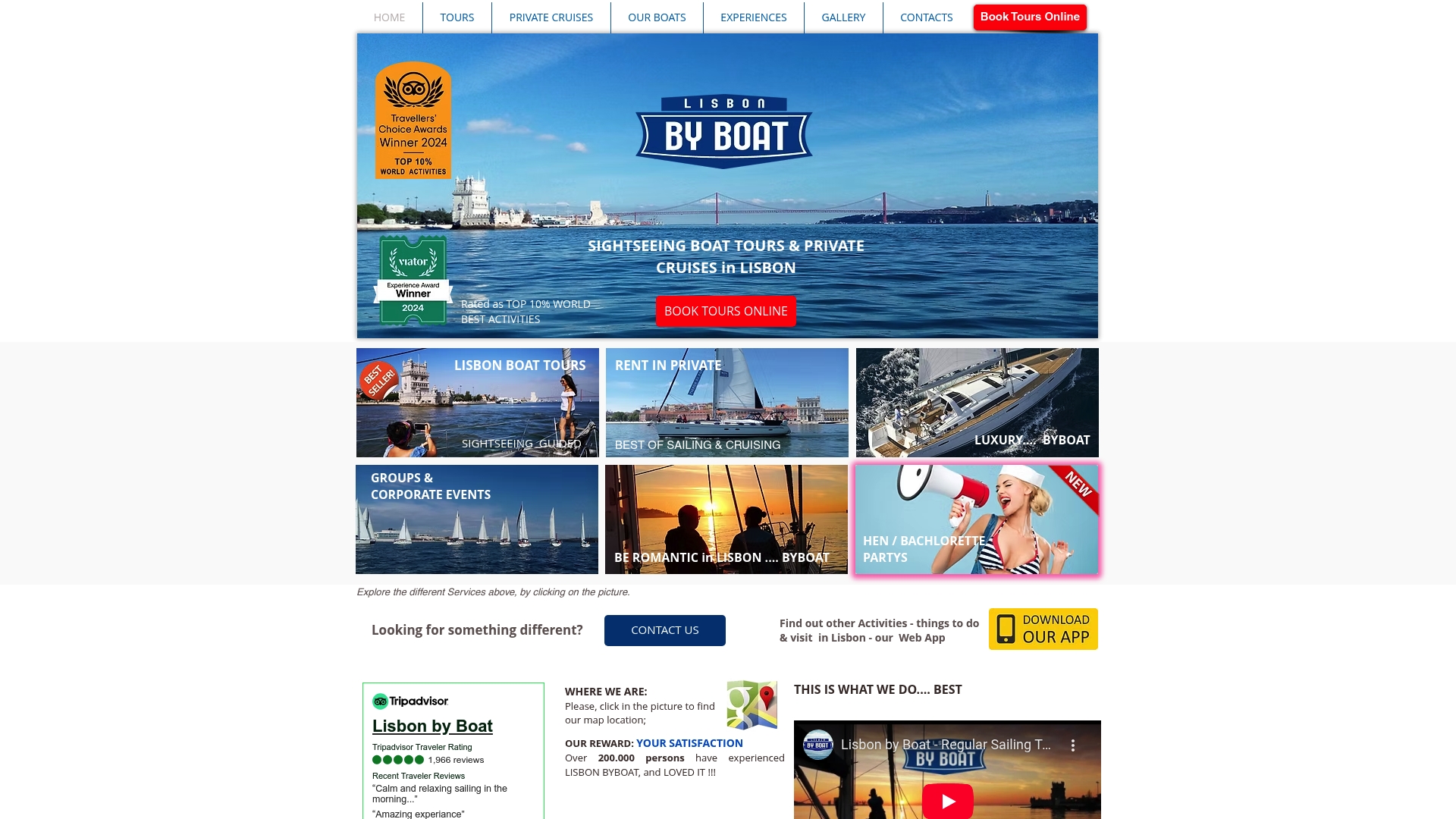
For a private outing with a smaller group, private tours start from €400 per yacht, and our Romantic Sunset Sailing is €390 per yacht. Dolphin watching is also offered at €50 to €65 per person on our dolphin watching page.
Planning a group or corporate outing
If you are organizing a team-building day or a company event in Lisbon, the history above works as a built-in program. A guide can turn the waterfront into a shared story rather than a list of stops. We offer activities for groups on a range of vessels: speedboats (RIBs) for groups up to 120, sailing yacht regattas up to 130, tall ships up to 200 and a motor ship up to 340 guests. Smaller teams can take a private yacht or catamaran for durations from 2 hours to a full day. Prices for these programs are not published, so send us your group size and date.
How to recognize each landmark on the water
Start downtown. Look for the large square open to the river, with arches along its sides: Praça do Comércio.
Look up. The hilltop castle with its towers is above the old town.
Watch for the bridge. It is a long red suspension span, and the Cristo Rei statue stands on the cliff beyond it on the south bank.
Head west toward Belém. A small, ornate limestone tower sits right at the water’s edge. The long monastery facade lies behind it, and the ship-prow monument is beside it on the shore.
Turn back and look again. The return pass lets you place everything in order.
Perspective
We run boats on the Tagus every day, and the thing that stays true is that Lisbon makes the most sense from the river. The city was built to face the water: the shipyards, the royal square and the tower at Belém all exist because of it. That is why we guide the tour live instead of playing a recording. A guide can point at the hillside, name the castle, and explain why the tower stands where it does, at the moment you are looking at it. Our fleet of sailing yachts is spacious and comfortable, and our crew is experienced, so you can focus on the view. For visitors with one free afternoon, two hours on the water covers more of Lisbon’s history than a day of crossing the city. For teams, the same story gives a group something to share. Start with the river, then choose which monuments you want to walk through afterward. Lisbon
FAQ
Which historical landmarks can I see from the Tagus?
The main ones are Belém Tower, Jerónimos Monastery, the Monument to the Discoveries, Praça do Comércio, the 25 de Abril Bridge and Cristo Rei. St. George’s Castle and the Cathedral appear on the hillside above the old town.
What is the oldest landmark you can see from the river?
St. George’s Castle dates to the mid-11th century, according to Visit Lisboa, and the Cathedral was completed in the early 13th century. Belém Tower dates from 1515 to 1521.
Is Cristo Rei an old monument?
No. It was inaugurated in 1959 and was inspired by Rio de Janeiro’s Christ the Redeemer, according to The West Australian. The 25 de Abril Bridge opened in 1966.
How long does a river tour take?
Our sailing tours last 120 minutes. Private cruises on yachts and catamarans can run from 2 hours up to a full day.
Sources
Recommended
Comments