

Walking in Lisbon: Your Self-Guided Route Planner

Lisbon rewards walkers more than almost any European city, and the best approach is a three-route strategy: a central 1-day loop (Baixa → Chiado → Bairro Alto → Alfama → São Jorge Castle) covering roughly 6 km in 3–4 hours; a compact Alfama loop of about 1–2.5 km taking 1–1.5 hours; and a flat riverside/Belém walk of 2–7 km that runs 2–4 hours depending on how far you go. Hills are real here. Baixa is flat and grid-like; Alfama is steep, cobbled, and uneven; the riverside is completely flat and stroller-friendly.
Central 1-day loop: ~6 km / 3–4 hours, sea level to hilltop castle
Alfama short loop: ~1–2.5 km / 1–1.5 hours, moderate-to-hard, cobbles and stairs
Riverside/Belém walk: 2–7 km / 2–4 hours, flat pavement, family-friendly
Key Takeaways
Walking in Lisbon rewards visitors most when they start at sea level, use the city’s free public lifts without hesitation, and get to Alfama before the cruise crowds arrive after 11:00 AM.
Point | Details |
Start at Praça do Comércio | Beginning at sea level saves your legs for the uphill sections that follow in Chiado and Alfama. |
Use free elevators | The Elevador da Baixa (Rua dos Fanqueiros 178) and Elevador do Castelo are free and skip the longest climbs. |
Alfama timing matters | Start the Alfama loop by 9:00 AM to beat cruise-ship crowds that arrive after 11:00 AM. |
Wear grippy shoes | Calçada portuguesa is slippery when wet; trail runners with rubber soles are the practical choice. |
Lisbonbyboat for the waterfront | A 2-hour sailing tour covers the full riverside monument stretch as a flat, guided complement to your walking day. |
Table of Contents
Which neighborhood walk suits you best?
Every visitor to Lisbon has a different pace, and the city’s neighborhoods genuinely cater to different types of travelers. Knowing which one fits your group before you lace up saves a lot of frustration.
Baixa and Chiado form the best launchpad for first-timers. The pedestrianized streets of Rua Augusta, Rua da Prata, and Rua do Ouro are flat, wide, and lined with cafés. Chiado adds bookshops, the Brasileira café (a literary institution since 1905), and a gentle uphill transition into Bairro Alto. The self-guided Chiado, Bairro Alto, and Baixa circuit typically runs 2–3 hours with mapped stops and café breaks built in.
Best for: First-time visitors, families with kids, anyone who wants coffee and pastries every 10 minutes
Bairro Alto is Lisbon’s evening neighborhood, but it earns its keep during the day too. The Miradouro de São Pedro de Alcântara sits at the top of the Elevador da Glória funicular and gives you a panoramic view of the castle hill across the valley. Photographers love the late-afternoon light here.
Best for: Nightlife seekers, photographers, anyone who wants a viewpoint without a brutal climb
Alfama and São Jorge Castle are where Lisbon’s oldest streets survive. The lanes are narrow, the calçada portuguesa (traditional limestone cobblestones) is steep, and the views from the castle walls are worth every step. History lovers and photographers who can handle uneven ground find this the most rewarding part of the city.
Best for: History lovers, photographers, walkers comfortable with hills and stairs
Belém and the riverside offer a completely different experience: flat pavement, wide open spaces, and three of Lisbon’s most iconic monuments within a short walk of each other. The pastéis de nata at the original Pastéis de Belém bakery alone justify the trip.
Best for: Families with strollers, museum-goers, seniors, anyone who wants monuments without hills
How to walk central Lisbon in one day: a step-by-step route
This route starts at sea level, which matters. Beginning at Praça do Comércio means your legs are fresh when you hit the hills, and the waterfront gives you an immediate sense of Lisbon’s scale before the city closes in around you.
Praça do Comércio — Start at the grand riverside square. Spend 10–15 minutes taking in the Tagus and the triumphal arch. This is your orientation point.
Rua Augusta — Walk north through the pedestrian arch and up the main shopping street. The grid of Baixa is flat and easy; budget 15–20 minutes to reach Rossio Square.
Rossio Square — The city’s historic central plaza, with wave-patterned cobblestones and the Teatro Nacional. Cross it and head west toward Chiado.
Chiado — Uphill from Rossio, Chiado rewards the climb with independent bookshops, the Brasileira café, and Praça Luís de Camões. Allow 20–30 minutes.
Largo do Carmo — A short walk from Chiado’s main square, this open plaza holds the ruined Carmo Convent, one of Lisbon’s most atmospheric spots. The back stairs here also give you access to the Santa Justa Lift viewing platform without queuing.
Miradouro de São Pedro de Alcântara — Head north into Bairro Alto to reach this terrace viewpoint. The Elevador da Glória funicular drops you right here from Restauradores if your legs need a break. Budget 15 minutes for the view.
Bairro Alto streets — Wander the grid of narrow streets downhill. This is the right moment to get deliberately lost, as local experts suggest: the side staircases and small plazas reward wandering.
Sé Cathedral — Head east toward Alfama. The Sé is Lisbon’s oldest church and marks the entry point to the historic quarter. Allow 15–20 minutes inside.
Miradouro de Santa Luzia and Miradouro das Portas do Sol — Two viewpoints close together above the Alfama rooftops. Both have benches and tile-panel murals. Budget 20 minutes total.
São Jorge Castle — The final climb. The castle walls offer the best 360-degree view in the city. Allow 45–60 minutes inside.
The full loop covers roughly 6 km and takes about 3–4 hours of walking time, not counting stops. A half-day version cuts off after Chiado and skips Alfama entirely, running about 2 hours and 3 km.
Queue alert: The Santa Justa Lift draws long lines at peak hours. Queues routinely exceed 45 minutes mid-morning. The back stairs from Largo do Carmo reach the same viewing platform for free, with no wait.
Pro Tip: Download a Google Maps offline area for central Lisbon before you leave your hotel. Signal in Alfama’s narrow alleys is patchy, and having the map cached saves you from stopping every two minutes to reload. For a richer experience, check the Lisbon city walking tour guide for a mapped version of this route.
The Alfama and São Jorge short loop
This compact route works as a standalone morning walk or as the final leg of the central day loop. Start near the Sé Cathedral or Martim Moniz square, both of which have metro access and public restrooms nearby.
The route runs roughly 1–2.5 km depending on how many side streets you take, and most walkers finish in 1–1.5 hours without stops. With castle time included, budget 2.5–3 hours. Difficulty is moderate-to-hard: the cobbles are uneven, several sections involve steep staircases, and wet calçada is genuinely slippery.
Key stops on the loop:
Sé Cathedral — Start point, free entry to the main nave
Miradouro de Santa Luzia — Tiled panels depicting pre-earthquake Lisbon; benches and shade
Miradouro das Portas do Sol — Slightly higher, with a direct view over the Alfama rooftops to the river
São Jorge Castle — Paid entry; the ramparts give the best panoramic view in the city
Descent via Rua do Chão da Feira — The most direct path back down to the Sé
Start by 9:00 AM. Alfama’s cruise-ship crowds arrive after 11:00 AM, and the narrow lanes become genuinely difficult to navigate once tour groups fill them. Early morning also gives you the best light for photography.
Accessibility caveat: there are no elevator alternatives for most of Alfama’s internal staircases. Visitors with strollers or limited mobility should skip this loop and focus on the Baixa and riverside routes instead.
The Belém and riverside walk
The riverside route is Lisbon’s most accessible long walk, and it pairs naturally with Belém’s monument cluster at the western end. The full distance from Cais do Sodré to Belém Tower is about 7 km, but most experienced route writers recommend walking the first 2 km to LX Factory, then catching tram 15E to Belém to skip a flat but featureless middle stretch.
Route highlights:
Cais do Sodré — Start at the ferry terminal and Time Out Market. Flat riverside path begins immediately.
Ribeira das Naus — A wide promenade with benches and river views, popular with locals on weekends.
LX Factory — A converted industrial complex with independent shops, cafés, and a Sunday market. Good rest stop at the 2 km mark.
Tram 15E to Belém — Catch it at the Cais do Sodré terminal or along the riverside. Single tickets or a Viva Viagem card both work.
Jerónimos Monastery — Lisbon’s finest Manueline architecture. Book timed entry online to avoid mid-day queues.
Padrão dos Descobrimentos — The Monument to the Discoveries, with a rooftop viewpoint worth the small entry fee.
Belém Tower — The iconic riverside fortress. Queues build fast after 10:30 AM; arrive early or book ahead.
Pastéis de Belém — The original custard tart bakery, open since 1837. The queue moves quickly and the tarts are worth it.
Museum opening hours shift seasonally, and Jerónimos in particular fills up by mid-morning on weekdays. Check current hours before you go.
Pro Tip: The riverside path from Cais do Sodré to LX Factory is entirely flat, wide, and stroller-friendly. For a deeper look at navigating Lisbon with young children, the Lisbon with a stroller guide covers the exact sections of this route with accessibility notes.
Longer trails and green walks around Lisbon
Once you’ve covered the central neighborhoods, Lisbon’s outer routes offer real exercise and noticeably fewer tourists. AllTrails lists several Lisbon-area routes with community ratings, difficulty labels, and downloadable GPX files.
Route | Distance | Time | Difficulty |
Monsanto Forest Park loop | 5–8 km | 2–3 hours | Easy to moderate |
Lisbon Hills Route | 10 km | 3–4 hours | Moderate to hard |
Riverside full walk (Cais do Sodré to Belém) | 7 km | 2–2.5 hours | Easy |
Graça to Mouraria photography route | 3–4 km | 1.5–2 hours | Moderate |
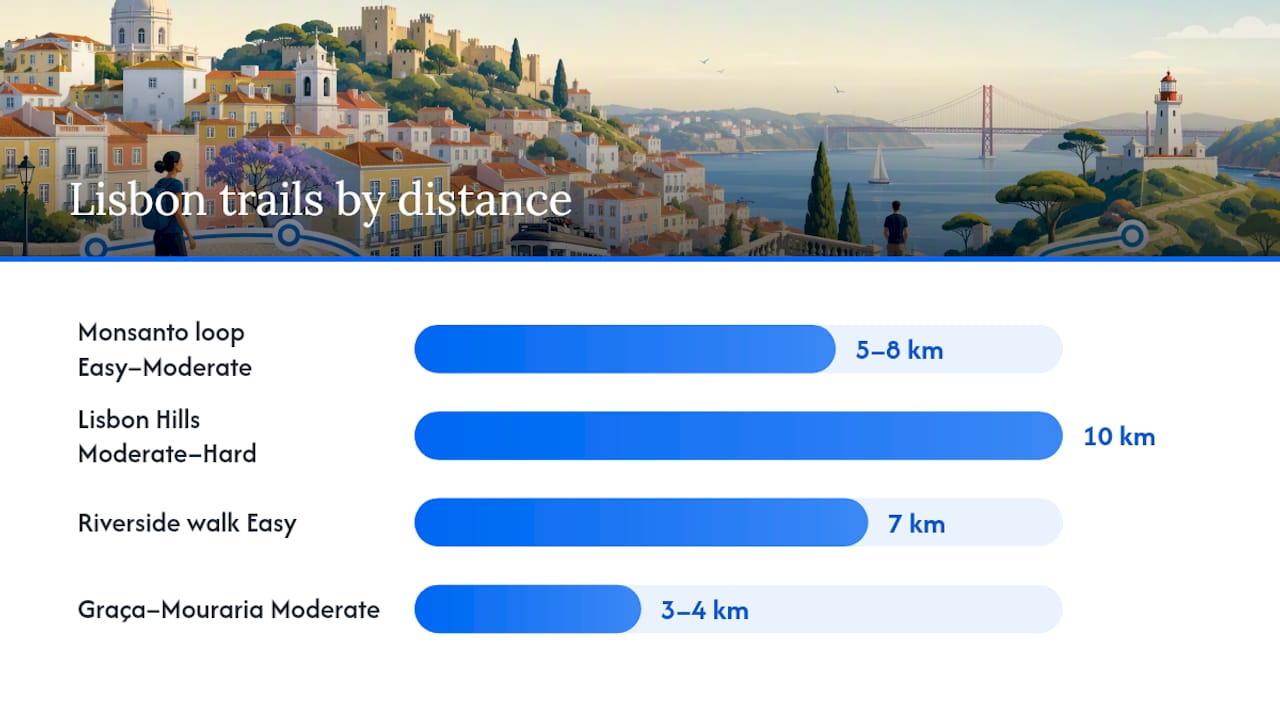
Monsanto is Lisbon’s largest urban forest, sitting on the western edge of the city and reachable by bus. The trails are well-marked and shaded, making it the best option on hot summer days. The Lisbon Hills Route strings together several miradouros and requires a full morning.
The Graça to Mouraria route deserves a special mention for photographers. It’s steeper than the central routes, but the viewpoints are less crowded and the light at golden hour is exceptional. Serious photographers who want sunset miradouro shots without a crowd should put this one on the list.
Packing checklist for longer walks:
Grippy-soled trail runners or hiking shoes (calçada is slippery when wet)
At least 1 liter of water per person; refill points are sparse on Monsanto trails
SPF 50 sunscreen; Lisbon’s summer sun is intense even in the morning
Small first-aid kit with blister plasters
Lightweight rain layer for spring and fall
Trail etiquette in Lisbon’s parks is straightforward: stay on marked paths, carry out your trash, and yield to faster walkers on narrow sections.
Practical walking tips: footwear, timing, safety, and comfort
The single most common mistake visitors make is wearing smooth-soled shoes on calçada portuguesa. The traditional limestone cobblestones are beautiful and genuinely slippery when wet. Trail runners with rubber grip soles are the practical choice; route testers consistently recommend grippy-soled shoes and sun protection as the two non-negotiable items.
Timing by route:
Alfama: Start by 9:00 AM. Cruise-ship visitors flood the neighborhood after 11:00 AM and the lanes become difficult to move through.
Miradouros: Golden hour (roughly 6:30–8:00 PM in summer) gives the best light and manageable crowds. Miradouro de São Pedro de Alcântara is particularly good at this time.
Belém: Mid-morning (9:00–11:00 AM) before the tour buses arrive. Monuments fill up fast after noon.
Baixa and Chiado: Flexible; avoid Saturday afternoon when local shoppers add to tourist foot traffic.
Safety and comfort:
Keep your phone and wallet in front pockets, not back pockets or open bags. Pickpockets work the tourist corridors around Rua Augusta and the Santa Justa Lift.
Avoid wearing headphones in Alfama’s narrower alleys at night; the lanes are disorienting and poorly lit.
Carry small cash (€5–€10) for pastry shops and neighborhood cafés that don’t take cards.
Public toilets are available at Praça do Comércio, Rossio, and inside most museums. Many cafés allow restroom use with a purchase.
Hydrate consistently. Lisbon’s summer temperatures regularly exceed 35°C (95°F), and the hills make the heat feel worse than it looks on a weather app.
How to manage Lisbon’s hills: funiculars, elevators, and Tram 28
Using Lisbon’s public lifts and funiculars isn’t a shortcut. It’s how locals actually move around the city, and local guides frame them as legitimate mobility aids that save energy for the parts of the route that actually reward walking.
Key lifts and funiculars:
Elevador da Bica — Connects Rua de São Paulo (near Cais do Sodré) to Bairro Alto. One of the most photographed funiculars in the city. Runs on the Viva Viagem card.
Elevador da Glória — Runs from Restauradores up to Miradouro de São Pedro de Alcântara. Short ride, big payoff. Viva Viagem card accepted.
Santa Justa Lift — The iconic iron elevator in Baixa, designed in the style of Gustave Eiffel’s workshop. Paid entry; queues regularly exceed 45 minutes at peak times. The viewing platform at the top connects to Largo do Carmo via a walkway, but the back stairs from Largo do Carmo reach the same point for free.
Elevador da Baixa (free) — Located inside Rua dos Fanqueiros 178. This free public elevator saves roughly a 70-meter climb and is almost entirely unknown to tourists. No queue, no ticket.
Elevador do Castelo (free) — Serves the castle hill area. Check current operating hours before planning your route around it, as schedules shift seasonally.
Tram 28 is the city’s most famous historic tram line, running through Alfama, Graça, and Estrela. It’s a genuine public transit route, not a tourist attraction, so it gets crowded. Ride it for the experience, but don’t rely on it as your primary route planner. Tram 15E is more practical for the Belém run.
Ticketing: A Viva Viagem card (available at any metro station) covers funiculars, trams, and the metro on a single reloadable card. Single paper tickets cost more per ride and create unnecessary friction.
Pro Tip: Use the free Elevador da Baixa inside Rua dos Fanqueiros 178 to skip the Santa Justa queue entirely. You reach the same elevated area near Largo do Carmo in under two minutes, with no ticket and no line.
Flat and accessible routes for seniors, families, and stroller users
Lisbon’s reputation for hills is well-earned, but the city has more flat walking than most visitors expect. The key is knowing where to look.
The Baixa pedestrian grid is the primary stroller and senior-friendly zone. Rua Augusta, Rua da Prata, and Rua do Ouro are all flat, wide, and free of traffic. The level riverside path extending from Praça do Comércio west toward Cais do Sodré adds another 1–2 km of smooth pavement with benches at regular intervals.
Accessible route options:
Praça do Comércio to Cais do Sodré: ~1.5 km, entirely flat, wide riverside path with benches and public restrooms at both ends
Cais do Sodré to LX Factory: ~2 km, flat riverside promenade, café stops every 400–500 meters
Baixa grid (Rua Augusta loop): ~1–2 km depending on detours, flat, pedestrianized, good restroom access inside nearby malls and museums
Belém monument cluster: Once you arrive by tram 15E, the monuments are within a flat 1 km of each other
Avoid the Alfama loop entirely if mobility is a concern. The calçada there is uneven enough to challenge confident walkers; for anyone with a stroller or limited mobility, it’s genuinely difficult. The Elevador da Bica and Elevador da Glória both have steps at the boarding points, so they’re not fully accessible either.
For families planning a full day, the family-friendly Lisbon guide covers child-friendly cafés, restroom locations, and the best neighborhoods for keeping young kids comfortable.
Maps, apps, and audio tours for self-guided walks
The right digital setup makes a significant difference in Lisbon’s narrow streets, where signal drops and printed maps become useless fast.
Best tools by use case:
Google Maps offline: Download the central Lisbon area before you leave your accommodation. Works without signal, covers transit connections, and handles the Belém tram route. The most practical option for most visitors.
AllTrails: Best for the longer green routes (Monsanto, Lisbon Hills). Community reviews include current trail conditions, and GPX files download directly to your phone for use on dedicated GPS devices or apps like Gaia GPS.
GPX files: If you use a Garmin or similar device, GPX files from AllTrails or the self-guided walking tour map give you turn-by-turn navigation without draining your phone battery.
Audio tours: Several apps offer prerecorded audio walking tours for Lisbon’s historic center. These work well for solo travelers who want historical context without booking a guide. The tradeoff is flexibility: a live local guide adapts to your pace and can answer questions; a prerecorded audio tour cannot.
Practical offline prep:
Save your hotel location as a pin before you leave
Screenshot the tram 15E stop locations for Belém
Download the AllTrails app and save your chosen trail offline the night before a longer walk
For a curated list of map resources and printable route options, the Lisbon self-guided walking tour map page has GPX files and Google Maps links organized by neighborhood.
How locals actually think about walking in Lisbon
The conventional wisdom about Lisbon walking tends to frame the hills as a problem to solve. Locals don’t see it that way. The lifts, funiculars, and trams are part of the city’s fabric, not a concession to laziness. A Lisboeta heading up to Bairro Alto takes the Elevador da Glória without a second thought, then walks the flat streets at the top. That’s the authentic approach, and it’s the one that leaves you with energy for the parts that actually matter.
The other thing most walking guides understate is the value of going slow. The suggested routes in this article are frames, not scripts. The best moments in Alfama tend to happen when you turn down an unmarked staircase because the light looks interesting, not because a map told you to. Get up early, buy a bica (espresso) at the counter of a neighborhood padaria rather than a tourist café, and leave at least an hour in your itinerary with no plan attached to it. That hour usually produces the memory you’ll talk about when you get home.
One more thing worth saying plainly: Lisbon in July and August is hot in a way that changes how you should plan. The miradouros face west and southwest, which means afternoon sun hits them directly. Golden hour is genuinely golden here, and the crowds thin out after 7:00 PM in a way they don’t at 2:00 PM. If you can shift your walking schedule two hours later than you normally would, the city rewards you for it.
See Lisbon’s waterfront from the water, not just the shore
Walking the riverside gives you one perspective on Lisbon’s monuments. Seeing them from the Tagus gives you another, and it’s the one that makes the scale of the city click.

Lisbonbyboat’s 2-hour sailing tours run daily from central Lisbon and cover the full historical coastline, from the Belém Tower to the Alfama hillside, with guides explaining the monuments as you pass them. For visitors who’ve spent a morning on their feet in Alfama, it’s a genuinely restful way to see the riverside stretch without walking another 7 km. Private cruises on yachts and catamarans are also available, from 2 hours to a full day, for groups who want a more personal experience. Book your spot on the next departure directly at Lisbonbyboat tours.
Sources
These are the primary sources used for route distances, timing, difficulty ratings, and elevator locations in this article. Check operating hours for lifts and attractions directly before your visit, as schedules change seasonally.
Recommended
Comments