

Structuring Half Day Private Cruises in Lisbon
TL;DR:
A half-day private cruise in Lisbon is a customizable boat charter lasting three to six hours, with four hours being ideal for balance. Departure timing influences the experience, with mornings suited for calm water activities and afternoons for social celebrations, sunrises, and sunsets. Selecting the right vessel, planning a flexible itinerary, and trusting the skipper’s local knowledge are key for a memorable trip.
A half-day private cruise is defined as an exclusive, fully customizable boat charter lasting between three and six hours, giving a group sole use of the vessel, crew, and itinerary. Structuring half day private cruises correctly is what separates a forgettable outing from one guests talk about for years. Whether you are planning a corporate team event on the Tagus River or a birthday celebration along the Lisbon coastline, the decisions you make before boarding determine everything. Vessel type, departure time, activity mix, and group size all interact in ways that reward careful planning and punish improvisation.
How to structure half day private cruises for maximum impact
The standard duration for a half-day private charter is four hours, though trips range from three to six hours depending on the operator and destination. Four hours is the sweet spot because it gives you enough time to reach open water, complete one or two meaningful activities, and return without exhausting guests. Anything shorter feels rushed; anything longer starts to blur into a full-day commitment that requires more catering, more planning, and more budget.
The industry term for this format is a half-day private charter, and it sits between a two-hour sightseeing tour and a full-day yacht hire. Understanding that distinction matters because it sets realistic expectations for what you can actually fit into the time. A four-hour window allows for roughly 45 minutes of transit each way, leaving two to two-and-a-half hours of active time at anchor or underway.
Pro Tip: Book a four-hour slot rather than three if your group includes first-time boaters. The extra hour absorbs the inevitable slow start as guests settle in, and it removes the pressure of watching the clock.
Morning vs. afternoon departures
Departure timing shapes the entire character of the trip. Morning departures offer calmer seas and better underwater visibility, making them the right call for snorkeling, swimming, or photography-focused outings. The Tagus estuary and the Atlantic approaches near Lisbon tend to see wind pick up through the afternoon, so morning slots also reduce the chance of choppy conditions affecting comfort.
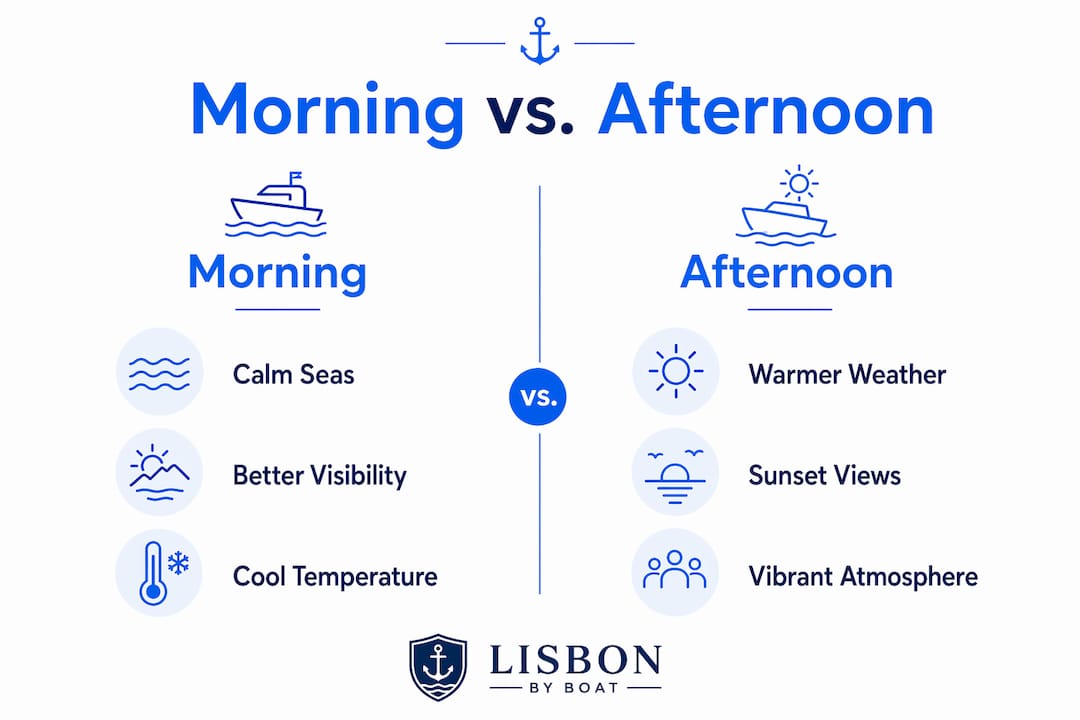
Afternoon departures, by contrast, create a social, celebratory atmosphere. The light is warmer, sunset views from the water are spectacular near the Belém Tower and the 25 de Abril Bridge, and guests arrive already energized from the day. For corporate events, bachelorette parties, or any occasion where mood matters more than water clarity, the afternoon window from 3 p.m. to 7 p.m. is consistently the stronger choice.
Key timing considerations at a glance:
Morning (9 a.m. to 1 p.m.): Calmer water, ideal for snorkeling and swimming, better light for photography
Afternoon (2 p.m. to 6 p.m.): Social energy, golden-hour light, sunset views over Lisbon
Weather buffer: Always build 30 minutes of flexibility into the schedule for boarding and safety briefings
Season factor: Lisbon’s summer afternoons bring reliable Atlantic breezes, which sailors love but can unsettle guests prone to motion sickness
What vessel type fits your group and event?
Vessel type drastically influences the atmosphere, comfort level, and suitability for different group types. Choosing the wrong boat is one of the most common and most avoidable mistakes in private cruise planning. The three main options for half-day yacht charters in Lisbon are sailing yachts, catamarans, and motorboats, and each serves a distinct purpose.
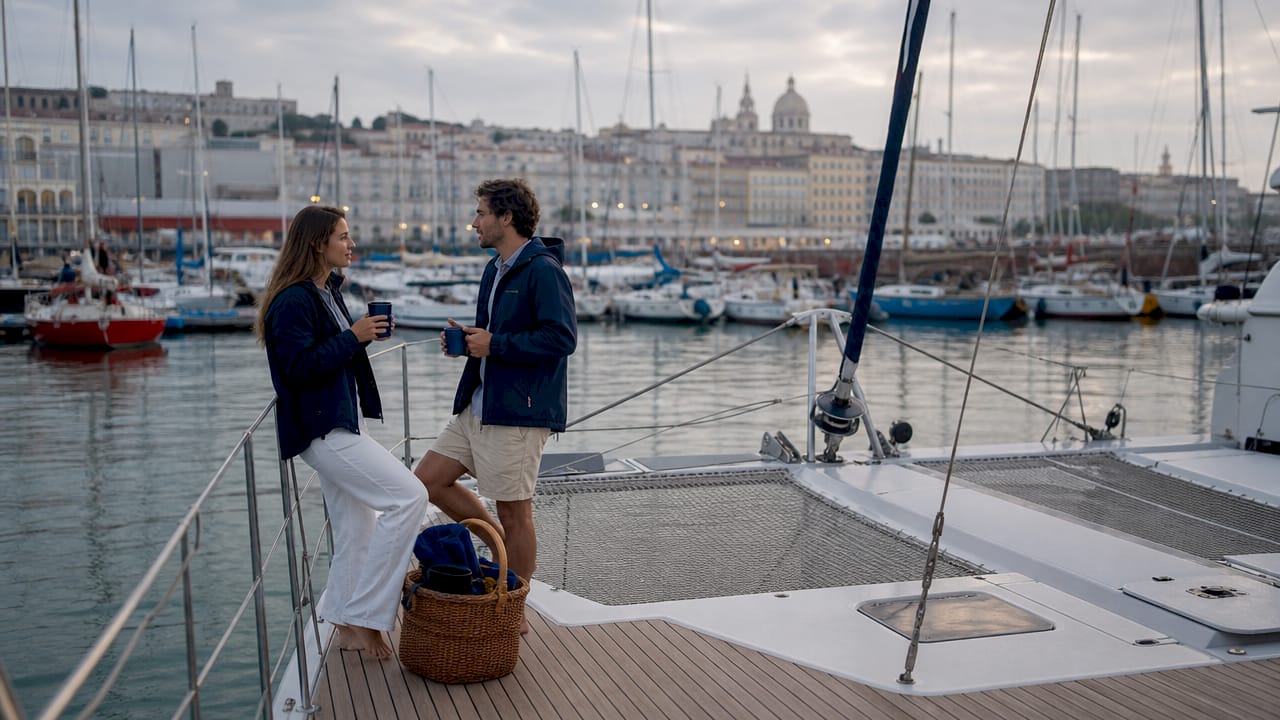
Most half-day charters comfortably accommodate 2 to 12 guests, with some larger vessels handling up to 20. Smaller groups consistently report higher satisfaction because there is more space per person, the crew can give individual attention, and the boat feels exclusive rather than crowded. For corporate groups above 15 people, a catamaran is almost always the right answer.
Vessel type | Best for | Capacity range | Key advantage |
Sailing yacht | Couples, small groups, relaxation | 2 to 8 guests | Authentic sailing experience, quieter |
Catamaran | Larger groups, stability seekers | 8 to 20 guests | Wide deck space, minimal rocking |
Motorboat | Active groups, fast transfers | 4 to 12 guests | Speed, flexibility, access to shallow areas |
Catamarans offer stability and generous deck space, which matters enormously for guests who are not regular sailors. A catamaran’s twin-hull design reduces side-to-side motion, making it the safest choice for groups with mixed sea experience. Sailing yachts deliver a more authentic, quieter experience that suits couples or small groups who want the feeling of the wind rather than the hum of an engine.
Crew reputation and vessel layout matter more than glossy photos when selecting a provider. A well-maintained 30-foot sailing yacht with an experienced skipper will outperform a newer, larger boat with an indifferent crew every time. When evaluating options on Lisbonbyboat or any charter platform, ask specifically about the skipper’s local knowledge of the Tagus and the Atlantic coast near Cascais and Setúbal.
Pro Tip: Ask the operator for the vessel’s actual guest-to-deck-space ratio, not just the maximum capacity. A boat rated for 12 guests that comfortably seats 8 for dining will feel very different from one designed with 12 in mind.
You can compare yacht and catamaran options in detail to match your group’s priorities before committing to a booking.
How to design an itinerary for a half-day private cruise
Clear event objectives are the foundation of every successful itinerary. Before you plan a single stop, answer one question: is this trip about relaxation, sightseeing, celebration, or team building? The answer determines your route, your activity mix, your catering choices, and your departure time. Trying to accomplish all four in four hours produces a trip that does none of them well.
A practical itinerary for a four-hour private boat tour in Lisbon follows this sequence:
Boarding and briefing (0:00 to 0:30): Guests arrive, safety briefing is completed, drinks are served, and the skipper reviews the plan. This time is rarely wasted because guests are still orienting themselves.
Transit to first destination (0:30 to 1:00): Use this leg for sightseeing. Passing Belém Tower, the Jerónimos Monastery waterfront, and the 25 de Abril Bridge gives guests iconic Lisbon views without burning activity time.
Primary activity (1:00 to 2:30): This is the core of the trip. For relaxation-focused groups, anchor in a calm bay and let guests swim or sunbathe. For corporate events, this window works well for structured activities or catered dining at anchor.
Secondary activity or scenic return (2:30 to 3:30): A second stop or a scenic return route keeps energy up. Sunset chasers should plan the return leg to coincide with golden hour over the city.
Return and disembarkation (3:30 to 4:00): Build this buffer in. Docking, unloading, and farewells always take longer than expected, and a rushed ending undercuts an otherwise excellent trip.
The biggest itinerary mistake is overloading the schedule. Two well-executed stops beat four rushed ones. Work with your skipper to identify one or two anchor points that match your group’s energy, and leave the rest of the route flexible. Treating your skipper as a local guide who adjusts plans based on wind, current, and group mood produces far better outcomes than handing over a rigid minute-by-minute schedule.
For themed events or special occasions, Lisbonbyboat’s guide on themed events on sailing boats offers specific ideas that translate well to half-day formats.
Managing guest experience and logistics on the day
Smooth logistics are invisible to guests. They only notice when something goes wrong. The following areas require deliberate attention before and during any custom half-day cruise.
Capacity discipline: Never book to the vessel’s legal maximum. A boat certified for 12 passengers is comfortable for 8 to 10. The extra space pays dividends in guest satisfaction, especially during meals or when guests want to move around.
Catering timing: For a four-hour trip, one substantial snack service and a drinks package is the right scale. A full sit-down meal works only if the vessel has a dedicated dining area and the itinerary includes at least 45 minutes at anchor.
Safety and weather policy: Verify weather-related refund and itinerary change policies before signing any charter agreement. Operators handle weather differently, and assuming automatic refunds is a common source of conflict. Lisbon’s Atlantic exposure means conditions can shift quickly, particularly in spring and autumn.
Communication with the crew: Brief the skipper on any guests with mobility limitations, seasickness concerns, or dietary restrictions before departure. This information changes seating arrangements, route choices, and catering logistics in ways that matter.
Corporate event specifics: For team-building outings, assign one point-of-contact from your organization to liaise with the crew. This prevents the skipper from fielding 15 different requests simultaneously and keeps the group coordinated. Lisbonbyboat’s resource on keeping teams motivated covers this dynamic in practical detail.
For groups celebrating special occasions, the logistics shift slightly. Decorations, surprise elements, and custom catering all require advance coordination with the operator, typically 48 to 72 hours before departure.
Key takeaways
Structuring a half-day private cruise requires aligning vessel type, departure timing, itinerary design, and guest logistics into a single coherent plan before anyone steps on board.
Point | Details |
Four hours is the standard | A four-hour charter balances transit, activity time, and guest energy without requiring full-day catering or budget. |
Match vessel to group size | Book below maximum capacity; catamarans suit larger groups, sailing yachts suit intimate outings. |
Set one clear objective | Decide between relaxation, sightseeing, or celebration first, then build the itinerary around that single goal. |
Use the skipper as a guide | Experienced skippers adjust routes in real time based on weather and group mood, improving outcomes significantly. |
Verify weather policies early | Confirm refund and rerouting terms before signing; Lisbon’s Atlantic conditions can change faster than guests expect. |
What I’ve learned from years on the Tagus
The most consistent mistake I see in private cruise planning is treating the itinerary as a contract rather than a starting point. Planners spend weeks perfecting a minute-by-minute schedule, then feel frustrated when the skipper suggests skipping a stop because the wind has picked up. That frustration is misplaced. The skipper’s local knowledge is the most valuable thing you are paying for, and overriding it to stick to a printed plan is how good trips become mediocre ones.
The second pattern I notice is underestimating how much guests value doing nothing. Corporate planners especially tend to fill every minute with structured activities, worried that idle time reads as poor planning. On the water, the opposite is true. Thirty minutes anchored in a calm bay with cold drinks and a view of the Serra de Sintra coastline creates more genuine connection than any facilitated exercise. The boat does the work. Your job is to get out of the way.
Lisbon’s geography makes it genuinely exceptional for half-day private boat tours. The Tagus estuary gives you protected, calm water for the first leg, and the Atlantic opens up just past the Belém Tower for guests who want open-sea sailing. Few European capitals offer that combination within a four-hour window. The private cruise experience in Lisbon is distinct precisely because the city’s history and its waterfront are inseparable.
— Lisbon
Plan your half-day private cruise with Lisbonbyboat
Lisbonbyboat offers sailing yachts and catamarans for private half-day charters along the Lisbon coastline, with itineraries customized to your group size, event type, and preferred departure time. Every booking includes an experienced skipper who knows the Tagus and the Atlantic approaches well enough to adapt your route in real time.
Whether you are organizing a corporate outing for 15 colleagues or a private celebration for six friends, the team at Lisbonbyboat handles vessel selection, catering coordination, and route planning. Browse the full range of luxury yachts in Lisbon to find the right vessel for your group, or explore the charter yacht options for a full overview of available formats and durations. Book early for summer and holiday dates, as the best vessels fill weeks in advance.
FAQ
What is the standard duration for a half-day private charter?
Half-day private charters typically last four hours, though durations range from three to six hours depending on the operator and destination. Four hours is the most common format because it balances travel time, activity time, and guest energy.
How many guests fit comfortably on a half-day charter?
Most half-day charters accommodate 2 to 12 guests comfortably, with some larger vessels handling up to 20. Booking below the vessel’s maximum capacity consistently improves guest comfort and satisfaction.
Should I choose a morning or afternoon departure in Lisbon?
Morning departures offer calmer water and better conditions for swimming or snorkeling, while afternoon departures suit celebrations and sunset views. The right choice depends on whether your priority is activity quality or social atmosphere.
What vessel type is best for a corporate group?
A catamaran is the strongest choice for corporate groups because its wide deck and stable twin-hull design accommodate larger numbers comfortably. Sailing yachts work better for smaller, more intimate groups where the sailing experience itself is part of the appeal.
Do I need to worry about weather cancellations?
Weather policies vary by operator, and refunds or route changes due to conditions are not always automatic. Always confirm the charter company’s weather policy in writing before booking to avoid surprises on the day.
Recommended
Comments