

Sailing Tour Accessibility: What Travelers Must Know
TL;DR:
Accessible sailing in Lisbon often lacks standardized definitions, requiring travelers to verify specific features such as doorway widths, ramp grades, and restroom accommodations before booking. True accessibility involves evaluating dock, internal, and restroom access separately, while adaptive programs enable active participation through specialized equipment and modifications. Advanced planning, direct communication, and understanding vessel types are essential to ensure a genuinely inclusive experience on Lisbon’s waters.
Planning a sailing tour in Lisbon sounds straightforward until you realize that sailing tour accessibility means something different to almost every operator you contact. The word “accessible” appears in marketing copy constantly, but it carries no legal or technical standard in the nautical tourism world. For travelers with mobility needs, that gap between promise and reality can turn an anticipated adventure into a frustrating dead end. This guide cuts through the vague language, gives you the exact questions to ask, and explains what genuine accessibility looks like on the water in Lisbon.
Table of Contents
Key Takeaways
Point | Details |
“Accessible” has no standard definition | Always verify specific features like ramp grades, doorway widths, and restroom specs before booking. |
Call operators 4 to 6 weeks ahead | Confirm every detail in writing. Online listings alone are not enough to ensure your needs are met. |
Tender transfers are a hidden barrier | Shore access via smaller tender boats can block wheelchair users even when the main vessel is accessible. |
Adaptive programs go beyond access | Specialized equipment like remote steering enables active participation, not just passive presence on deck. |
Lisbon’s marina infrastructure varies | Some docks offer level boarding; others require step negotiation. Verify the specific marina before you commit. |
Sailing tour accessibility: what it actually means
The phrase “accessible sailing” gets used loosely. Some operators mean there is a ramp to get on board. Others mean the restroom has a grab bar. Very few mean a fully roll-in shower, step-free routes across every deck, and widened doorways throughout. Research shows that 80 to 90% of sailing vessels lack full roll-in shower access or step-free routes across decks, which means most “accessible” labels are only partially true.
True boat tours accessibility breaks into three distinct categories that need to be evaluated separately. Dock access covers whether you can board the vessel without climbing steps or crossing unstable gaps. Internal mobility covers whether you can move between cabin, deck, and restroom once on board. Restroom usability covers whether the facilities physically accommodate your equipment and needs. Accessibility means different things depending on which part of the vessel experience you are evaluating.
Common barriers that rarely appear in marketing materials include:
Tender transfers: Reaching some shoreside locations requires boarding a smaller tender boat. These boats often have gaps of 1 to 3 feet between the vessel and the dock, with unstable platforms that challenge wheelchair users significantly.
Narrow doorways: Many sailing yachts have interior doorways under 28 inches wide, which is too narrow for most power wheelchairs.
Steep companionways: The below-deck passages on sailing vessels are often steep ladder-style stairways, not gradual ramps.
Lack of adapted restrooms: A restroom labeled “accessible” may only mean it has a fold-down grab rail, not a roll-under sink or turning radius.
Pro Tip: When you contact an operator, ask for the exact doorway width in inches, the ramp grade as a percentage, whether the restroom has a roll-in shower or a lip, and whether any part of the tour requires a tender transfer. If they cannot answer those questions with specifics, treat that as a red flag.
Adaptive sailing programs and inclusive options
Adaptive sailing programs represent a fundamentally different category from standard commercial tours. Where a commercial accessible sailing trip focuses on removing barriers so a passenger can ride along, adaptive programs focus on enabling active participation. The biggest hurdle in accessible sailing is often not the disability itself but the absence of adaptive equipment at commercial operators.
Organizations focused on inclusive sailing experiences use tools like:
Remote-controlled steering rudders: Allow sailors with limited grip strength or motor control to actively steer the vessel.
Specialized seating systems: Provide lateral support and positioning for sailors who cannot maintain balance on a moving deck.
Modified rope systems: Replace standard lines with hand-controlled alternatives that require less grip and upper body force.
Lower center of gravity hulls: Designed for stability, reducing the risk of capsizing in boats adapted for participants with physical disabilities.
Programs like Chesapeake Region Accessible Boating operate on donation-based models, pairing adaptive equipment with volunteer-led community experiences. These programs produce results that go well beyond the physical act of sailing. Participants report improved autonomy and stronger social connections through involvement in adaptive sailing.
“Adaptive sailing does not just move people around the water. It gives people agency over where they go and how they get there. That distinction changes everything.”
For travelers visiting Lisbon, it is worth contacting local sailing clubs in advance to ask whether they partner with any adaptive sailing program, or whether they can accommodate requests for specialized seating or adapted controls on a private charter.
How to verify and book accessible sailing tours
The most common mistake travelers make when booking accessible sailing trips is relying entirely on what a website says. Booking only online is insufficient. Direct communication that requests exact measurements and standards is the only way to confirm whether a tour genuinely fits your needs.
Here is a practical step-by-step process:
Start 4 to 6 weeks before your travel date. Experts recommend calling operators well in advance to confirm details like doorway widths and lift availability. Last-minute requests rarely get accommodated well.
Ask for written confirmation of every feature. Email or written records protect you if the experience does not match what was promised. Verbal assurances alone are not enough.
Request specific measurements. Doorway widths, turning radius space in the restroom, ramp grade percentages, and step heights are the numbers that determine whether your equipment fits.
Ask directly about tender transfers. Tender ports use smaller boats that often lack lifts or ramps. If any part of your tour requires a tender, ask whether accessible alternatives exist for shore access.
Check whether crew members are trained in mobility assistance. A physically accessible boat still requires crew who know how to assist safely without making assumptions or creating risk.
Review cancellation and modification policies. If you arrive and the promised access does not exist, you need to know what your options are in writing.
Pro Tip: Disability travel advocacy organizations and specialized accessible travel agents maintain vetted lists of genuinely accessible operators. Using one of these resources can save hours of research and prevent unpleasant surprises on the day of your tour. For a detailed breakdown of what to verify, the Lisbon boat accessibility guide is a strong starting point.
Lisbon’s sailing tour environment and accessibility
Lisbon sits along the Tagus River estuary, and its nautical tourism operates across several distinct marinas and dock areas. Not all of them are equal from an accessibility standpoint. Local hospitality guides recommend verifying dock and onboard access well ahead of booking because infrastructure varies meaningfully from one location to another.
The table below gives a practical overview of the key accessibility factors specific to Lisbon’s sailing context:
Factor | What to check | Why it matters |
Dock surface | Level boarding ramp vs. steps | Some Lisbon docks require step negotiation at the gangway |
Tender requirement | Is any portion of the tour tender-based? | Tender gaps of 1 to 3 feet can block wheelchair access entirely |
Marina terrain | Cobblestone vs. smooth surface around the dock | Getting to the dock itself can be a barrier in older Lisbon areas |
Onshore activity | Post-sailing walking routes | Many of Lisbon’s waterfront areas are historically cobbled and uneven |
Operator knowledge | Crew training in mobility assistance | An accessible vessel is only as good as the people operating it |
Lisbon has made improvements to waterfront accessibility in recent years, particularly around the Belém and Parque das Nações areas. That said, older dock areas retain the uneven stone surfaces characteristic of the city’s historic port. If you plan to extend your day beyond the boat, always scope out the surrounding terrain as part of your planning.
For building a personalized itinerary that accounts for these factors, the guide to crafting an accessible Lisbon itinerary walks through the practical details of combining sailing with accessible onshore options.
Comparing vessel types for accessibility
Different boat types offer very different levels of natural accessibility. The structure of the vessel itself, before any adaptation, determines how much modification is realistically possible.
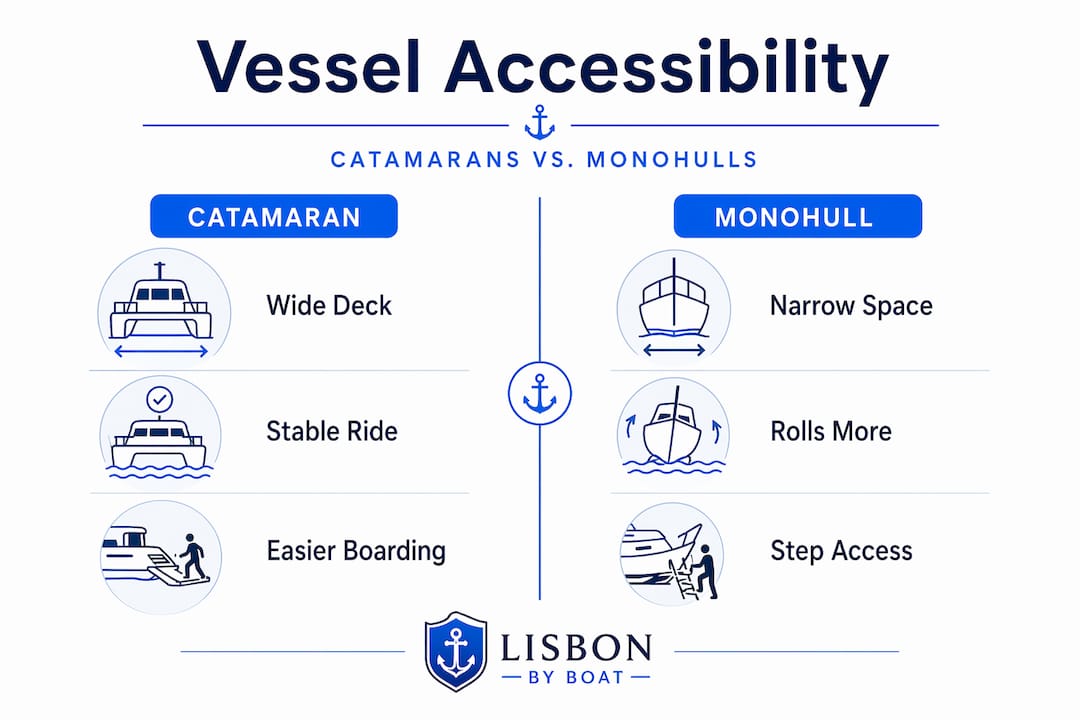
Vessel type | Deck space | Restroom access | Boarding ease | Stability | Best for |
Catamaran | Wide, open deck | Usually easier to fit | Lower freeboard helps | High | Wheelchair users, families |
Motor yacht | Variable | Often tight | Depends on dock setup | High | Guests with limited mobility but no chair |
Sailing yacht | Narrower deck | Usually restricted | Companionway steep | Moderate | Ambulatory guests with some limitations |
Small tour boat | Very limited | Rarely adequate | Often step-based | Low | Not recommended for significant mobility needs |
Catamarans consistently rank as the most accessible yacht charters for guests with significant mobility needs. Their wide beam and low freeboard make boarding easier, and their deck space allows for wheelchair movement. Sailing yachts vary widely. Only about 2 to 4% of vessels in most fleets are designed with full accessibility in mind, so checking the specific boat, not just the operator’s general reputation, is critical.
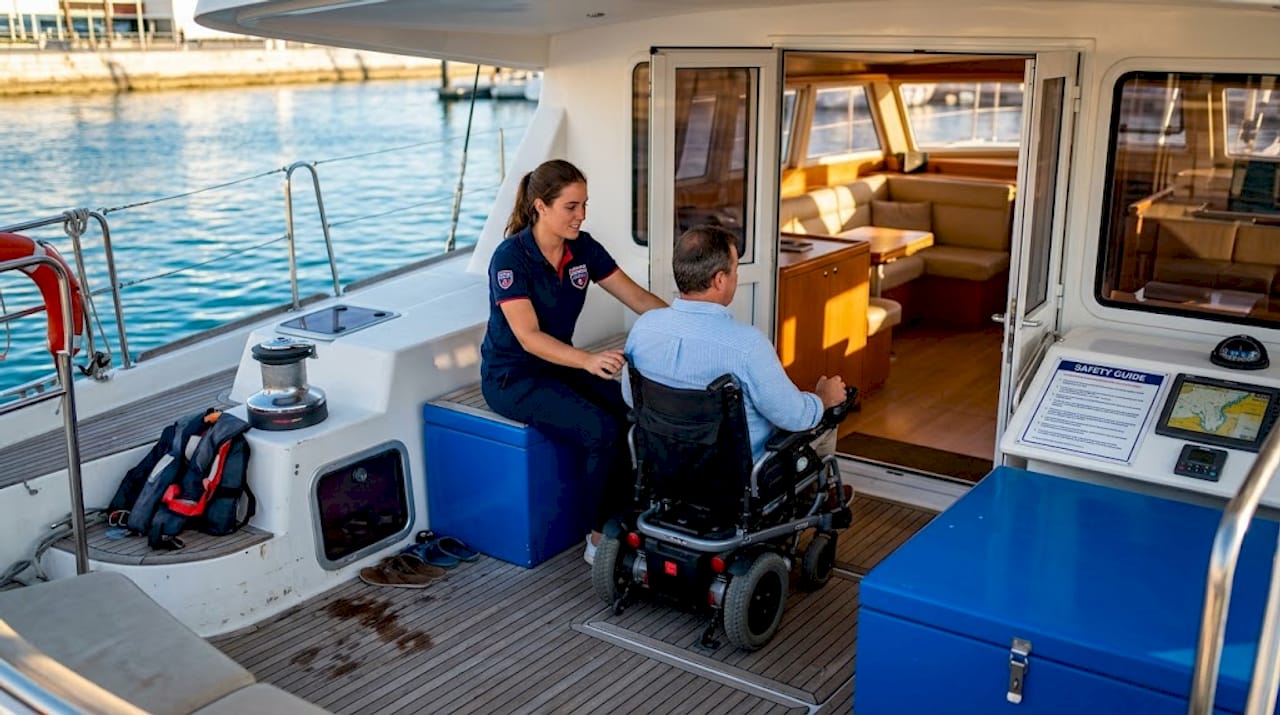
For travelers using mobility equipment, the inclusive sailing options in Lisbon resource provides a clear breakdown of which vessel types work best for different mobility profiles.
My honest take on navigating accessibility claims
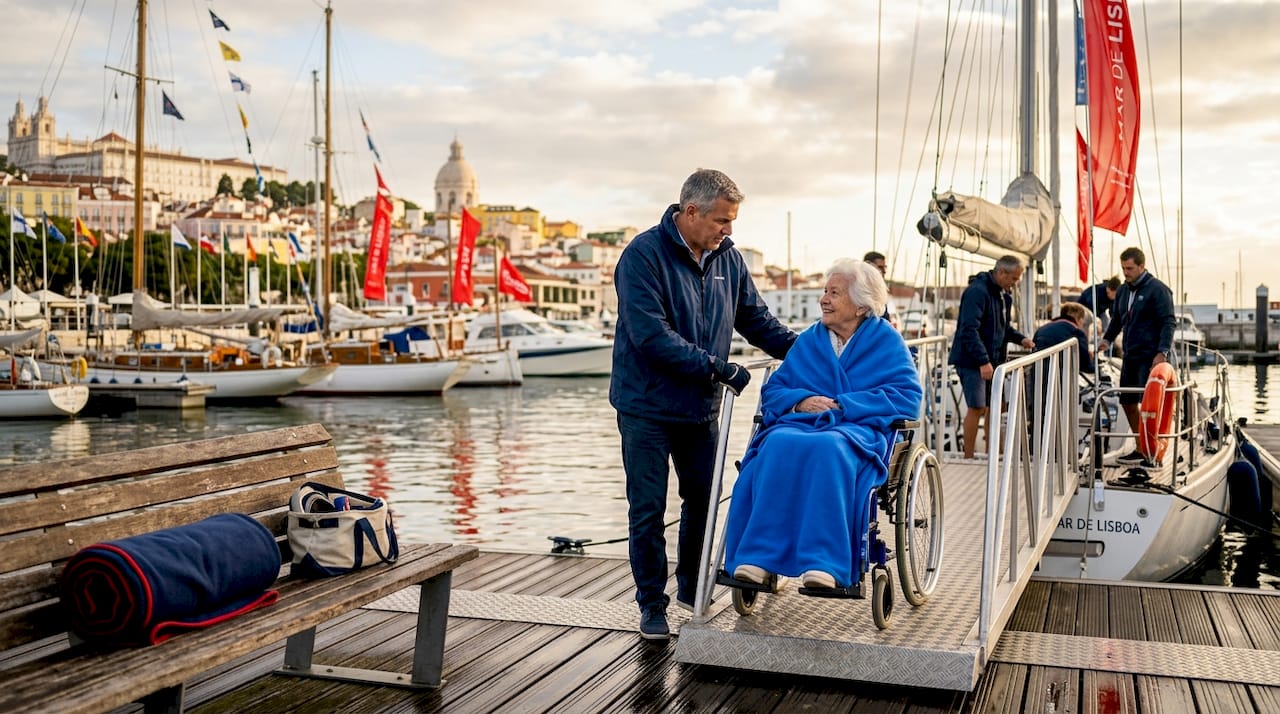
I’ve spent considerable time talking with travelers who came to Lisbon expecting one thing and got another. The pattern repeats itself. Someone books a tour marketed as “wheelchair-friendly,” arrives at the dock, and discovers that friendly means there’s a handrail on the gangway. That’s it.
What I’ve learned is that the emotional stakes here are higher than most operators realize. For many travelers, a sailing tour is not just a nice activity. It’s the thing they’ve been looking forward to for months, the experience they planned their entire trip around. When it falls apart at the dock because of an undisclosed step, the disappointment runs deep.
My honest advice: adaptive sailing programs that use specialized equipment are genuinely worth seeking out even if they require more planning, because they center participation rather than just tolerance. Commercial tours that advertise accessibility are worth pursuing too, but only after you’ve asked the specific questions outlined in this article and received written answers.
The social and community value of sailing with others who understand your needs is something no amount of grab rails can replace. Prioritize operators who treat your questions as normal and expected, not as a special burden. That attitude, more than any single physical feature, predicts whether your experience will be genuinely inclusive.
— Lisbon
Sail with Lisbonbyboat: accessible tours worth booking
Lisbonbyboat offers daily 2-hour sailing tours along Lisbon’s historic coastline, with options ranging from shared group tours to fully private yacht charters on sailing yachts and catamarans. Private charters allow you to customize every aspect of your experience, including boarding arrangements, pace, and route, giving travelers with mobility needs a level of control that shared tours rarely provide.
For travelers seeking the most accessible yacht charters available in Lisbon, Lisbonbyboat’s luxury yacht options include catamarans well-suited to guests with mobility equipment. Lisbonbyboat’s knowledgeable guides explain Lisbon’s major monuments and sights along the route, and private bookings can be arranged with customized accessibility requirements discussed in advance. Contact Lisbonbyboat directly to confirm which vessel and dock configuration best fits your specific needs before you arrive.
FAQ
What does “accessible sailing tour” actually mean?
There is no universal standard for this term. Accessibility without a standard means operators define it themselves, so travelers must verify exact features like ramp grades, doorway widths, and restroom specs before booking.
Which boat type is best for wheelchair users in Lisbon?
Catamarans are generally the best option for wheelchair users because of their wide deck space, lower boarding height, and greater stability compared to monohull sailing yachts.
How far in advance should I book an accessible sailing tour?
Contact operators at least 4 to 6 weeks before your travel date to confirm specific accessibility features in writing and to allow time for any necessary arrangements or vessel substitutions.
What is a tender transfer and why does it matter?
A tender transfer means you board a smaller secondary boat to reach shore or the main vessel. Tender transfers pose significant barriers for wheelchair users because these smaller boats rarely have lifts or ramps, and boarding gaps can be 1 to 3 feet wide.
Can people with significant mobility limitations actively sail, not just ride along?
Yes. Adaptive sailing programs use remote-controlled steering equipment and modified controls to enable people with limited motor skills to actively steer and participate, not just observe from a seat.
Recommended
Comments