

Lisbon Sailing Routes Guide for 2026 Explorers
TL;DR:
Lisbon offers diverse coastal sailing routes suitable for all skill levels, with wind and tidal conditions influencing passage timing. Key routes include Cascais for beginners, Arrábida for experienced crews, and Berlengas for offshore adventures, each featuring unique attractions. Successful sailing from Lisbon depends on thorough planning, vessel choice, weather awareness, and local expertise to ensure safe, rewarding experiences.
A sailing routes guide defines the recommended navigational courses along coastal and maritime waters that help sailors move safely, efficiently, and memorably from one destination to the next. Lisbon sits at one of Europe’s most compelling sailing departure points, where the Tagus River meets the Atlantic Ocean and centuries of maritime history frame every passage. From the sheltered estuary to the wild Arrábida coastline and the remote Berlengas Archipelago, the sailing routes from Lisbon offer a range of experiences that suit beginners on catamarans and seasoned sailors on offshore monohulls alike.
What are the most popular sailing routes departing from Lisbon?
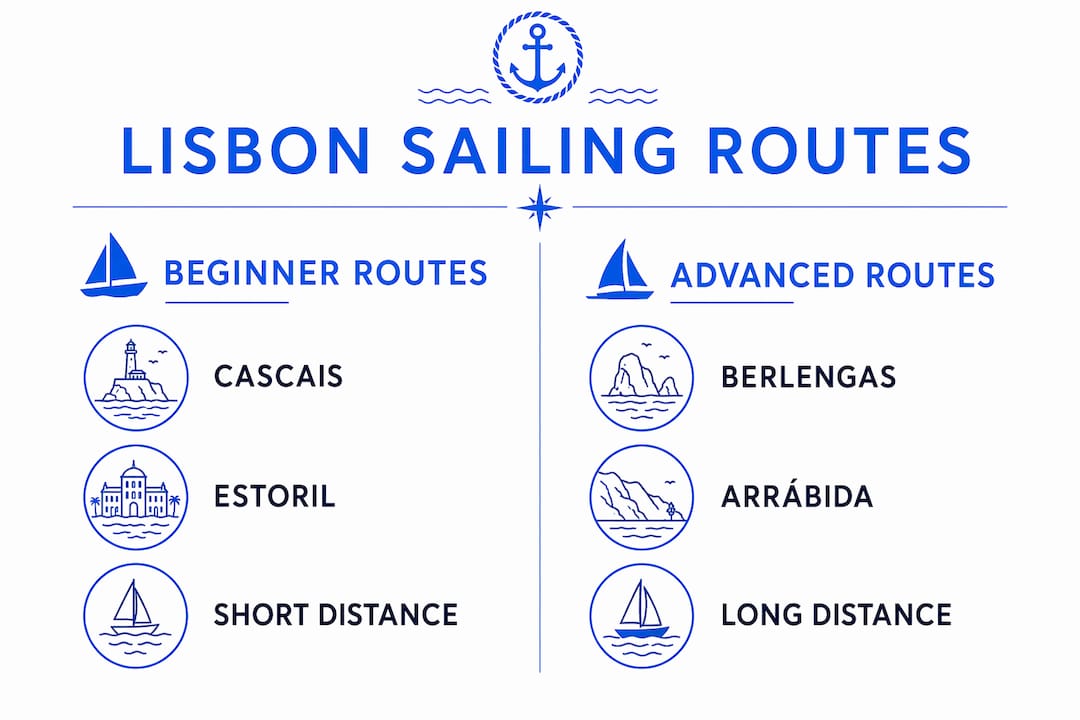
Lisbon’s geography creates a natural launching pad for four distinct coastal sailing routes, each with its own character, difficulty level, and reward.
Lisbon to Cascais and Estoril is the most accessible route for first-time sailors and those on shorter charters. The passage runs approximately 17 nautical miles westward along the northern bank of the Tagus estuary and into the open Atlantic. Cascais Marina is a well-equipped facility with berths for vessels of all sizes, and the town itself offers excellent dining and the historic Cidadela fortress. Sailing time is typically two to three hours, making it ideal for a half-day excursion or the first leg of a longer coastal itinerary.
Lisbon to Sesimbra and Arrábida takes sailors south across the Tagus and along the Setúbal Peninsula. The Arrábida Natural Park coastline is arguably the most visually dramatic sailing in the region, with limestone cliffs dropping into turquoise water and secluded coves that are unreachable by road. This route covers roughly 35 to 45 nautical miles depending on anchorage choices, and the sea conditions are more exposed than the Cascais run. Crew experience matters here, particularly when Atlantic swells push in from the southwest.
Lisbon to the Berlengas Archipelago is the offshore option. The Berlengas sit approximately 80 nautical miles north of Lisbon, requiring an overnight passage or an early start for a long day sail. The archipelago is a UNESCO Biosphere Reserve, and the anchorage off Berlenga Grande is one of the most spectacular in Portuguese waters. This route suits experienced sailors comfortable with open Atlantic conditions and passage planning.
Lisbon to Setúbal and the Sado Estuary offers a quieter, nature-focused alternative. The Sado Estuary is home to a resident bottlenose dolphin population, and the river passage to Setúbal combines wildlife watching with access to the Arrábida wine region. Distance from Lisbon is around 40 nautical miles.
Route | Distance | Difficulty | Key Attraction |
Lisbon to Cascais | ~17 NM | Beginner | Cascais Marina, Cidadela fortress |
Lisbon to Arrábida | ~35–45 NM | Intermediate | Limestone cliffs, secluded coves |
Lisbon to Berlengas | ~80 NM | Advanced | UNESCO Biosphere Reserve |
Lisbon to Sado Estuary | ~40 NM | Intermediate | Dolphin watching, Arrábida wine |
A standard multi-day sailing itinerary covers 120 to 160 nautical miles over seven days, averaging 15 to 25 NM daily. That pace translates to two to five hours of sailing per day, leaving afternoons free for swimming, exploring, and dining ashore.
How do seasonal weather patterns affect sailing routes from Lisbon?
Wind is the single most important variable in any sailing itinerary guide, and Lisbon’s wind patterns are distinctive enough to deserve serious attention before you leave the dock.
The dominant summer wind is the Nortada, a strong northerly thermal wind that builds through the afternoon along the Portuguese coast between June and September. The Nortada typically reaches 15 to 25 knots by early afternoon and can exceed 30 knots on exposed stretches north of the Tagus. For southbound routes toward Arrábida and Setúbal, this is a gift: you sail downwind in the afternoon and return upwind in the calmer morning hours. For northbound passages toward the Berlengas, the Nortada is a direct headwind and demands an early morning departure before it builds.
Spring and autumn offer the most balanced conditions. May through June and September through October deliver pleasant temperatures, moderate winds, and fewer crowds at marinas and anchorages. These months suit mixed-experience crews and family sailing trips particularly well. Winter sailing is possible but requires careful monitoring of Atlantic frontal systems, which bring strong westerly and southwesterly winds with little warning.
Sea breezes along the Arrábida coast create localized afternoon wind acceleration in the channels between headlands. Sailors unfamiliar with these effects sometimes find conditions more challenging than forecast models suggest. Consulting the Instituto Português do Mar e da Atmosfera (IPMA) for local marine forecasts is standard practice among experienced Lisbon sailors.
Pro Tip: Set your departure times based on the Nortada cycle, not convenience. Leave for northbound passages before 9 a.m. and plan southbound legs for early afternoon to use the wind rather than fight it.
What are key practical considerations when charting sailing routes from Lisbon?
Charting sailing routes from Lisbon requires decisions across four practical areas: marina logistics, provisioning, charter arrangements, and regulatory compliance.
Marina options and berth costs
Marina de Cascais and Doca de Belém in Lisbon are the two primary bases for charter departures. Marina de Cascais is larger, better equipped for offshore passages, and offers direct Atlantic access. Doca de Belém sits inside the Tagus estuary and suits day sails and river passages. Premium berths cost €80 to €150 per night for a 40-foot yacht, a figure consistent with comparable Portuguese marinas. Budget accordingly for a week-long itinerary, as marina fees alone can reach €700 to €1,000.
Popular marinas fill during peak season, and advance booking via VHF channel 9 or direct online reservation is strongly recommended from June through August. Arriving without a reservation in Cascais during July is a gamble that frequently results in anchoring outside the marina or motoring to an alternative berth.
Provisioning and supplies
Lisbon’s Mercado da Ribeira and the Pingo Doce supermarket chain near the marinas are the best provisioning stops before departure. Stock up the day before or early morning to avoid crowds and shortages, particularly for fresh produce and ice. Smaller ports like Sesimbra have limited provisioning options, so departing Lisbon with full stores is the right call for any multi-day route.
Charter and regulatory considerations
Bareboat charters in Portuguese waters require proof of sailing competence, typically an RYA Day Skipper certificate or equivalent. Skippered charters remove this requirement entirely and add the benefit of local knowledge. One-way charter relocation fees range from €200 to €500 depending on season and provider, a cost that must be factored into total trip budgets when planning non-circular itineraries.
Pro Tip: For first-time Lisbon sailors, a skippered catamaran charter removes both the licensing requirement and the learning curve on local tidal flows in the Tagus. It is the fastest path to actually enjoying the sailing rather than managing it.
How does vessel type affect your route choices around Lisbon?
The boat you sail determines which routes are practical, comfortable, and safe. Three vessel categories dominate Lisbon charter fleets: monohulls, catamarans, and motor yachts.
Monohulls between 38 and 50 feet are the standard offshore choice for routes to the Berlengas and Arrábida. They handle Atlantic swells well, point higher into the wind than catamarans, and berth easily in most Portuguese marinas. The trade-off is interior space: a week aboard a 42-foot monohull with four adults requires realistic expectations about comfort.
Catamarans between 40 and 50 feet offer significantly more living space and a stable platform for families and groups unfamiliar with offshore motion. Wind and crew skill level should guide vessel selection as much as budget. Catamarans are ideal for the Cascais and Sado Estuary routes but require wider berths, which limits marina options at smaller ports like Sesimbra.
Motor yachts suit travelers who prioritize destination over passage. They cover the Cascais run in under an hour and reach Arrábida in two, but they sacrifice the sailing experience that defines these coastal routes. For a coastal sailing adventure where the journey matters as much as the destination, a sailing vessel is the right choice.
Vessel Type | Best Routes | Crew Suitability | Marina Flexibility |
Monohull (38–50 ft) | Berlengas, Arrábida | Experienced sailors | High |
Catamaran (40–50 ft) | Cascais, Sado Estuary | Families, beginners | Moderate |
Motor Yacht | Cascais, day trips | Any | High |
What insider tips will improve your Lisbon coastal sailing experience?
Local knowledge separates a good sailing trip from a great one. These are the details that experienced Lisbon sailors know and first-timers typically learn the hard way.
The tidal flow in the Tagus estuary runs at up to four knots on spring tides. Timing your departure from Doca de Belém with an outgoing tide adds speed and reduces fuel consumption on motor-assisted passages. Arriving back against a flooding tide in the late afternoon can add 45 minutes to an otherwise straightforward return.
Professional captains who manage daily sailing rhythm using knowledge of regional thermal winds significantly improve the experience for everyone aboard. A skipper familiar with the Nortada cycle, the Tagus tidal gates, and the anchorage conditions at Portinho da Arrábida is worth more than any navigation app.
A few specific spots reward the effort of getting there:
Portinho da Arrábida: The most beautiful anchorage within a two-hour sail of Lisbon. Arrive before 11 a.m. in summer to secure a spot before the day-tripper boats arrive.
Lagoa de Albufeira: A sheltered lagoon south of Cascais accessible by dinghy, surrounded by pine forest and almost unknown to non-sailing visitors.
Berlenga Grande: The fortress of São João Baptista, visible from the anchorage, dates to the 17th century and can be visited by dinghy. The underwater visibility in the marine reserve reaches 20 meters on calm days.
Pro Tip: Combine a Sesimbra anchorage with dinner at one of the harbor-front seafood restaurants. Order the percebes (barnacles) and the grilled dourada (sea bream). Both are caught locally and served the same day.
Flexibility in adjusting routes due to changing weather conditions improves safety and satisfaction far more than rigid adherence to a planned itinerary. Build one or two buffer days into any multi-day sailing itinerary guide to absorb weather delays without stress.
Key takeaways
The best sailing routes from Lisbon combine the Nortada wind cycle, tidal timing in the Tagus, and vessel selection to deliver safe, rewarding passages to destinations that cannot be reached any other way.
Point | Details |
Route selection by skill level | Cascais suits beginners; Arrábida and Berlengas require intermediate to advanced experience. |
Seasonal timing matters | May to June and September to October offer the best wind, weather, and marina availability. |
Marina costs and booking | Budget €80 to €150 per night and book in advance during peak season to secure berths. |
Vessel choice shapes the trip | Catamarans favor families on sheltered routes; monohulls handle offshore passages better. |
Local expertise adds real value | A professional skipper familiar with Tagus tides and the Nortada transforms route planning. |
What sailing from Lisbon has taught me about planning
Most sailing itinerary guides treat route planning as a logistics problem. After multiple seasons sailing out of Lisbon, I’d argue it’s closer to a negotiation with the Atlantic. The Nortada does not care about your departure schedule. The Tagus tidal gate does not wait for late risers. The anchorage at Portinho da Arrábida fills by noon in July regardless of how good your intentions were.
The sailors who have the best experiences here are the ones who plan thoroughly and then hold their plans loosely. They know the distances, the marina contacts, and the provisioning stops. But they also know when to stay an extra night in Cascais because the swell is up, or to skip the Berlengas entirely and spend two days in the Sado Estuary instead. That flexibility is not a failure of planning. It is the plan working exactly as it should.
New sailors often underestimate how much Lisbon’s maritime geography rewards patience. The city’s coastline is not a backdrop. It is the destination. The Torre de Belém seen from the water at golden hour, the dolphins off the Sado, the silence of the Berlengas anchorage at dawn. These are not things you can rush toward. They arrive when the conditions are right and you are ready to receive them.
— Lisbon
Discover Lisbon’s coastline with Lisbonbyboat
Lisbonbyboat offers the most direct way to experience everything this sailing routes guide describes. Daily two-hour sailing tours depart from central Lisbon and cover the historic Tagus waterfront, with expert guides explaining the monuments and maritime history visible from the water. For travelers who want more time at sea, Lisbonbyboat’s luxury yacht charters include private catamarans and sailing yachts available from two hours to a full day, with experienced local crews who know every anchorage and tidal window along the coast. For a curated introduction to the region, the guided boat tours combine coastal exploration with the kind of local knowledge that no navigation app can replicate.
FAQ
What is the easiest sailing route from Lisbon for beginners?
The Lisbon to Cascais route covers approximately 17 nautical miles and takes two to three hours, making it the most accessible option for sailors with limited offshore experience. Cascais Marina provides full facilities and the passage stays close to shore throughout.
What is the best time of year to sail from Lisbon?
May through June and September through October offer the most favorable sailing conditions, with moderate winds, pleasant temperatures, and better marina availability than the peak summer months of July and August.
Do I need a sailing license to charter a boat in Lisbon?
Bareboat charters in Portuguese waters require a recognized sailing qualification such as an RYA Day Skipper certificate. Skippered charters through operators like Lisbonbyboat remove this requirement entirely.
How far in advance should I book a marina berth in Lisbon?
Advance booking is strongly recommended for peak season between June and August, as popular marinas including Cascais fill quickly. Booking two to four weeks ahead via VHF channel 9 or online reservation systems is standard practice.
Can families with children sail the Lisbon coastal routes?
The Cascais and Sado Estuary routes are well suited to family sailing trips on catamarans, offering stable platforms, short passages, and calm anchorages. The Berlengas route is better reserved for experienced adult crews given its offshore exposure.
Recommended
Comments