

Top 10 Historical Sites in Lisbon: What to See and How to Visit
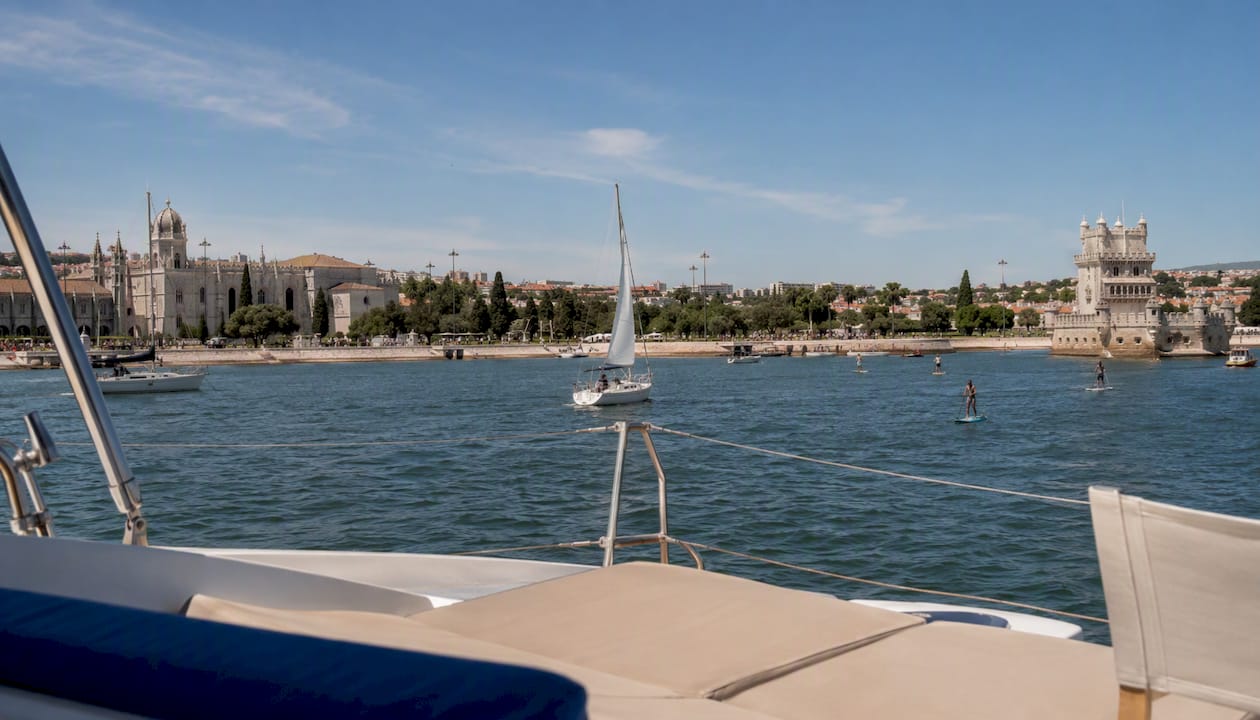
Lisbon packs more history per square mile than almost any European capital. Here are the ten historical sites worth prioritizing, with a quick reason and rough visit time for each:
São Jorge Castle — Moorish-era hilltop fortress with sweeping city views; allow a little over an hour to two hours.
Jerónimos Monastery — Portugal’s finest Manueline architecture, built to honor the Age of Discoveries. Allow 1–1.5 hours.
Belém Tower — 16th-century river fortress and UNESCO landmark. Allow about three quarters of an hour to an hour.
Lisbon Cathedral (Sé de Lisboa) — the city’s oldest building, dating to 1147, with Gothic and Romanesque layers. Allow about half an hour to three quarters of an hour.
Praça do Comércio — grand riverside square rebuilt after the 1755 earthquake. Allow about twenty to thirty minutes to walk and absorb.
Rossio (Praça Dom Pedro IV) — the city’s historic social center, framed by 19th-century fountains and the National Theatre. Allow about fifteen to twenty minutes.
Carmo Convent — ruined Gothic nave left open to the sky after the 1755 earthquake, now an archaeological museum. Allow about three quarters of an hour to an hour.
National Pantheon — baroque dome housing Portugal’s greatest figures. Allow about half an hour to three quarters of an hour.
Santa Justa Lift — 1902 iron elevator connecting the Baixa to the Chiado with rooftop views; allow 20–30 minutes.
São Vicente de Fora — 16th-century monastery and royal pantheon with exceptional azulejo tile galleries; allow about three quarters of an hour to an hour.
Key Takeaways
Lisbon’s most important historical sites cluster into three geographic groups — Belém, the Alfama, and the Baixa — and visiting them by group rather than by checklist is the single most effective way to make the most of limited time.
Point | Details |
Top priority sites | Jerónimos Monastery, Belém Tower, and São Jorge Castle are the three sites that most reward advance ticket booking. |
UNESCO in the city | Only Jerónimos Monastery and Belém Tower hold UNESCO World Heritage status within Lisbon proper, inscribed together in 1983. |
Best time to visit | Arrive at Belém before 10 AM; visit castle viewpoints in late afternoon for the best light over the city. |
Sintra is a full half-day | The train from Rossio takes about 40 minutes; plan at least a half-day and book Pena Palace tickets in advance. |
Lisbonbyboat river tours | A 2-hour Tagus sailing with Lisbonbyboat adds the maritime perspective that land visits alone cannot provide. |
Table of Contents
UNESCO heritage in and near Lisbon: what’s in the city and what’s a day trip
How to walk Lisbon’s history: three routes that tell the city’s story
Plan your visit: tickets, hours, itineraries, and getting around
Why seeing Lisbon’s monuments from the Tagus changes everything
Why the Alfama district is Lisbon’s most layered neighborhood
Lisbon’s most famous landmarks, site by site
The sites below are the ones that actually deliver on the promise of Lisbon’s layered past, from Moorish ramparts to Manueline stone lace to Pombaline grid streets. Each entry covers what to look for, why it matters, and what to know before you go.
Jerónimos Monastery (Mosteiro dos Jerónimos)
Commissioned by King Manuel I in the early 16th century, Jerónimos stands as the high-water mark of Manueline architecture. The style fuses Gothic structure with maritime motifs — ropes, coral, armillary spheres — carved into limestone with almost absurd precision. The two-story cloister is the centerpiece: walk it slowly and look up. The church holds the tombs of Vasco da Gama and Luís de Camões.
According to the monastery’s own history, it was founded by royal vow to give thanks for the voyages and to pray for sailors departing from the Tagus. That origin explains why it feels less like a church and more like a monument to ambition. Budget 1–1.5 hours. Tickets are required; book online in advance during April through October.
Accessibility note: The cloister ground floor is wheelchair accessible; upper galleries involve stairs.
Belém Tower (Torre de Belém)
Completed around 1514 by architect Francisco de Arruda, the tower served as a river defense post and a ceremonial gateway for ships leaving Lisbon. Its Manueline ornamentation — rhinoceros gargoyles, twisted rope stonework, the cross of the Order of Christ — makes it one of the most photographed structures in Portugal. The interior is narrow and the stairs are steep; the upper terrace view over the Tagus is the payoff.
Allow 45–60 minutes. Lines can be long by mid-morning; arrive before 9:30 AM or book tickets online.
Accessibility note: The tower’s spiral staircases are not wheelchair accessible beyond the ground floor.
São Jorge Castle (Castelo de São Jorge)
The castle’s hilltop site has been fortified since at least the 1st century BC, though the medieval layout visitors see today reflects 13th and 14th-century modifications under Portuguese and Moorish rulers. A major 20th-century restoration removed later additions to restore the medieval appearance. Don’t miss the periscope installed in 1999 inside one of the towers — it projects a live 360° panorama of the city onto a concave dish, and most visitors walk right past it.
Allow 1.5–2 hours. The grounds include a small archaeological museum and peacocks roaming the inner ward. Tickets required; combo passes with other Lisbon sites are sometimes available at the gate.
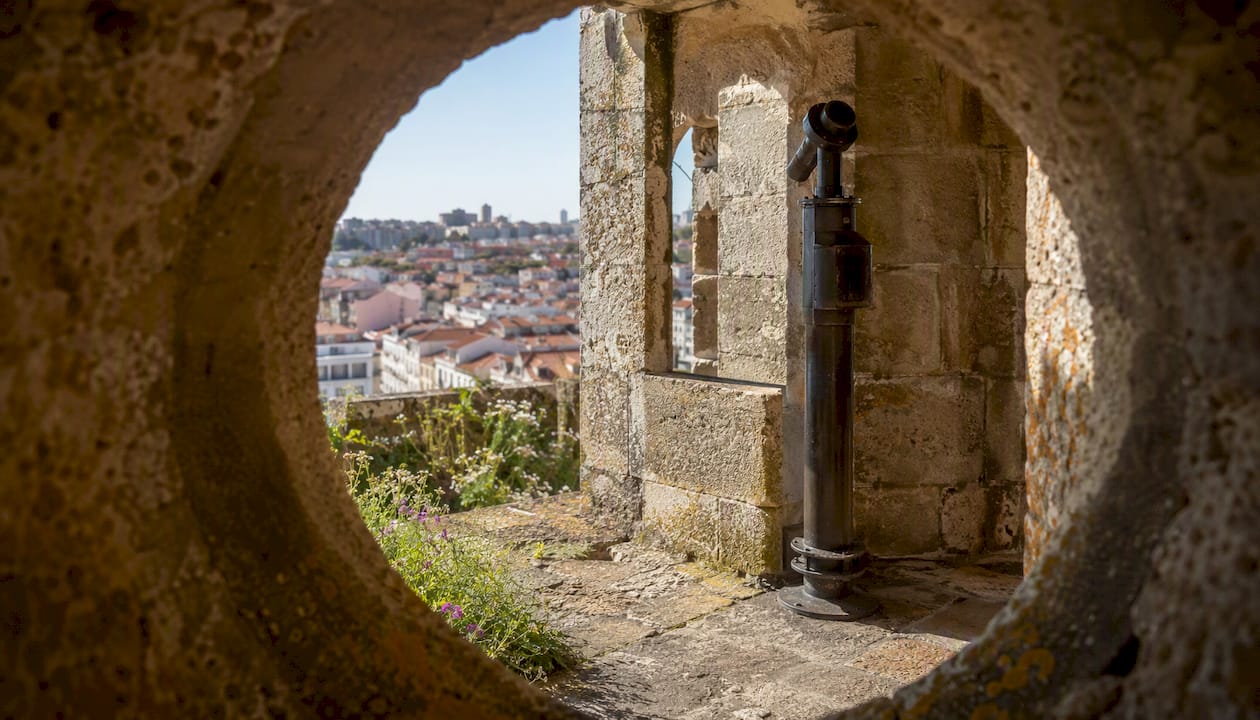
Accessibility note: The outer walls and main courtyard are accessible; some tower interiors involve steep stairs.
Lisbon Cathedral (Sé de Lisboa)
Construction began in 1147, making the Sé the oldest building in Lisbon. It was built on the site of a mosque shortly after Afonso Henriques captured the city from the Moors. Earthquakes and centuries of rebuilding left it with Romanesque towers, a Gothic ambulatory, and a Baroque sacristy — all visible in a single walk-through. The cloister holds ongoing archaeological excavations of Roman and Moorish layers beneath the floor.
Admission to the main nave is free; the cloister and treasury charge a small fee. Allow 30–45 minutes.
Praça do Comércio (Terreiro do Paço)
Rebuilt after the catastrophic 1755 earthquake as the centerpiece of the Marquis of Pombal’s urban renewal plan, Praça do Comércio is where Lisbon faces the Tagus. The equestrian statue of King José I dominates the center; the triumphal arch leads north into the Baixa grid. The square is free to enter and best appreciated early morning when the light off the river is flat and golden.
Rossio (Praça Dom Pedro IV)
Rossio has been Lisbon’s social hub since the Middle Ages. The current square features 19th-century wave-pattern cobblestones, two baroque fountains, and the National Theatre of Dona Maria II on the north side. It connects directly to the Baixa shopping streets and the Alfama tram lines. No ticket needed; it’s a natural pivot point for any city-center walking route.
Carmo Convent (Convento do Carmo)
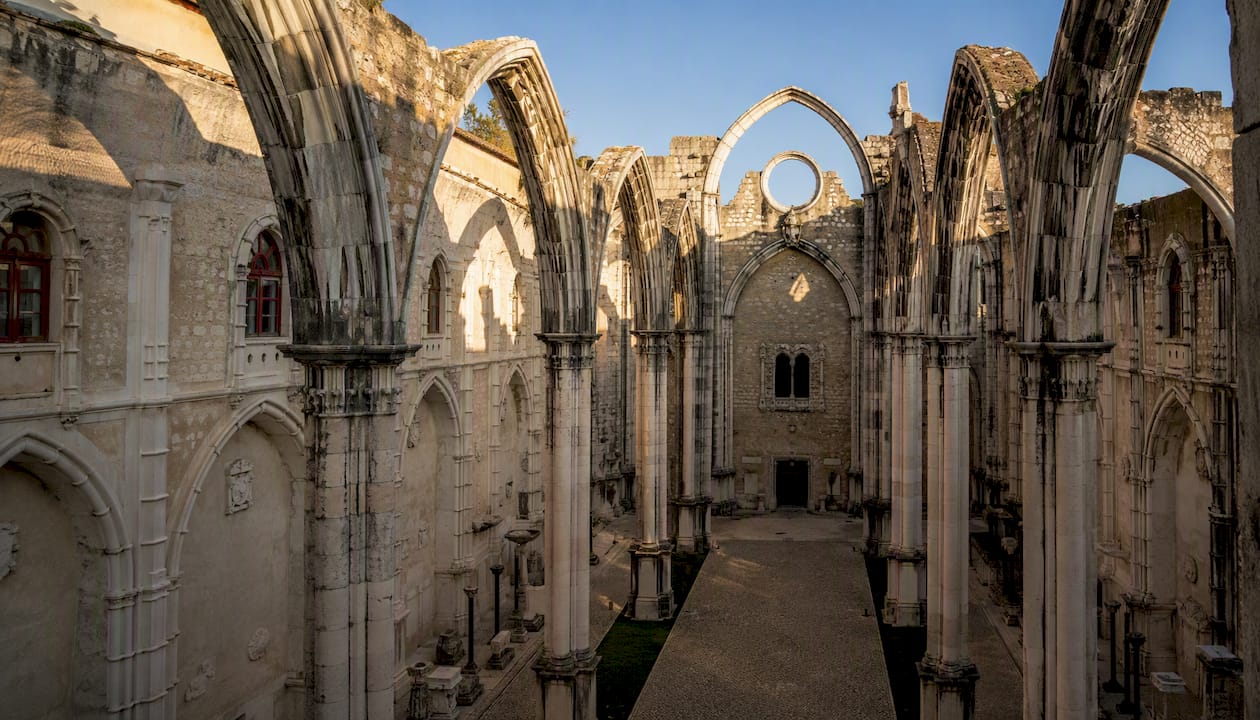
The Carmo Convent’s roofless Gothic nave is one of Lisbon’s most striking spaces. The 1755 earthquake brought down the roof and it was never rebuilt; the exposed arches now frame the sky above an archaeological museum with Egyptian mummies, Peruvian mummies, and medieval stonework. It’s an unusual combination that works. Allow 45–60 minutes; tickets are modest and rarely require advance booking.
National Pantheon (Panteão Nacional)
Originally built as the Church of Santa Engrácia, construction dragged on for nearly three centuries before it was repurposed as the National Pantheon in 1966. The baroque dome and white marble interior hold the cenotaphs of Vasco da Gama, Luís de Camões, and Amália Rodrigues, among others. The rooftop terrace offers one of the best views over the Alfama rooftops and the Tagus. Allow 30–45 minutes.
Santa Justa Lift (Elevador de Santa Justa)
Designed by Raoul Mesnier du Ponsard and opened in 1902, the Santa Justa Lift is a wrought-iron structure that connects the Baixa to the Chiado neighborhood above. The top platform connects via a walkway to the ruins of the Carmo Convent. Lines are long during peak hours; go before 9 AM or after 5 PM. Allow 20–30 minutes including the rooftop view.
São Vicente de Fora
Built in the late 16th century under King Philip I of Portugal, São Vicente de Fora is less visited than the Belém sites but equally rewarding. The azulejo tile galleries on the upper floor depict scenes from La Fontaine’s fables in 18th-century blue-and-white tiles. The monastery also serves as the royal pantheon of the House of Braganza. Allow 45–60 minutes.
Monument to the Discoveries (Padrão dos Descobrimentos)
Built in 1960 to mark the 500th anniversary of Henry the Navigator’s death, the Padrão dos Descobrimentos stands on the Tagus riverbank in Belém. The 52-meter limestone prow-shaped structure carries 33 figures from Portugal’s Age of Discovery. The interior elevator reaches a rooftop platform with direct views of the Belém Tower and the Tagus. Allow 30–45 minutes.
Site reference table:
Pro Tip: Book Jerónimos Monastery and Belém Tower tickets together online at least 48 hours ahead during high season (April through October). Both sites sell out their timed-entry slots by mid-morning on busy days, and the combined ticket saves time at the gate.
UNESCO heritage in and near Lisbon: what’s in the city and what’s a day trip
Lisbon’s only in-city UNESCO World Heritage sites are the Jerónimos Monastery and Belém Tower, inscribed in 1983 as a serial property. UNESCO recognized them jointly for their 15th and 16th-century association with the Age of Discoveries — two monuments that bookend the same stretch of Tagus riverbank and tell the same story from different angles.
Everything else in the region requires leaving the city:
Sintra Cultural Landscape (UNESCO, inscribed 1995): Pena Palace, Quinta da Regaleira, the Moorish Castle, and the National Palace of Sintra all sit within a short distance of each other in the Sintra hills. Trains from Rossio station run frequently and take about 40 minutes. Plan a full half-day minimum; a full day is better if you want to visit more than two sites.
Monastery of Alcobaça (UNESCO, inscribed 1989): About 80 miles north of Lisbon, this is a longer day trip, best combined with Batalha Monastery and Nazaré for a full northern day.
Monastery of Batalha (UNESCO, inscribed 1983): Similar distance to Alcobaça; works as a paired excursion rather than a standalone day trip from Lisbon.
UNESCO citation: The Jerónimos Monastery and Belém Tower are recognized as a single serial World Heritage property, inscribed for their outstanding universal value as symbols of Portugal’s maritime expansion during the 15th and 16th centuries.
Sintra is the realistic near-Lisbon UNESCO extension for most visitors. Alcobaça and Batalha reward travelers with a rental car and a full spare day.
How to walk Lisbon’s history: three routes that tell the city’s story
The 1755 earthquake erased most of medieval Lisbon below the castle hill. What replaced it, the Pombaline Baixa grid running from Praça do Comércio north to Rossio, is itself a historical artifact: Europe’s first earthquake-resistant urban plan, built with interlocking timber frames called “gaiola pombalina.” That context turns a walk through the city center into something more than sightseeing.
Route 1: Compact city center loop (2–3 hours)
Start at Praça do Comércio — face the river and read the square as Pombal’s deliberate statement of recovery.
Walk north through the Baixa grid to Rossio — the straight streets are the earthquake plan made visible.
Take the Santa Justa Lift up to the Chiado level.
Walk five minutes to Carmo Convent — the ruined nave is the earthquake’s most honest monument.
Return downhill via Chiado to the waterfront.
Accessibility note: The Baixa grid is flat and fully accessible. The Chiado section involves a moderate uphill walk or the lift.
Route 2: Belém riverside loop (3–4 hours)
Take the train from Cais do Sodré to Belém (about 15 minutes).
Start at the Monument to the Discoveries for the broadest river view.
Walk west to Belém Tower — arrive before 10 AM.
Double back east to Jerónimos Monastery — the cloister is the highlight.
Optional: the nearby MAAT (Museum of Art, Architecture and Technology) for a modern counterpoint.
Tram 15E runs along the waterfront from Praça do Comércio to Belém if you prefer not to take the train.
Route 3: Alfama heritage route (2–3 hours)
Start at Lisbon Cathedral (Sé) at the base of the Alfama hill.
Walk uphill through the Alfama’s narrow streets toward São Vicente de Fora.
Continue to the National Pantheon for the rooftop view.
Finish at São Jorge Castle for the city panorama.
Tram 28 runs through the Alfama and covers the steepest sections if your legs need a break. The Alfama’s cobblestone streets are steep and uneven; they are not suitable for wheelchairs or strollers in most sections.
Plan your visit: tickets, hours, itineraries, and getting around
Opening hours and ticketing
Most Lisbon historical sites open between 9 and 10 AM and close between 5 and 6 PM, with reduced hours on Mondays and public holidays. Jerónimos Monastery and Belém Tower are closed on Mondays. São Jorge Castle is open daily. The National Pantheon closes on Mondays.
Advance online booking is worth it for Jerónimos, Belém Tower, and São Jorge Castle during April through October. The Carmo Convent, São Vicente de Fora, and the National Pantheon rarely require advance booking outside peak summer weeks.
Sample itineraries
Half-day Belém (4 hours):
Train from Cais do Sodré to Belém.
Belém Tower (45–60 minutes).
Jerónimos Monastery (1–1.5 hours).
Monument to the Discoveries (30 minutes).
Return by train or Tram 15E.
Full-day central Lisbon loop (7–8 hours):
Praça do Comércio (20 minutes).
Baixa walk to Rossio (20 minutes).
Santa Justa Lift and Carmo Convent (1.5 hours).
Lunch in Chiado.
Lisbon Cathedral (45 minutes).
Alfama walk to São Vicente de Fora (45 minutes).
National Pantheon (30 minutes).
São Jorge Castle (1.5 hours).
Sintra day trip (full day):
Train from Rossio to Sintra (about 40 minutes).
Pena Palace (2 hours).
Quinta da Regaleira (1.5 hours).
Sintra village lunch.
Return by train.
Practical visit summary:
Best times and transport
Early morning (before 10 AM) is the best window for Belém and the Monastery. Castle viewpoints are best in late afternoon when the light faces west over the city. For transport: trains to Belém and Sintra are the most reliable options; Tram 28 covers the Alfama but runs slowly in peak hours; the ferry from Cais do Sodré to Cacilhas gives a river-level view of the Lisbon waterfront for a few euros.
Why seeing Lisbon’s monuments from the Tagus changes everything
Standing at the foot of Belém Tower on land, you see a tower. From the Tagus, you see what 16th-century navigators saw: a fortified gateway at the mouth of a river that led to the world. That shift in perspective is not a metaphor. The Belém Tower was built as a river defense and symbolic monument — its logic only becomes clear when you’re looking at it from the water.
A short sailing on the Tagus places the Belém Tower, the Monument to the Discoveries, and Jerónimos Monastery in visual relationship with each other in a way no walking route can replicate. You see the harbor approach the 15th and 16th-century navigators used, the defensive geometry of the tower relative to the river channel, and the scale of the Discoveries Monument against the Tagus shoreline. The UNESCO serial property makes more sense from this angle: two monuments on the same riverbank, telling the same story.
What onboard commentary typically covers:
The harbor defense system and why the tower’s position in the river mattered.
The visual relationship between the Discoveries Monument, the monastery, and the river approach.
The role of the Tagus as the departure point for voyages to India, Brazil, and Africa.
The history of Lisbon’s maritime excursions and the city’s ongoing relationship with the river.
Pro Tip: The best photo light for Belém from the water is in the morning, when the sun is behind you and the tower faces east. Afternoon light works well for the Discoveries Monument, which faces south toward the river.
For a deeper look at how the UNESCO sites read from the river, the Lisbon’s UNESCO Sites by Boat guide covers the sightlines and recommended viewing angles in detail.
Why the Alfama district is Lisbon’s most layered neighborhood
The Alfama is the only part of Lisbon that survived the 1755 earthquake largely intact, which is why its street pattern still follows Moorish-era logic: narrow, winding lanes that follow the hillside contours rather than any grid. The name itself derives from the Arabic “al-hamma,” meaning hot springs or baths.
The neighborhood’s historical layers are visible in a single walk. Roman ruins sit beneath the Sé. Moorish street patterns wind above it. Medieval churches and 16th-century monasteries punctuate the hillside. The Alfama also carries an intangible cultural heritage that no monument can contain: fado music, recognized by UNESCO as an intangible heritage of humanity, was born in these streets and still performed in its small restaurants most evenings.
The Alfama rewards slow walking. The viewpoints (miradouros) at Portas do Sol and Santa Luzia offer the best angles over the rooftops toward the Tagus. The neighborhood is steep and the cobblestones are uneven; comfortable shoes matter more here than anywhere else in Lisbon.
Guided tours and audio guides: what actually helps
Audio guides are available at Jerónimos Monastery, São Jorge Castle, and the National Pantheon, and they’re worth renting at the monastery in particular. The cloister’s carved details have specific iconographic meaning that’s easy to miss without context.
For the Alfama and the broader city, a walking tour with a local guide outperforms any audio guide. The neighborhood’s history is relational — it connects streets, buildings, and people — and a good guide makes those connections live. Most reputable walking tours depart from Praça do Comércio or Rossio and run two to three hours.
For the Belém cluster, a guided boat tour adds a dimension that no land-based guide can provide. Seeing the monuments from the Tagus while a guide explains the harbor defense system and the Age of Discovery narrative is a different kind of understanding. Lisbonbyboat’s guided sailing tours cover exactly this route, with commentary on the monuments as they appear from the river.
Private tours are available at most major sites; São Jorge Castle offers group tours in English on a set schedule. Check each site’s official page for current tour times, as schedules shift seasonally.
Combining sites into itineraries that actually work
The most common mistake in Lisbon is treating the city as a checklist and trying to cover Belém, the Alfama, and Sintra in a single day. Each cluster deserves its own half-day at minimum.
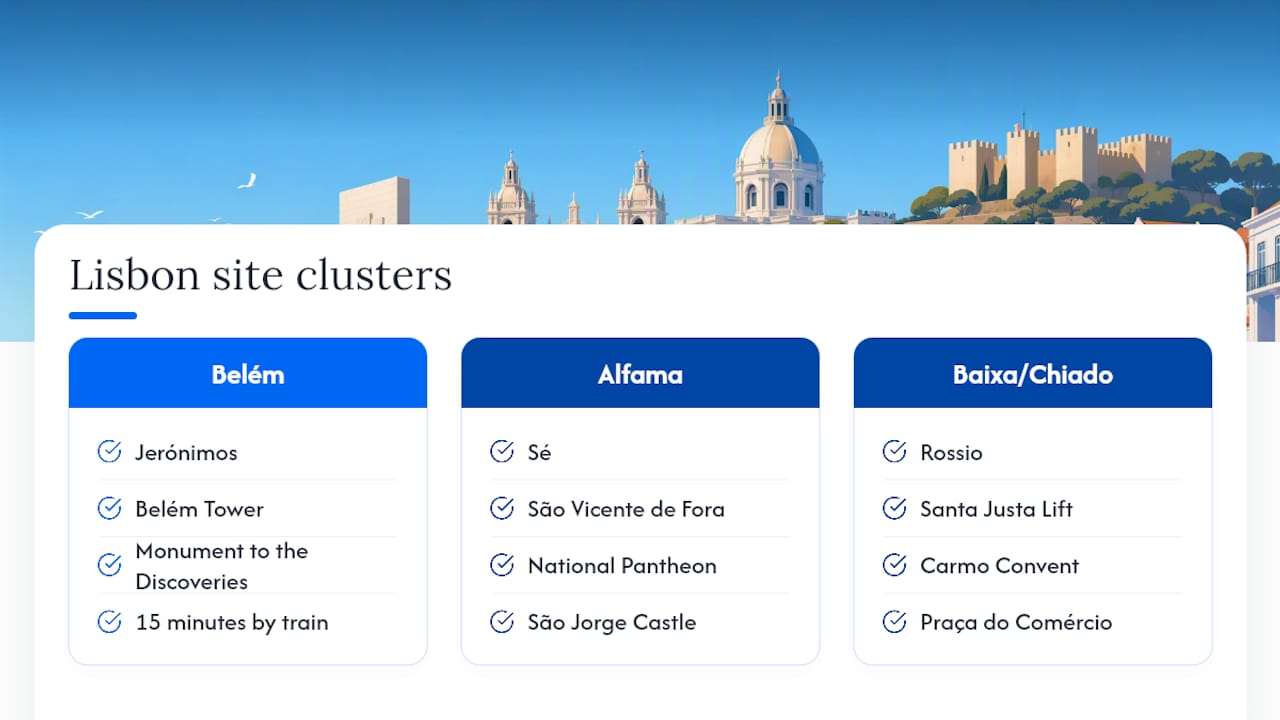
By geography: Group sites by neighborhood, not by type. Belém sites (Jerónimos, Belém Tower, Monument to the Discoveries) are 15 minutes from the city center by train and work as a self-contained morning. The Alfama cluster (Sé, São Vicente de Fora, National Pantheon, São Jorge Castle) fills an afternoon. The Baixa/Chiado cluster (Rossio, Santa Justa Lift, Carmo Convent, Praça do Comércio) connects them.
By theme: A “maritime Lisbon” day covers Praça do Comércio, the Belém cluster, and a Tagus sailing. A “medieval Lisbon” day covers the Sé, São Jorge Castle, and the Alfama. A “resilience” day follows the earthquake narrative: Praça do Comércio, the Baixa grid, Carmo Convent (the earthquake’s most visible scar), and the Santa Justa Lift.
By time budget: If you have one day, do the Belém loop in the morning and the Alfama in the afternoon. If you have two days, add the Baixa/Chiado cluster on day one and Sintra on day two. Three days allows you to slow down and actually spend time in each place rather than photographing it and moving on.
Popular visitor guides consistently recommend combining sites for time-efficient visits, and the geographic grouping approach is the most practical way to do it.
What most visitors miss about Lisbon’s historical sites
Most travelers arrive in Lisbon with a checklist and leave having photographed monuments they didn’t fully understand. That’s not a criticism — it’s a structural problem with how the sites are presented. The Jerónimos Monastery and Belém Tower are marketed as photo stops when they’re actually the physical record of one of the most consequential periods in world history. The UNESCO inscription says as much: these are monuments of “outstanding universal value” for what they represent about human exploration, not just for how they look.
The sites that surprise visitors most are usually the ones with the least marketing: the Carmo Convent’s roofless nave, the São Jorge Castle periscope, the azulejo galleries at São Vicente de Fora. These are places where the history is still present in a physical, unmediated way. No reconstruction, no replica, no interpretive panel required.
The other thing worth saying: Lisbon’s history is not finished. The Alfama is still a living neighborhood. Fado is still performed in its restaurants. The Tagus is still a working river. The best historical experience in Lisbon is not the one that puts the past behind glass — it’s the one that shows you how the past and the present are still in conversation.
See Lisbon’s maritime monuments from the water
The Belém cluster reads differently from the Tagus than from the riverbank. Lisbonbyboat runs daily 2-hour sailing tours that pass the Belém Tower, the Monument to the Discoveries, and the Jerónimos Monastery shoreline, with onboard guides explaining the maritime history behind each monument. For travelers who want a private experience, luxury yacht and catamaran charters are available from 2 hours to a full day.

The boat option works as a complement to a walking itinerary, not a replacement. See the sites on foot first, then see them from the river. The two perspectives together give you the complete picture. For readers considering a private charter experience, this guide to yacht charter types explains the options clearly.
Book a tour or check availability at Lisbonbyboat.
Sources
For booking tickets, verifying current opening hours, and reading deeper history before your visit:
Recommended
Comments