

Nautical Terminology Explained for Your First Sail
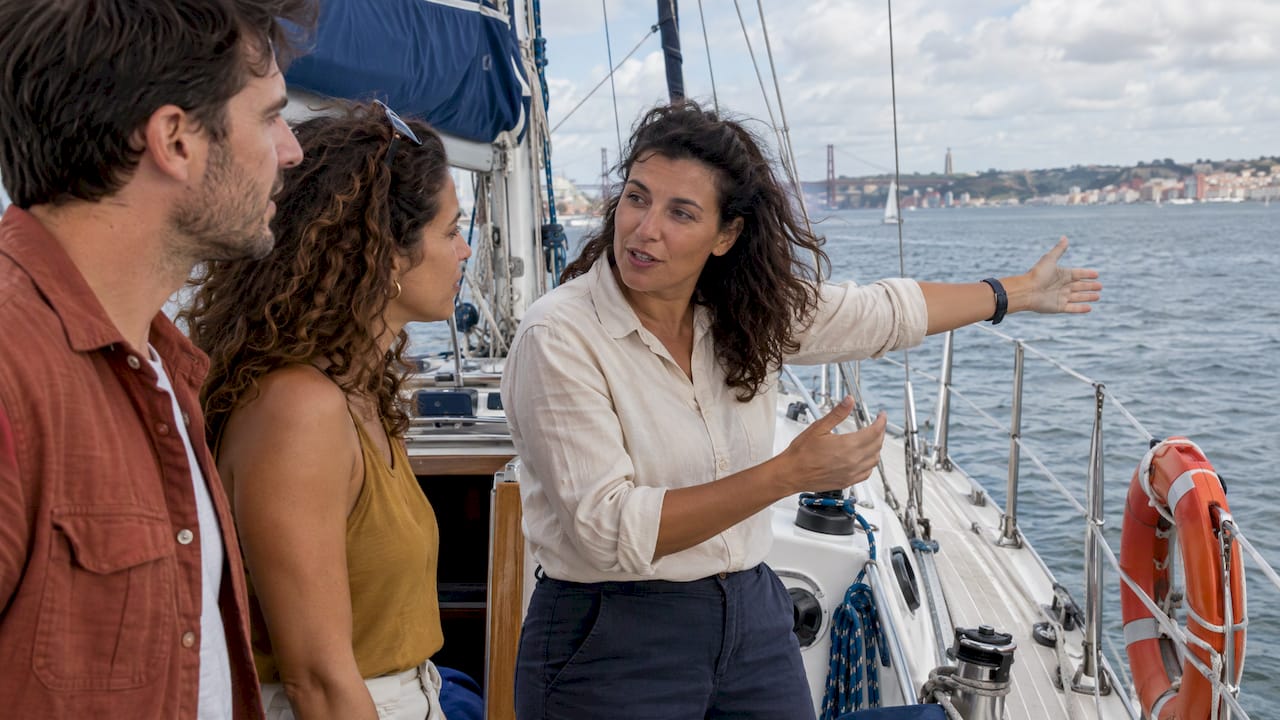
Nautical terminology is the vocabulary of ships and sailing. It is a small set of fixed words for the parts of a boat, directions, wind and speed, and a few dozen of them cover nearly everything you will hear on a first sail. If you are joining a boat tour in Lisbon, or organizing one for a team, learn the words below and the crew’s commentary will make sense from the first minute. On our two-hour Lisbon sailing tour, the guides explain the monuments along the Tagus, and a little vocabulary lets you follow the boat as well as the view.
TL;DR
“Nautical” simply means relating to ships, sailing or sailors. The word comes from the Latin nauta, “sailor.”
Bow is the front, stern is the back, port is the left and starboard is the right, always as seen from the boat facing forward.
Windward is the side the wind hits, leeward is the side away from it, and the boat leans (heels) away from the wind.
A knot is one nautical mile per hour, which is 1.852 kilometers per hour.
Fixed terms exist for clarity and safety, so crew instructions are worth following the way they are given.
Table of Contents
What “nautical” means and why boats have their own words
The Cambridge Dictionary defines “nautical” as an adjective meaning relating to ships, sailing or sailors, with maritime and marine as close synonyms. The University of Iowa traces it back to the Latin noun nauta, meaning sailor or mariner. So a “nautical tour” is just a tour by boat, and “nautical terms” are the words sailors use.
Why not just say left and right? Because on a boat, those words stop working. California’s state boating manual explains that life afloat is oriented to the boat, not to the individual, and that precise terms can save critical seconds in an emergency. Your left changes when you turn around. The boat’s left does not.
The Oregon State Marine Board gives the clearest example: if someone shouts “Man overboard, port side!”, accurate terms could mean the difference between locating and losing sight of a person in the water. That is the real reason the vocabulary exists, and it is why a skipper’s short instructions are worth following exactly as given.
Directions on a boat: bow, stern, port, starboard
These six words do most of the work. The Oregon State Marine Board’s glossary defines them as follows.
Term | Meaning | On deck, in plain words |
Bow | The forward part of the boat | The pointed front |
Stern | The back end | Where you often find the wheel or tiller on a yacht |
Fore | To or at the front | “Forward of the mast” |
Aft | Toward the stern | “Aft of the cockpit” |
Port | Left side when facing the bow | The side with the red light at night |
Starboard | Right side when facing the bow | The side with the green light at night |
The key phrase is “facing the bow.” Port stays port whichever way you happen to be looking. One memory aid from Textbook of Sailing: port and left both have four letters. Another: port wine is red, matching the red sidelight on the port side, while the green sidelight sits on starboard.
A quick example
Imagine you are standing at the back of a sailing yacht, looking toward the front. A guide says, “Look to starboard, that is Belém.” Starboard is on your right. Now turn and face the stern: starboard is still on the side that was on your right when you faced forward, which is now your left. Nothing about the boat changed, only you. This is why the crew will say “starboard side” and not “your right.”
Wind, sails and why the boat leans
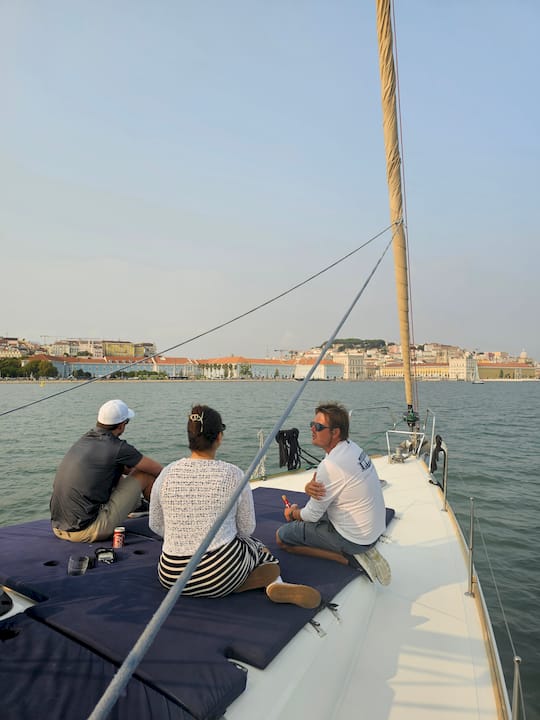
Two more words come up the moment the sails go up: windward and leeward. Textbook of Sailing defines windward as the side the wind is blowing onto, and leeward (pronounced “loo-ard”) as the side away from the wind, where the sails normally lie. When the boat heels, meaning leans over under the force of the wind, the leeward side goes down. Crew and guests often sit on the windward side, which helps hold the boat up.
Heeling feels dramatic the first time and is a normal part of sailing. A boat that leans is a boat that is using the wind.
What actually pushes a sailboat
Most people assume the wind simply pushes the sails from behind. California’s boating manual calls that a common error: the wind pushes directly only when running dead downwind, which is the slowest point of sail. Mostly, a sail works by shaping airflow so that pressure differs on its two sides. That pressure difference is called lift, and it is the primary force driving the boat. Maximum lift occurs with the wind on the beam (the side of the boat) or slightly ahead of it.
That is why a yacht can sail across the wind at a pleasant speed, and why the angle of the sails matters so much to the crew.
The sails and the steering
You will hear the names of a few pieces of equipment. SailStarter’s glossary defines them well:
Mainsail: the primary sail, set on the mast and boom, present on almost every sailboat rig.
Jib: a triangular headsail set forward of the mast.
Helm: the steering station, either a wheel or a tiller (a handle fixed to the rudder). By extension, the person steering is at the helm.
Anchor: the weighted device dropped to the bottom to hold a boat in place, connected to the boat by its rode, meaning the line or chain.
Buoy: a floating marker anchored to the bottom, used to mark channels, hazards, moorings or open water.
Two more parts sit below the waterline. Textbook of Sailing explains that the keel does two jobs: its weight keeps the boat from blowing over, and its shape keeps her from sliding sideways. The rudder is the smaller fin at the stern that steers the boat. Salt and sun are hard on every hull and fitting, which is why owners read up on saltwater protection for a boat as part of ordinary upkeep.
Speed and distance: knots and nautical miles
“We’re doing six knots” sounds like a different language from miles per hour, but it is simple. According to the New South Wales Government’s maritime glossary, one knot is a speed of one nautical mile per hour, or 1.852 kilometers per hour, and one nautical mile equals 1.852 kilometers, or 1.151 miles.
In American terms, a nautical mile is a little longer than the land mile you drive. The University of Iowa gives the international nautical mile as exactly 1,852 meters, or 6,076 feet.
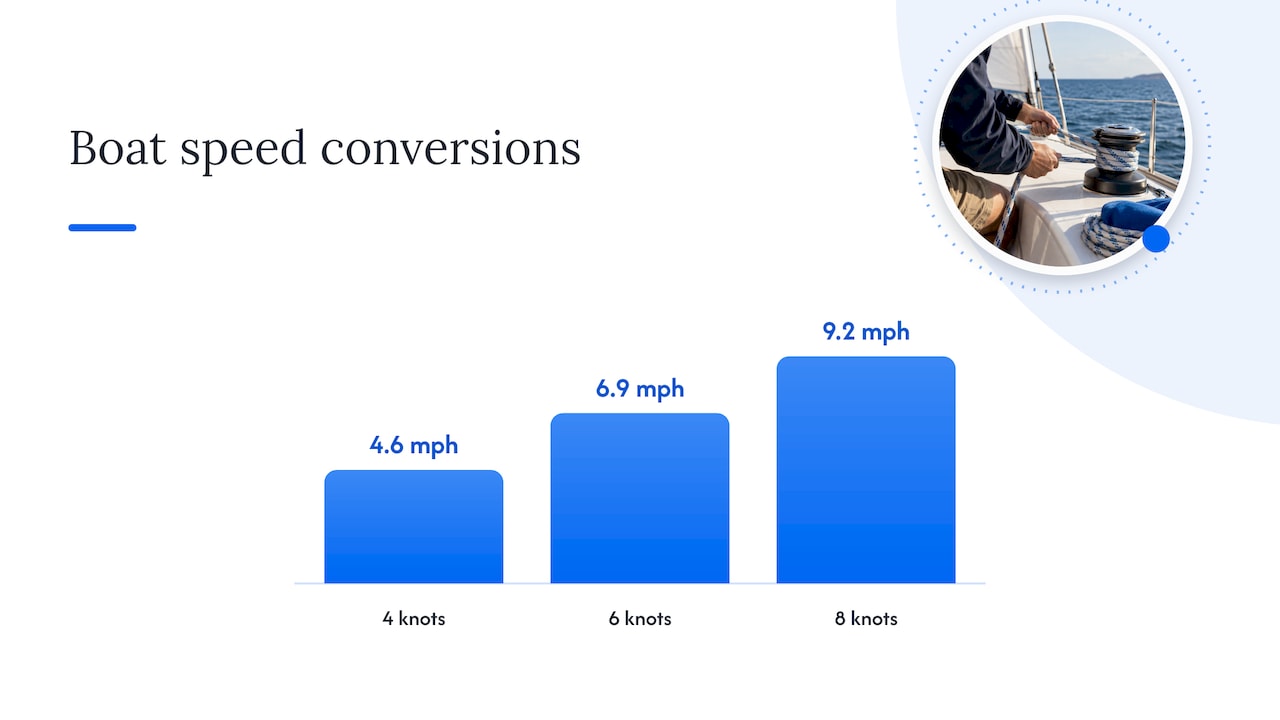
A rough conversion for your trip:
Boat speed | Roughly in miles per hour |
4 knots | 4.6 mph |
6 knots | 6.9 mph |
8 knots | 9.2 mph |
These follow from the 1.151 ratio above. They feel faster on the water than they sound, because you are close to the surface with the wind on your face. Also note that “knots per hour” is a mistake: a knot already contains the hour.
Port side, starboard side: rules you will notice on the water
Boats follow shared conventions, and a few show up in plain sight. NOAA’s general coastal rule is “red, right, returning”: coming into port from the sea, red markers, lights or buoys should be on your right. This is the rule in United States waters, and buoyage differs by system and region, so a mark’s color alone does not tell you the whole story. A skipper reads the local system. For a passenger, it is enough to know that the colored markers you pass are not decoration.
A glance at a nautical chart
A nautical chart is the sailor’s map, and you do not need to read one as a passenger. Still, it explains much of the vocabulary. Skippercheck tells beginners to start with the scale, the depth numbers, the colored depth areas and the symbols for dangers, buoys and lights. The small numbers on the water are soundings, meaning the depth at that spot. Distance is measured on the latitude scale, because one minute of latitude is about one nautical mile. That is where the nautical mile gets its logic: it is tied to the size of the Earth, not to a road.
Words you may hear on a Tagus sail
On a guided sail you will meet a mix of nautical words and the guide’s commentary on Lisbon. Here is how they fit together.
“Ready about” or “tacking”: the crew is turning the bow through the wind to change direction. Expect the sails to move and the boat to change its lean. Stay clear of the lines and of the boom, the horizontal pole at the foot of the mainsail.
“Heeling”: the lean described above.
“Underway”: the boat is moving and not tied up or anchored.
“Galley” and “head”: the boat’s kitchen and its toilet.
“Deck” and “cockpit”: the surface you walk on and the seating area near the helm.
“Ahoy”: a call used to hail a boat or get attention, and still fine to use as a friendly greeting.
If you want to know who does what once you are aboard, our guide to the roles of crew on sailing tours covers it. For practical preparation, see our boat safety tips for Lisbon tours.
Thinking in nautical terms takes a little practice
California’s boating manual observes that it takes practice to think directly in nautical terms instead of picturing land terms and translating them. It adds that most people find it greatly satisfying once the language becomes second nature. You will not get there in one afternoon, and you do not need to. The practical trick is to anchor everything to the bow. Find the front of the boat, and port, starboard, fore and aft all fall into place.
For groups, this is a useful icebreaker. A team on a corporate outing can pick up six words in ten minutes, and calling “port!” or “starboard!” to point out a landmark becomes a shared joke by the end of the sail.
Our perspective
We run guided sails on the Tagus, and we have noticed that vocabulary changes how guests enjoy a tour. Once someone knows that the bow is the front and that port is the left side as you face it, they stop worrying about where to stand and start looking at the city. That is the idea behind our live commentary. Our guides explain the major monuments and sights along the Lisbon coastline, and they explain the boat in the same breath, so a first-time passenger leaves with the view and with the language. We also think the best way to learn these words is on the water, not from a list. A sailing yacht or catamaran gives you the sails, the helm and the heel to point at while someone explains them. That is why we offer everything from a shared two-hour tour to private yachts and larger vessels for groups: the same words, at the scale that suits your party. Lisbon
See the words in action on the Tagus
The quickest way to make these terms stick is to hear them where they apply. Our Lisbon Sailing Tour lasts 120 minutes and costs 45 € per person. The Sunset Sailing Tour is also 120 minutes and starts from 60 € per person. Tours include live commentary, beverages and snacks. If you prefer your own boat, a private tour starts from 400 € per yacht, and for a couple, Romantic Sunset Sailing is 390 € per yacht.
Planning a team-building day or a group outing? We have vessels for groups of different sizes, from speedboats to sailing yachts and tall ships. See the group activities page for the options, or browse the private sailing and cruising programs.
FAQ
What are the most common terms in sailing?
Start with bow (front), stern (back), port (left) and starboard (right). Add windward (toward the wind), leeward (away from the wind), helm (the steering station), knot (one nautical mile per hour) and heel (to lean). With these, you can follow almost any conversation on a first sail.
What does “nautical” mean?
It means relating to ships, sailing or sailors. The word comes from the Latin nauticus, which in turn comes from the Greek nautikos, from naus, meaning ship, according to the American Heritage Dictionary. Maritime and marine are close synonyms.
Is a knot the same as a mile per hour?
No. A knot is one nautical mile per hour, or 1.852 kilometers per hour, while a nautical mile is about 1.151 statute miles. So one knot is a little faster than one mile per hour, roughly 1.15 mph.
How do I remember port and starboard?
Port and left both have four letters. Port wine is red, and the port sidelight is red, while starboard carries the green light. Always judge left and right from the boat facing the bow, not from where you stand.
Do I need to know any of this before booking a sailing tour?
No. The guides explain the boat and the sights as you go. A few terms simply make the commentary and any crew instruction easier to follow.
Sources
Recommended
Really handy guide – I always mixed up port and starboard until I read that both are named as seen from the boat facing forward. The explanation of why the boat heels away from the wind will make a first sail on the Tagus feel much less intimidating for beginners. Bookmarking this before our trip to Lisbon!
Regards, Mark