

Best Lisbon Monuments: Top Historical Sites to Visit

TL;DR:
Lisbon’s historic monuments, from Jerónimos Monastery to Belém Tower, tell a story of exploration, architecture, and Portuguese pride. Prioritizing UNESCO sites and grouping nearby landmarks enhances the experience and understanding of the city’s rich history. Exploring Lisbon from the water reveals a different perspective, connecting monuments to their riverine context and creating memorable views.
Lisbon is one of Europe’s oldest cities, and its skyline tells the story. From medieval fortresses on hilltops to 16th-century riverfront towers, the best Lisbon monuments pack more history per square mile than almost any other capital. The challenge is not finding monuments. It is deciding which ones to prioritize when you have a limited number of days and want every stop to count. This guide cuts through the noise, ranks the most historically significant and visually rewarding sites, and gives you the practical context you need to plan a visit worth remembering.
Table of Contents
2. Jerónimos Monastery: Lisbon’s greatest architectural achievement
3. Belém Tower: the fortress that watched explorers sail away
4. Monument to the Discoveries: reading Portugal’s maritime story in stone
5. Belém Tower, Jerónimos, and the Monument: why Belém works as a full itinerary
6. São Jorge Castle: medieval fortress with one of the city’s best panoramas
7. Lisbon Cathedral: the oldest building most visitors rush past
8. National Pantheon: the monument that took 284 years to finish
9. Santa Justa Lift: the iron elevator that connects two worlds
My perspective on experiencing these monuments the right way
Key takeaways
Point | Details |
UNESCO sites first | Jerónimos Monastery and Belém Tower are the city’s crown jewels and worth anchoring your visit around. |
Cluster your visits | Grouping monuments by neighborhood saves hours of transit and reduces queue fatigue. |
Mix interiors with viewpoints | Pairing monument interiors with nearby panoramic viewpoints creates a richer, more satisfying experience. |
Go beyond the obvious | The National Pantheon and Lisbon Cathedral reward visitors who look past the UNESCO headliners. |
Evening visits add depth | São Jorge Castle’s night events offer a dimension that a standard daytime tour simply cannot match. |
1. How to choose the best Lisbon monuments for your visit
Not every monument in Lisbon deserves equal time. With dozens of historical sites spread across a hilly city, smart travelers use a few core criteria to build their shortlist.
Historical significance is the first filter. Monuments tied to UNESCO World Heritage status, the Age of Discovery, or pivotal events in Portuguese history carry more depth than decorative landmarks. They reward visitors who read even a little background beforehand.
Architectural style is the second. Lisbon’s Manueline architecture, which blends Gothic, Moorish, and Renaissance influences from Portugal’s maritime expansion era, is unlike anything you will find elsewhere in Europe. Prioritizing monuments that showcase this style makes the trip distinctive.
Location clustering matters more than most guides admit. The city’s hills and spread-out geography mean poor itinerary planning can cost you two hours in transit for what should be a 20-minute walk. Grouping monuments by proximity to anchor your days around Belém, Alfama, or the Baixa district is the single best logistical decision you can make.
Finally, weigh visitor experience factors like accessibility, crowd levels by time of day, and special events. Some monuments open their best features only on weekends or during seasonal programs.
Pro Tip: Book timed-entry tickets online for the two UNESCO sites before you arrive. Walk-up lines at Jerónimos Monastery regularly stretch 45 minutes or more during summer mornings.
2. Jerónimos Monastery: Lisbon’s greatest architectural achievement
If you visit one monument in Lisbon, this is it. The Jerónimos Monastery is a UNESCO World Heritage Site designated in 1983 and one of the finest examples of late Gothic and Manueline architecture anywhere in the world.
Construction began in 1501 and stretched to 1601, making it a century-long achievement tied directly to the wealth generated by Vasco da Gama’s voyage to India. Da Gama’s tomb sits inside the church, which gives the monastery a weight that photographs cannot fully convey. You are standing next to one of history’s most consequential explorers.
The two-story cloisters are the visual centerpiece. Intricate stone carvings cover every arch and column, depicting maritime imagery, armillary spheres, and twisted rope motifs. It takes time to absorb. Plan at least 90 minutes inside.
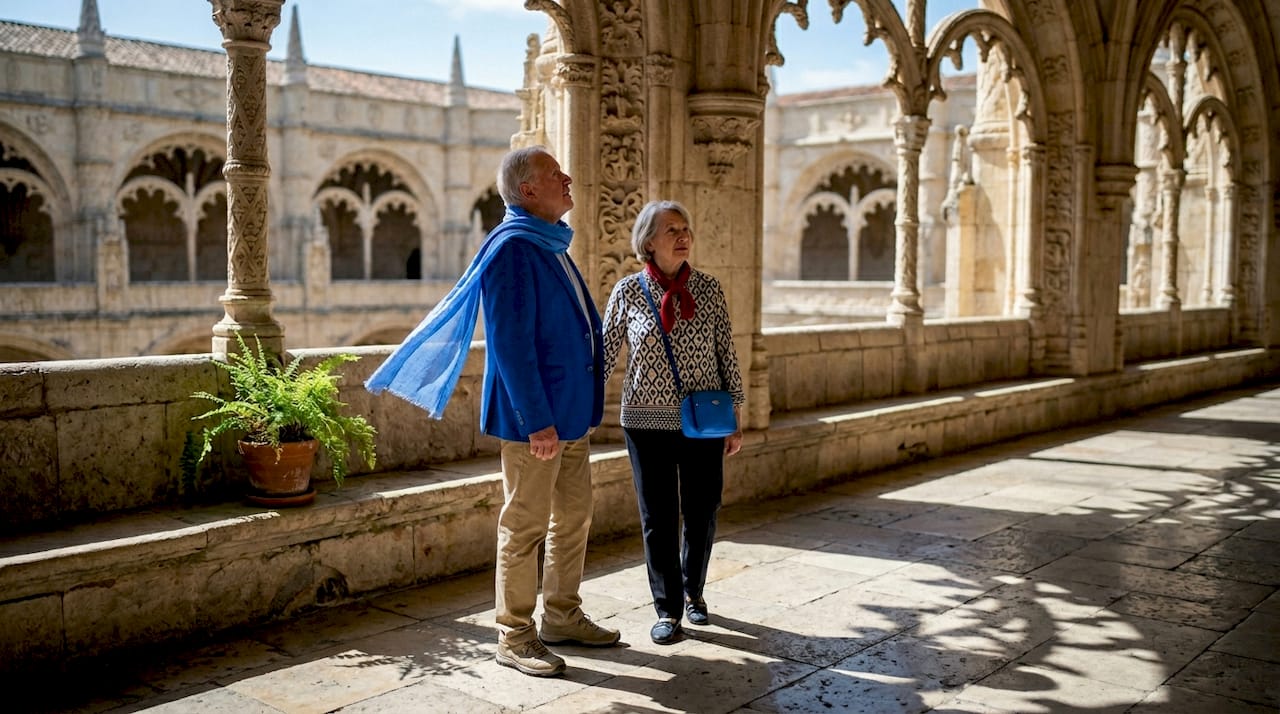
Pro Tip: Visit the monastery immediately when it opens at 10 a.m. The cloisters empty out within the first 30 minutes before tour groups arrive, giving you unobstructed views and better photos.
3. Belém Tower: the fortress that watched explorers sail away
Few famous buildings in Lisbon are as visually striking from the water as Belém Tower. This 16th-century fortress was built between 1514 and 1520 to control access to Lisbon’s port, and it served as the last thing Vasco da Gama and his fleet saw as they departed for unknown waters.
The tower is compact by fortress standards, but every level tells a different story. The lower bastion offered artillery defense. The upper loggia provided ceremonial and residential space for the tower’s governor. The views of the Tagus River from the top are the best free reward after a modest entrance fee.
Belém Tower sits about a 10-minute walk from Jerónimos Monastery, which makes pairing the two an obvious choice. Between them, you will also pass the Monument to the Discoveries, discussed further below. This cluster alone justifies a full half-day in Belém.
Pro Tip: Come to Belém Tower in the morning light. The tower faces west, so afternoon sun creates flat, harsh photos. Morning light gives you the warm stone tones the architecture deserves. Also, one of the best ways to see it is on a boat tour with Lisbon ByBoat, because this monument was build to be seen from the water.
4. Monument to the Discoveries: reading Portugal’s maritime story in stone
The Padrão dos Descobrimentos stands as one of Lisbon’s most distinctive famous landmarks. Unveiled in its current permanent form in 1960 to mark the 500th anniversary of Prince Henry the Navigator’s death, the monument rises 52 meters along the Tagus riverbank and depicts 33 figures from Portugal’s exploration era in a dramatic sword-shaped formation.
Henry the Navigator stands at the prow, but the figures behind him represent every layer of the maritime enterprise: navigators, cartographers, missionaries, soldiers, and poets. It is a deliberate argument about who deserves credit for one of history’s most consequential chapters.
The interior houses an exhibition space and an elevator to the top. The compass rose mosaic on the plaza in front, a gift from South Africa in 1960, maps Portugal’s exploration routes across the world. Stand at the center and you can orient yourself toward every destination the Portuguese once sailed.
5. Belém Tower, Jerónimos, and the Monument: why Belém works as a full itinerary
The real strength of Belém is not any single monument. It is the thematic and spatial coherence between all three sites within a 15-minute walk of each other. Each one illuminates the others.
Monument | Distance from Jerónimos | Main draw |
Jerónimos Monastery | Starting point | Manueline architecture, Da Gama’s tomb |
Monument to the Discoveries | 5-minute walk west | Exploration history, rooftop views |
Belém Tower | 10-minute walk west | Fortress architecture, Tagus views |
Spend your morning at the monastery, mid-morning at the monument, and finish at Belém Tower before lunch. The nearby Pastéis de Belém bakery, open since 1837, is exactly where you should reward yourself. It is not technically a monument, but it is a Lisbon institution.
Also, an excelent way to see al this is by boat with Lisbon ByBoat, because Discoverie's Monument and Belem Tower are much better seen from the water!
6. São Jorge Castle: medieval fortress with one of the city’s best panoramas
Perched on Lisbon’s highest hill above Alfama, São Jorge Castle has been fortifying this hilltop since the Moorish occupation, with the current structure reflecting centuries of subsequent modification under Christian kings. The views from the battlements cover the entire city, the Tagus estuary, and on clear days, the hills across the river.
What sets São Jorge apart from other Lisbon historical sites is its programming. On May 23, 2026, the castle opened for free night-time events with thematic performances and guided tours as part of the European Night of Museums. Night events like these add genuine dimension to what can otherwise feel like a standard fortress visit. The combination of illuminated ramparts, live reenactments, and cooler evening temperatures makes a completely different experience from the daytime version.
Pro Tip: If you are visiting Alfama anyway for the Lisbon Cathedral, walk up to São Jorge Castle for sunset. The golden light over the terracotta rooftops of Alfama from the castle walls is one of the most memorable views in the city.
7. Lisbon Cathedral: the oldest building most visitors rush past
The Sé de Lisboa is the oldest cathedral in the city, dating to the 12th century, yet most visitors walk right past it on the way to other Alfama attractions. That is a significant mistake.
The cathedral’s architecture layers centuries of history in a way no single-era building can. It was constructed in Romanesque style, damaged severely in the 1755 earthquake, and rebuilt with Gothic and Baroque modifications that created the complex, multi-era structure you see today. The cloister excavations have revealed Roman and Moorish ruins beneath the current structure, turning a visit into an accidental archaeology lesson.
Entry to the cathedral nave is free, which makes it an easy addition to any Alfama morning. The treasury and cloisters charge a small fee but contain some of Lisbon’s finest medieval relics.
8. National Pantheon: the monument that took 284 years to finish
The National Pantheon’s iconic white dome rises 80 meters above the Santa Apolónia waterfront and is visible from across the Tagus. But the building’s backstory is even more interesting than its architecture.
Construction on the church of Santa Engrácia began in 1682. A nobleman was falsely accused of stealing from the church, and legend holds that he cursed the building before his execution, condemning it to eternal incompletion. Construction stalled, restarted, and stalled again for nearly three centuries. The phrase “obras de Santa Engrácia” became a Portuguese idiom for a project that never ends. The dome was finally completed in 1966, nearly 284 years after the foundation was laid.
Today the building serves as Portugal’s national mausoleum, housing the tombs of presidents, literary figures like Fernando Pessoa, and fado legend Amália Rodrigues. The rooftop terrace offers one of the best panoramic views of Lisbon and is far less crowded than the Belém sites.
9. Santa Justa Lift: the iron elevator that connects two worlds
The Santa Justa Lift is technically an elevator, but it functions as one of Lisbon’s most photographed famous buildings. Built between 1898 and 1902 and inaugurated with a royal ceremony, this neo-Gothic iron structure connects the Baixa district at street level to the Carmo neighborhood on the hilltop above.
What makes it interesting historically is what it replaced. Before the lift, residents and workers had to climb steep, winding streets to cross between these two neighborhoods. The lift was a genuine urban innovation, designed by a student of Gustave Eiffel, which explains the structural similarity to Parisian ironwork.
The viewing platform at the top gives you a direct sightline over the ruins of the Carmo Convent, destroyed in the 1755 earthquake and left unroofed as a permanent memorial to the disaster. The combination of views is hard to beat for a single ticket price.
Pro Tip: If you hold a Lisboa Card, Santa Justa Lift rides are included. Skip the cash line and head to the dedicated card holders’ entrance on the side.
My perspective on experiencing these monuments the right way
I have watched a lot of travelers come through Lisbon with the same itinerary problem: they treat the monuments as a checklist rather than a narrative. They rush from São Jorge Castle to Belém Tower to the cathedral in a single day, cover everything, and absorb very little.
My honest recommendation is to resist that approach. The Belém cluster alone tells a story that takes time to appreciate. Jerónimos Monastery was built with the direct profits of the spice trade. Belém Tower watched the ships leave. The Monument to the Discoveries memorializes the people who made it possible. When you walk between those three sites slowly and connect them as chapters in the same story, you leave understanding something real about Portugal’s place in history. That understanding does not happen when you are running to the next monument.
The São Jorge Castle night events are also genuinely worth scheduling around if your dates align. The castle during the day is impressive. The castle at night, lit up with historical performances on the ramparts, is something you will actually remember years later.
Finally, and this is a perspective few guides mention: some of the best views of these monuments are not from inside them. Seeing Belém Tower and Jerónimos from the water fundamentally changes how you understand their scale and relationship to the Tagus. It is a different kind of visit, and it is worth adding.
— Lisbon
See Lisbon’s monuments from the water with Lisbon byboat

The relationship between Lisbon’s greatest monuments and the Tagus River is not incidental. Belém Tower was built to control river access. Jerónimos Monastery rises directly from the waterfront. The Monument to the Discoveries points toward the sea. You understand all of them differently when you see them from the water.
Lisbonbyboat offers daily 2-hour sailing tours along Lisbon’s coast where expert guides explain the history and significance of every major monument you pass. For a more personalized experience, luxury yacht charters on the Tagus let you set the pace and linger where the views demand it. Whether you are planning a half-day tour or a full-day private cruise, the water offers a perspective on Lisbon’s famous landmarks that no land-based itinerary can replicate.
FAQ
What are the must-visit Lisbon monuments?
The top monuments include Jerónimos Monastery, Belém Tower, São Jorge Castle, the Monument to the Discoveries, Lisbon Cathedral, and the National Pantheon. Both UNESCO-listed sites in Belém are the highest priority for first-time visitors.
Are Jerónimos Monastery and Belém Tower close to each other?
Yes. Both are located in the Belém district along the Tagus River, about a 10-minute walk apart, making them easy to visit on the same half-day itinerary alongside the Monument to the Discoveries.
When is the best time to visit Lisbon’s famous monuments?
Early morning on weekdays is the least crowded window. Timed-entry tickets booked online help avoid long queues at the two UNESCO sites, especially during summer.
What is the Santa Justa Lift and why is it worth visiting?
The Santa Justa Lift is a neo-Gothic iron elevator built between 1898 and 1902 that connects the Baixa and Carmo neighborhoods. Its viewing platform offers direct views over the ruins of the Carmo Convent and a wide Lisbon panorama.
Is the National Pantheon worth visiting in Lisbon?
Absolutely. The National Pantheon houses the tombs of Portugal’s most significant cultural and political figures, features an 80-meter white dome with a fascinating 284-year construction history, and has a rooftop terrace with some of the city’s best views with far fewer crowds than Belém.
Recommended
Comments