

What Is a Sailing Schedule? A Traveler's Guide
- lisbonbyboat
- 3 days ago
- 8 min read

TL;DR:
A sailing schedule provides expected departure and arrival times, routes, and key details for travelers.
Check-in cutoffs are more critical than departure times, as missing them can result in denied boarding.
A sailing schedule is an official timetable that lists a vessel’s expected departure and arrival times, the route it follows, and the key details travelers need to plan around. Think of it as the backbone of any boat trip, whether you’re boarding a two-hour coastal tour in Lisbon or a full-day private charter on the Tagus.
Before you book, here’s what the schedule actually means for you:
Check-in cutoffs matter more than departure time. Many operators enforce a 30–60 minute pre-departure cutoff. Miss it and you may be turned away even if the boat is still docked.
ETD and ETA are estimates, not guarantees. Actual departure and arrival times can shift due to weather, port traffic, or safety calls.
Live updates beat the static timetable. Always confirm with the operator directly on the day of travel, not just at booking.
Table of Contents
What does a sailing schedule actually contain?
A sailing schedule is built around a handful of standard fields. Knowing what each one means saves you from surprises on the day.
Route and port rotation: The sequence of departure and arrival points (e.g., Lisbon Marina → Belém Tower → return).
ETD (Estimated Time of Departure) and ETA (Estimated Time of Arrival): Planning anchors, not hard commitments. The real-world equivalents, ATD and ATA, are recorded after the fact.
Vessel or voyage number: Identifies the specific boat and sailing, useful when contacting the operator.
Terminal check-in cutoff: The hard deadline to be aboard or checked in, typically 30–60 minutes before ETD.
Service validity dates and footnotes: Look for phrases like “valid April 1–October 31” or “weekends only.” Seasonal footnotes on ferry schedules can mean a sailing that runs in July simply doesn’t exist in November.
Frequency: How often the service runs — daily, twice daily, or on specific days of the week.
Statistic to remember: Missing the check-in cutoff can result in denied boarding even when the vessel is still at the dock. Build your arrival time around the cutoff, not the departure time.
One thing many travelers overlook: a sailing listed on a given calendar date may depart late at night and arrive the following morning. Schedules index sailings to the departure date, so always check whether your trip crosses midnight before planning your return logistics.
How do schedules differ between private charters, shared tours, and ferries?
Not all sailing timetables work the same way. The type of service you book determines how rigid the schedule is, how far ahead you need to plan, and what happens if something changes.
Service type | Flexibility | Booking lead time | Best for |
Private charter | High — you set the date and time | Weeks to months ahead in peak season | Groups, events, custom itineraries |
Shared daily tour | Low — fixed departure slots | Days to a week ahead | Solo travelers, couples, small groups |
Commercial ferry | Very low — strict published timetable | Can book same-day, but cutoffs are firm | Point-to-point transfers |
Private charters operate on demand. You agree on a date and time with the operator, and the schedule is built around your group. Private charter flexibility comes with a trade-off: peak-season availability in Lisbon can thin out fast, especially from June through September.
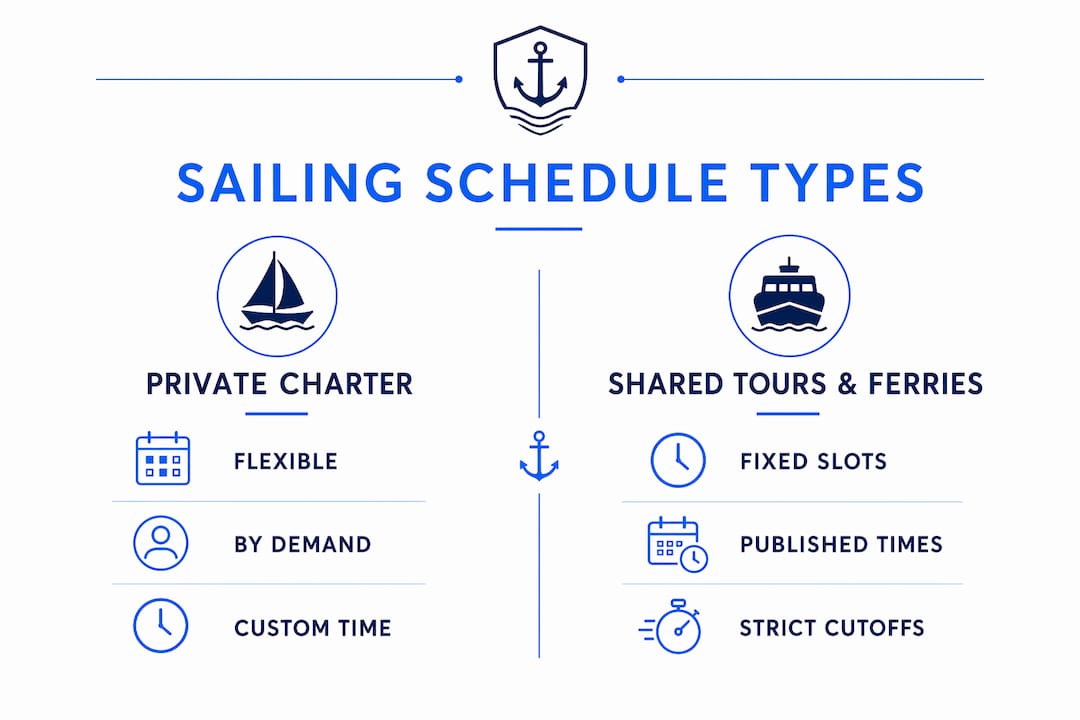
Shared daily tours run on fixed slots — Lisbonbyboat’s two-hour coastal tours, for example, follow advertised departure times. You show up, check in before the cutoff, and sail with other guests. Group boat tours like these may also require a minimum passenger count to operate; if that threshold isn’t met, the operator typically moves bookings to the nearest available departure.
Commercial ferry services are the most rigid. They run on published timetables with strict cutoffs and are better suited to transfers than scenic experiences.
Pro Tip: Book shared Lisbon tours at least a week ahead in summer. Private charters on popular dates — sunset slots, weekends in July and August — can sell out a month or more in advance.
Why do sailing schedules change so often?
A published timetable is a starting point, not a contract. Weather is the most common reason times shift. Wind, swell, and visibility can make a departure unsafe even on a morning that looked fine the night before. Safety and local regulations always override a published time — no operator is going to push off into rough conditions because the schedule says 10:00 AM.
Port traffic and crew rostering add another layer of variability. A busy marina can delay boarding by 20–30 minutes with no warning. Seasonal service windows matter too: summer in Lisbon brings more daily departures, while shoulder months can reduce frequency to weekends only or pause certain routes entirely.
Tidal windows also affect practical timing on the Tagus. A departure that works at high tide may need to shift 30 minutes earlier or later when tidal access to certain stops is limited. It’s a detail most travelers never think about until it affects their afternoon.
How to plan your trip around a sailing schedule
Follow this sequence from booking to boarding and you’ll avoid the most common mistakes.
Confirm the schedule at booking. Get the ETD, ETA, check-in cutoff, and boarding location in writing — email or booking confirmation.
Note the check-in cutoff, not just the departure time. If the tour departs at 10:00 AM and the cutoff is 30 minutes prior, you need to be at the dock by 9:30 AM.
Build buffers for onward connections. If you’re catching a flight after a half-day tour, allow several hours between your ETA and your flight’s check-in. ETAs can and do slip.
Save your confirmation and operator contact. Screenshot the booking details and store the operator’s phone number or WhatsApp before you leave your hotel.
Check for live updates 24 hours out. Conditions can change overnight. A quick message to the operator the evening before costs nothing.
Arrive at the dock 10–15 minutes before the cutoff. Not before the departure time — before the cutoff.
Sample timeline for a half-day tour followed by an afternoon flight:
8:45 AM — Arrive at marina (cutoff is 9:00 AM for a 9:30 AM departure)
9:30 AM — Depart
1:00 PM — Return to dock (ETA)
1:30 PM — Buffer for disembarkation and transport
4:00 PM — Earliest realistic flight check-in
Pro Tip: Lisbon’s summer light lasts until nearly 9:00 PM, so late-afternoon departures offer spectacular views of the 25 de Abril Bridge and the Jerónimos Monastery. Check the 2026 sailing trends for peak-season slot availability before you finalize your itinerary.
Where to find live status and confirm your sailing
The published timetable and the live status of your sailing are two different things. Public schedule databases list baseline ETD/ETA data, but they don’t replace real-time operator communication.
Most reliable channels, in order:
Operator booking confirmation — your first reference; contains ETD, check-in time, and contact details.
Operator website live-status page — updated as conditions change.
SMS or email from the operator — most Lisbon leisure operators send a pre-departure reminder 24 hours out.
Phone or WhatsApp — fastest for day-of questions; save the number before you travel.
Port authority notices — relevant for port closures or major weather events affecting multiple operators.
Day-of checklist:
24 hours before: Check your email for operator updates; verify the schedule on the operator’s website.
4 hours before: If no update has arrived, send a quick WhatsApp or email to confirm.
30–60 minutes before departure: Be at the dock, confirmation in hand.
How Lisbonbyboat publishes and confirms schedules
Lisbonbyboat runs two-hour daily coastal tours on fixed departure slots, plus private charters on yachts and catamarans ranging from two hours to a full day. The scheduling model reflects those two tracks.
For daily shared tours, departure times are published on the ByBoat Tours page and confirmed at booking. Seasonal adjustments — more frequent slots in summer, reduced frequency in autumn — are reflected in the live timetable on the website.

For private charters, the schedule is agreed directly with the team at booking. Once a deposit is placed, the slot is confirmed regardless of passenger count, which is the key difference from shared departures.
What to expect in your confirmation message:
ETD and ETA for your specific sailing
Check-in time (typically 30 minutes before departure)
Boarding location within the marina
Cancellation and rebooking policy summary — including what happens if weather forces a change
Operator contact for day-of questions
What to do when your sailing is delayed or canceled
Stay calm and work through this in order.
Check live status first. Confirm the change through the operator’s website or your confirmation message before assuming the worst.
Contact the operator directly. Phone or WhatsApp gets the fastest response. Have your booking reference ready.
Review your booking terms. Most Lisbon leisure operators offer a move to the next available slot or a full refund for weather-related cancellations.
Document everything. Screenshot the cancellation notice and any operator messages — you’ll need these for travel insurance claims or airline rebooking requests.
Common options operators offer: transfer to the next sailing that day, a full refund processed within a few business days, or a credit toward a future booking. Who covers a missed flight? Your travel insurance, not the operator — maritime operators are not liable for onward connections affected by weather-driven delays. Book travel insurance that covers missed connections if your itinerary is tight.
Key Takeaways
A sailing schedule is an estimate, not a guarantee — and the check-in cutoff is the one time on that schedule you cannot afford to miss.
Point | Details |
Treat ETD/ETA as estimates | Build buffers into every connection; actual times can shift due to weather or port traffic. |
Arrive before the cutoff | Check-in closes 30–60 minutes before departure — missing it can mean denied boarding. |
Monitor live updates | Confirm with the operator 24 hours and again 4 hours before departure, not just at booking. |
Know your schedule type | Private charters offer flexible timing; shared tours run on fixed slots with minimum-passenger rules. |
Keep operator contact handy | Phone or WhatsApp is the fastest channel when conditions change on the day. |
A note from the water
Schedules exist to give travelers a reliable framework, but the sea sets the final terms. At Lisbonbyboat, every departure decision starts with safety: if conditions on the Tagus or the coast don’t meet our standards, we don’t sail — and we tell you as early as possible so you can adjust your plans.
When a change is necessary, the team reaches out directly by phone, WhatsApp, or email, and we work to get every affected traveler onto the next available slot or issue a refund promptly. The goal is always to get you on the water, just sometimes at a slightly different time than originally planned.
If you’re planning a private charter or a daily tour and want to talk through timing, seasonal availability, or what to expect on the day, reach out directly — we’d rather answer your questions before you arrive than have you standing on the dock wondering what happens next.
Useful sources and where to verify your sailing
When you need to confirm schedule information, go to the most direct source available.
Your operator booking confirmation — the single most reliable document for your specific sailing; contains ETD, check-in time, and cancellation terms.
Operator live-status page — updated in real time as conditions change; check this the morning of your tour.
Operator phone or WhatsApp — use for day-of questions; faster than email when time is short.
Port authority notices — relevant when a weather event or port closure affects multiple services simultaneously; check the local port authority’s website for Lisbon.
Recognized marine weather services — services like Windy or the Portuguese Institute for Sea and Atmosphere (IPMA) give you the same conditions data operators use to make departure decisions.
Save screenshots of your confirmation and any operator messages before you travel. If a cancellation triggers a travel insurance claim, that documentation is what the insurer will ask for first.
Recommended
Comments