

Typical Catamaran Amenities: What to Expect Onboard

Most catamarans give you a wide open deck, a sheltered saloon, a galley, at least one toilet (called a head) and a netted trampoline between the hulls. How much more you get depends on the boat’s size, its layout and whether it was built for cruising, day trips or luxury charters. This guide walks through the standard features, the extras that show up on bigger boats, and the questions worth asking before you book a sightseeing trip or a group outing.
TL;DR
Expect a shaded or enclosed saloon, a galley, a head, a cockpit for sitting outside and a trampoline at the bow.
Cabins and bathrooms sit in the two hulls, while the social spaces sit on the deck between them.
Air conditioning, Wi-Fi, flybridge lounges, water toys and icemakers are upgrades, not standards. They are more common on charter-style and luxury boats.
Short sightseeing trips use a simpler setup than overnight charters, so check what is actually included for your outing.
Before a group event, confirm toilets, shade, capacity, catering and accessibility in writing.
Table of Contents
How a catamaran is laid out
A catamaran has two parallel hulls joined by a deck. That one design choice explains most of its amenities. The hulls hold the sleeping cabins and the heads and showers. The platform between them holds the places where people spend the day.
RunBoats describes the common cruising layout as a saloon and galley on the bridge deck, cabins and heads in the hulls, and a forward trampoline between the hulls. Think of it as a floating apartment on three levels of use: living on the middle deck, sleeping below on each side, and lounging on the open areas above and forward.

The cockpit and saloon
The cockpit is the open-air seating area at the back. On many designs it connects directly to the saloon, the indoor lounge with big windows. Some builders make that connection almost seamless. Cruising World’s review of one popular model notes a tilt-and-lift door between cockpit and saloon that joins inside and outside into a single living space.
For passengers this means you can move between sun and shade without leaving the group. If it starts to drizzle or the wind picks up, you step indoors and the conversation carries on.
The galley
The galley is the kitchen. On most catamarans it sits in the saloon rather than below deck. RunBoats points out that a galley in the saloon keeps the cook connected with guests. On a sightseeing or party outing, the same layout lets a crew member pour drinks and set out snacks without disappearing from view.
The trampoline
The trampoline is the net or mesh surface between the hulls at the front. It is the feature most people remember: a place to stretch out, watch the water pass beneath you and take photos. It is also the one to treat with a little care. Walk on it as the crew instructs, and keep small children close.

Core amenities you will find on most catamarans
Here is the baseline, in the order passengers usually notice it.
Amenity | What it is | Why it matters to passengers |
Saloon | Indoor lounge with large windows | Shelter from sun, wind and rain |
Cockpit | Outdoor seating at the stern | Fresh air with some roof cover on many designs |
Galley | Kitchen area, often in the saloon | Drinks and food prepared within the group |
Heads | Marine toilets, usually in the hulls | Essential on anything longer than a short hop |
Trampoline | Mesh deck between the bows | Sunbathing and views |
Open deck space | Wide side decks and foredeck | Room to move, with little tilt under sail |
Swim ladder or platform | Steps at the stern | Access to the water where swimming is allowed |
The stability that makes these spaces comfortable is part of the catamaran’s reputation. The American Sailing Association’s textbook describes cruising catamarans as stable, fast and self-sufficient little islands for friends and family. For a first-time sailor, a flatter ride and more room to walk around are often the reason to pick a catamaran over a single-hull yacht.
Toilets, shade and weather cover
Three questions come up constantly, so here are straight answers.
Do catamarans have toilets? Most boats big enough to carry passengers on a multi-hour trip have at least one head, usually in a hull. Larger charter boats often have several, because each cabin gets its own. Smaller day boats may have one shared head, so ask.
Is there a galley? Cruising catamarans nearly always have one. Day-trip boats may simplify it to a bar or a serving counter, with cold drinks and snacks brought aboard.
Is there shelter? Yes on most. The saloon is the main refuge, and many cockpits have a hard top or a bimini (a fabric canopy). RunBoats adds that large windows make shade, opening hatches and ventilation important in warm weather, which is worth remembering if your trip is in summer.
How amenities change with the type of boat
The word “catamaran” covers a lot of ground. A boat built for crossing oceans, one built for a week-long charter and one built for a two-hour harbor tour will not offer the same list.
Sightseeing catamarans
Boats built for short passenger trips put comfort for many people ahead of sleeping space. A vessel review from Baird Maritime describes a 27.3-metre sightseeing catamaran with enclosed, air-conditioned main-deck cabins, multimedia systems, snack bars and accessible layouts for passengers with limited mobility. That is one vessel in one country, not a universal standard, but it shows the direction of the category: seating, climate control, food service and step-free access matter more than bunks.
Charter-style cruising catamarans
Boats rented for multi-day trips sleep guests and keep them self-sufficient. Cruising World’s buying guide describes this type as having berths for family and friends, many heads and showers, multiple dining spaces, storage for water toys, flybridge lounges, charging stations and Wi-Fi.
Luxury and long-range boats
The same article lists more extras that appear on high-end boats: dive gear and a compressor, a big-screen TV, a high-powered RIB (rigid inflatable boat) for exploring, an icemaker and even a blender. Treat these as options. A catamaran with none of them can still be an excellent way to see a coastline.
Sail or motor?
A sailing catamaran uses a mast and sails, often with engines for maneuvering. A power catamaran relies on engines alone. In general, sailing boats keep more deck gear and rigging in the cockpit area, while power cats tend to free up the aft deck and sometimes the flybridge for lounging. The core spaces, saloon, galley, heads and trampoline, are common to both. Because designs vary by builder, ask the operator to describe the specific boat rather than assuming.
Optional extras worth knowing about
These are the features that separate a basic outing from a premium one. None is a given.
Air conditioning: more common on larger passenger boats and luxury charters, and useful in hot climates.
Flybridge lounge: an upper deck with seating and often a better view.
Water toys: paddleboards, snorkel gear or inflatables, where swimming is part of the program.
Sound system: for celebrations and group events.
Charging points and Wi-Fi: found on charter-style boats according to Cruising World’s description above.
Icemaker and cold storage: helpful when drinks are a big part of the trip.
Tender or RIB: a small boat for reaching spots the main vessel cannot.
If you want to see how an excursion operator presents this kind of list, a luxury private catamaran tour page is a good model of what to look for before you pay.
What to check before you book
Whether you are a tourist planning an afternoon or an event planner organizing a team day, the same short checklist saves surprises. Ask the operator and get the answers in writing.
Toilets: how many, and where? Is there one for the whole group or several?
Shade and shelter: is there an enclosed saloon or a covered cockpit? What happens in rain or strong wind?
Food and drink: what is included, what costs extra, and can dietary needs be met?
Capacity: the legal passenger number for that boat, and how seating works at that number.
Accessibility: steps, narrow doors and stairs to the hulls can be hard for people with limited mobility. Ask about boarding as well as onboard movement.
Sound and presentation: if you need a microphone for a guide or a speech, confirm it exists and works outdoors.
Swimming and activities: are they part of the trip, and is equipment supplied?
Safety briefing and equipment: a good crew briefs every passenger before leaving the dock.
Cancellation and weather policy: what happens if conditions change?
For corporate groups there are three further points: confirm whether the boat can be privately chartered rather than shared, whether the program can be shaped around your timing, and whether the crew can lead a team activity or only operate the boat.
Perspective: what we think matters most
We run guided sailing tours and private charters on the Tagus River, and we see the same pattern with every group: people rarely remember the spec sheet. They remember whether they were comfortable, whether they could hear the guide, and whether the crew made them feel looked after. That is why we put spacious sailing yachts and a live, personal commentary at the center of what we do. A boat can have every feature on the list, but a coastline like Lisbon’s, with its historic monuments and river views, comes alive when someone explains what you are looking at. Our tours include live commentary, beverages and snacks, so the basics are covered before you step aboard. We also believe the right vessel depends on the group. A couple on a romantic sunset wants quiet and privacy. A hen party wants energy. A company wants room to mix, plus a program that runs on time. Our fleet runs from sailing yachts and catamarans to speedboats and larger vessels, and our durations are flexible, from two hours to a full day. Tell us what you need and we will match the boat to it. Lisbon
Choosing the right boat for your group
Here is a simple way to match your plans to a boat type.
First visit, sightseeing: choose a guided tour with live commentary and a route that passes the main monuments. A two-hour length is enough to see the waterfront without tiring anyone.
Couples: pick a private option with fewer passengers and a sunset departure. Light and privacy matter more than gadgets.
Friends and family: a private yacht or catamaran gives you space for the whole party, and the cost per person falls as the group grows.
Celebrations: a faster boat or a party vessel suits groups who want music and movement.
Corporate events: look for larger vessels or multiple boats if the group is big, and confirm catering and program support.
For more help on comparing routes and operators, our guides on scenic Lisbon boat routes and catamaran tours in Lisbon go deeper, and our Lisbon boat tour price comparison helps you set a budget.
Sail Lisbon with us
If you are visiting Lisbon, you can see the city from the water on our guided sailing tours. The Lisbon Sailing Tour lasts 120 minutes and costs €45 per person. The Sunset Sailing Tour is also 120 minutes and starts from €60 per person. If you would rather have a boat to yourselves, a private tour starts from €400 per yacht, and the Romantic Sunset Sailing program is €390 per yacht. Dolphin watching tours are €50 to €65 per person.
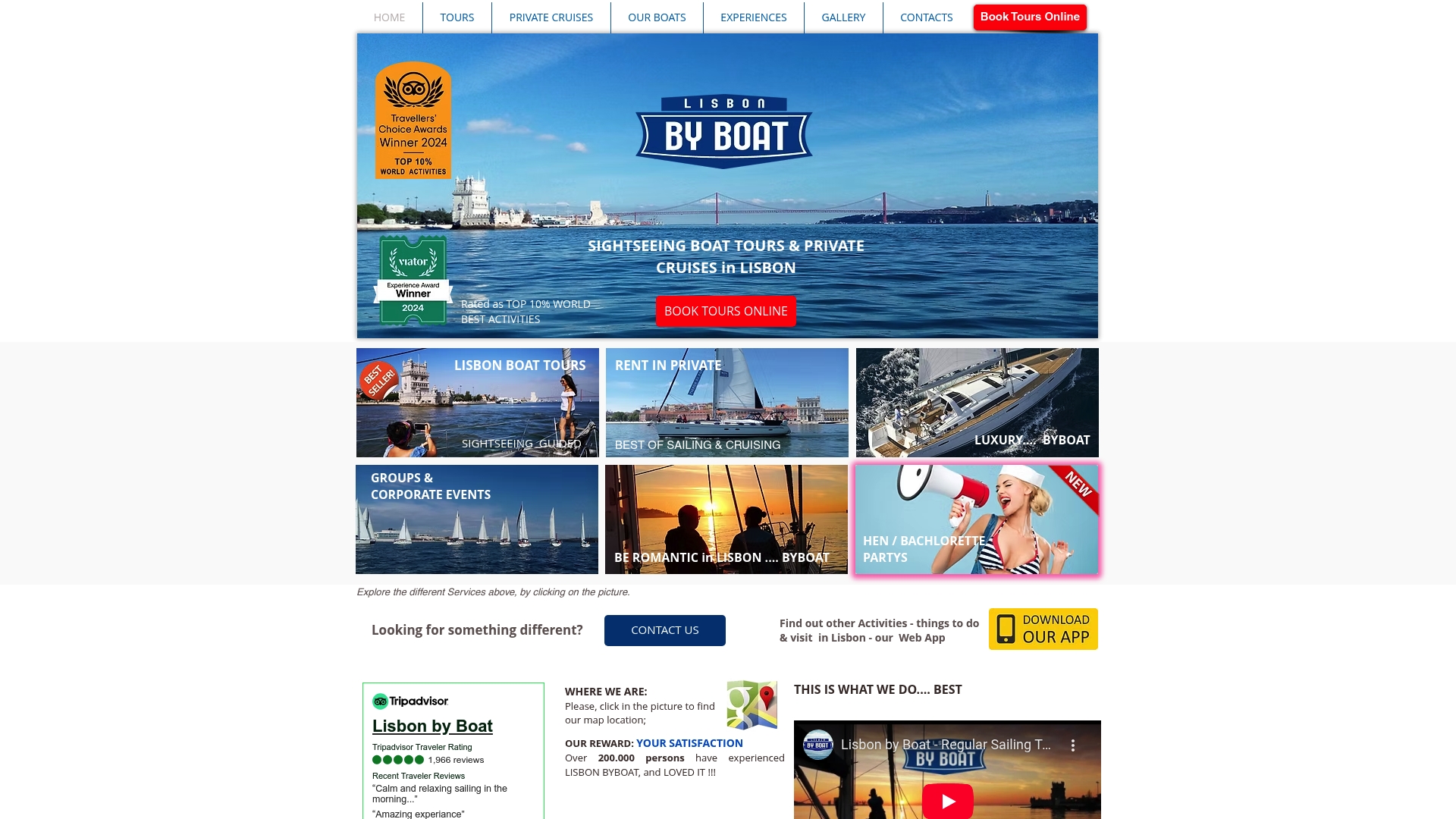
See all departures and book on our sailing tours page. For groups, from small parties to events with hundreds of guests, our group activities page lists the vessels we offer, and our private sailing and cruising programs cover yachts, catamarans and rigid inflatable boats.
FAQ
What amenities are typically found on a catamaran?
Most have a saloon, a galley, one or more heads, a cockpit for outdoor seating and a trampoline at the bow. Charter and luxury boats add features such as flybridge lounges, Wi-Fi, water toys and icemakers. Sightseeing boats lean toward seating, snacks and accessibility.
Do catamarans have toilets?
Usually yes. Cruising and charter catamarans normally have heads in the hulls, often one per cabin on bigger boats. Smaller day boats may have a single shared head, so confirm the number with the operator before a group outing.
Is a catamaran comfortable for people who get seasick?
The two-hull design gives a stable platform with little heeling under sail, which many passengers find more comfortable than a single-hull yacht. Stability is not a guarantee, since sea conditions still matter. If you are prone to motion sickness, ask your doctor or pharmacist about suitable options before you travel.
What should a corporate group confirm about onboard facilities?
Confirm passenger capacity, toilets, shade, catering, sound equipment and accessibility, and whether the charter is private. Ask for the details in writing and share any dietary or mobility needs well ahead of the date.
Sources
Recommended
Decision-making is another skill that players can practise while playing Snow Rider.
Throughout the game, players face situations in which they must quickly choose between different actions. They may need to decide whether to move left, move right, jump over an obstacle, or avoid collecting a gift because doing so could create a greater risk of crashing.
These decisions require players to evaluate the situation and select the most appropriate action.
For instance, if several obstacles appear close together, players must identify the safest available route. They need to consider their position, the distance between obstacles, and the timing of their movements.
This creates an engaging environment for practising quick decisions.
The game also teaches players that not every opportunity is worth taking. Sometimes, avoiding danger is more important than collecting additional snow rider rewards.