

Portuguese Language Basics for Lisbon Travelers

Most American travelers set sail in Lisbon ready for adventure, yet few realize that mastering a handful of Portuguese phrases can instantly deepen your coastal experience. Over 270 million people worldwide speak Portuguese, making it one of the most useful languages beyond any single country. For first-time sailors, learning simple greetings and nautical terms not only smooths interactions with local professionals but also unlocks authentic connections that enrich every moment of your maritime journey.
Table of Contents
Key Takeaways
Point | Details |
Importance of Basic Portuguese | Learning fundamental Portuguese phrases enhances interactions with locals, particularly in Lisbon. Simple greetings can lead to meaningful exchanges and greater respect from residents. |
Nautical Communication | Familiarizing yourself with nautical terms is essential for a smooth maritime experience. Phrases related to sailing will enhance your understanding and rapport with maritime professionals. |
Pronunciation Techniques | Practicing pronunciation is crucial for effective communication. Focusing on specific sounds and syllable stress can improve clarity and confidence when speaking Portuguese. |
Engaging with Locals | Making an effort to converse in Portuguese, even at a basic level, fosters genuine connections. It reflects cultural sensitivity and can lead to more enriching experiences while exploring Lisbon’s coastal areas. |
Portuguese Language Fundamentals for Tourists
Learning basic Portuguese is an essential skill for travelers exploring Lisbon’s vibrant coastal landscape. The Portuguese language worldwide connects you with over 270 million speakers across multiple continents, making it far more than just a local communication tool.
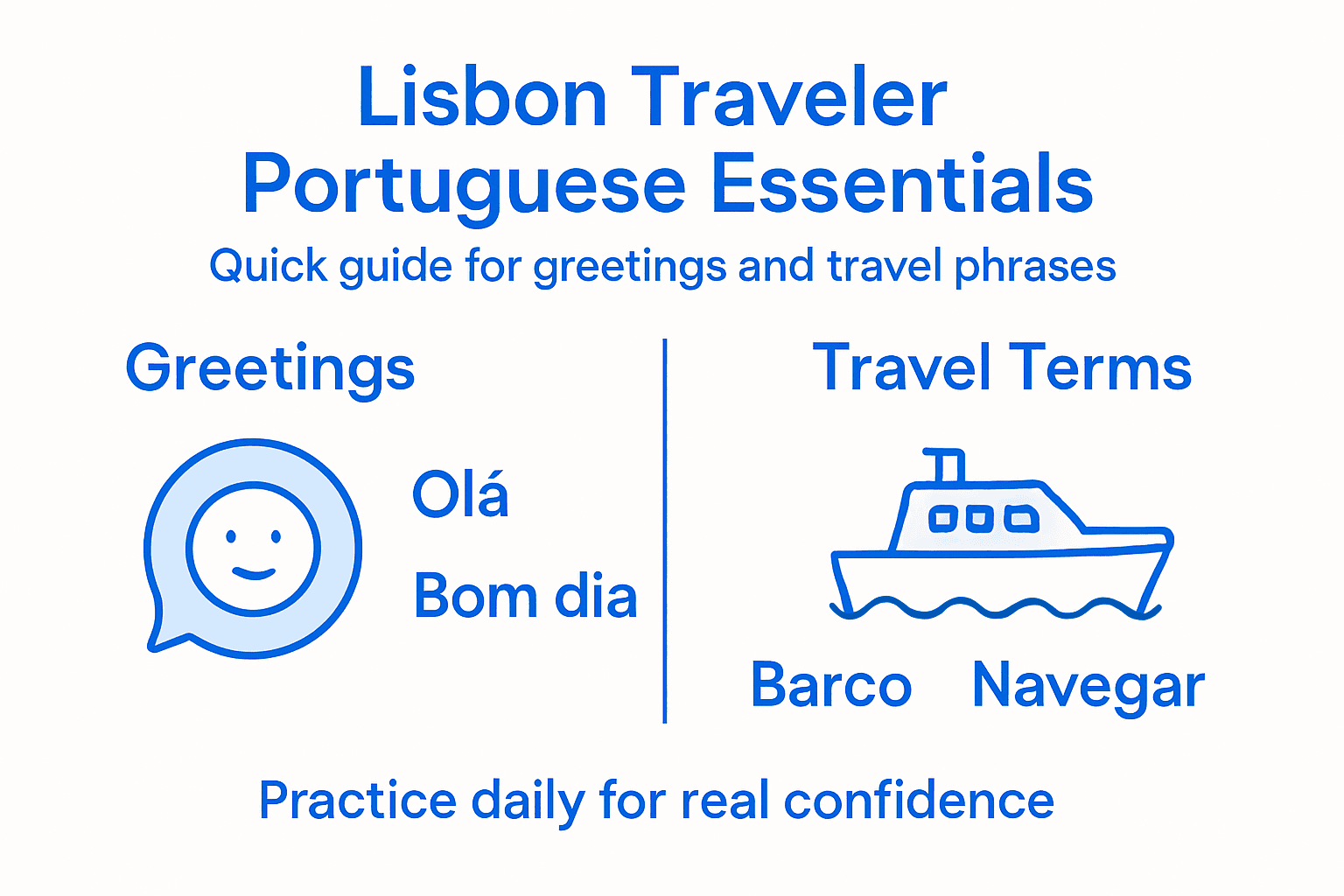
Portuguese pronunciation might seem challenging at first, but understanding a few key fundamentals can transform your travel experience. Focus first on mastering essential greetings like “Olá” (Hello), “Bom dia” (Good morning), “Por favor” (Please), and “Obrigado/Obrigada” (Thank you - male/female). These simple phrases demonstrate respect and often open doors to warmer interactions with local sailors, restaurant staff, and tour guides.
Understanding Portuguese language basics involves recognizing some linguistic patterns. Portuguese uses gendered nouns, meaning words have masculine or feminine forms, which affects article and adjective usage. For sailors and maritime tourists, learning nautical terms can be particularly helpful. Words like “barco” (boat), “mar” (sea), and “vela” (sail) will enhance your communication during coastal tours and interactions with maritime professionals.
Pro Tip: Download a Portuguese language app before your trip and practice 15 minutes daily to build confidence in basic communication skills.
Essential Greetings and Polite Expressions
Mastering Portuguese greetings is crucial for travelers seeking genuine connections during their Lisbon adventures. Polite Portuguese expressions are deeply rooted in cultural respect and can significantly enhance your travel interactions. Learning these phrases demonstrates cultural sensitivity and opens doors to more meaningful exchanges with locals.
Portuguese greetings follow a time-based system that differs slightly from English. During the day, you’ll use “Bom dia” (Good morning) until around noon, then transition to “Boa tarde” (Good afternoon) until early evening, and finally “Boa noite” (Good evening/Good night). When meeting someone, a friendly “Olá” (Hello) works universally, while “Como está?” (How are you?) shows additional politeness. For sailors and maritime tourists, adding nautical-specific greetings like “Tudo bem?” (All good?) can create instant rapport with local maritime professionals.

Understanding the nuances of politeness is key in Portuguese communication. Common polite phrases include “Por favor” (Please), “Obrigado” (Thank you - for males) or “Obrigada” (Thank you - for females), “Com licença” (Excuse me), and “Desculpe” (Sorry). These expressions are not just words but cultural bridges that show respect and facilitate smoother interactions. Pronunciation matters, so practice these phrases with native speakers or language apps to build confidence.
Pro Tip: Record yourself practicing Portuguese greetings and listen back to improve pronunciation and build muscle memory for key phrases.
Here’s a quick reference for common Portuguese greetings and polite expressions:
Phrase in Portuguese | English Meaning | Context Usage |
Olá | Hello | Universal greeting, casual or formal |
Bom dia | Good morning | Used until noon, polite entry in shops |
Boa tarde | Good afternoon | From noon to evening, formal settings |
Boa noite | Good evening/night | Evening greeting or saying goodbye |
Por favor | Please | Requesting help or service |
Obrigado/Obrigada | Thank you (male/female) | Expressing gratitude in any situation |
Com licença | Excuse me | Getting attention or passing by |
Desculpe | Sorry | Apologizing for inconvenience |
Common Travel and Nautical Phrases
Navigating Lisbon’s maritime landscape requires more than just basic greetings - it demands a strategic approach to communication. Portuguese maritime terminology reflects Portugal’s rich seafaring history, offering travelers a unique linguistic window into the country’s cultural heritage. Understanding these specialized phrases can transform your sailing experience from ordinary to extraordinary.
Essential nautical vocabulary goes beyond simple translation. Key terms like “mar” (sea), “navegar” (to sail), “barco” (boat), and “porto” (port) are fundamental for maritime communication. For sailors exploring Lisbon’s coastal regions, mastering phrases like “Qual é a direção do vento?” (What is the wind direction?) or “Qual é a profundidade?” (What is the depth?) can prove invaluable during maritime excursions. These specific terms not only help with practical navigation but also demonstrate respect for local maritime culture.
Common travel phrases extend beyond nautical contexts, covering crucial communication scenarios for tourists. Practical expressions like “Onde fica…?” (Where is…?), “Quanto custa?” (How much does it cost?), and “Eu não entendo” (I don’t understand) are essential survival tools. When combined with nautical terminology, these phrases create a comprehensive communication toolkit that empowers travelers to navigate both linguistic and geographical landscapes with confidence. Remember that pronunciation and context are just as important as the words themselves.
Pro Tip: Create a quick reference card with key nautical and travel phrases, laminating it to protect against water damage during your maritime adventures.
Simple Pronunciation and Usage Tips
Improving Portuguese pronunciation requires a strategic approach that goes beyond memorizing words. European Portuguese has unique sound characteristics that can challenge English-speaking travelers, particularly with its distinctive nasal vowels and complex consonant pronunciations. Understanding these nuances will help you communicate more effectively and avoid common misunderstandings during your Lisbon maritime adventures.
Focusing on specific pronunciation challenges is crucial for sailors and tourists. The Portuguese ‘r’ sound, for instance, differs significantly from English, often sounding more like a soft growl or light roll at the back of the throat. Nasal vowels - which occur when air passes through both the mouth and nose - are another distinctive feature. Words like “não” (no) and “ação” (action) require practice to pronounce correctly. Listening to native speakers through language apps, podcasts, or local maritime guides can dramatically improve your pronunciation skills.
Mastering European Portuguese pronunciation techniques involves understanding stress patterns and intonation. Portuguese words typically have stress on the second-to-last syllable, with exceptions marked by accent marks. Pay special attention to words ending in -ão, which have a unique nasal sound that can be challenging for English speakers. For nautical travelers, practicing maritime-specific terms with local professionals can provide authentic pronunciation guidance and build confidence in communication.
Pro Tip: Record native Portuguese speakers saying nautical phrases and practice mimicking their pronunciation, focusing on capturing the subtle nuances of their speech.
The table below compares typical pronunciation challenges for English speakers learning Portuguese:
Challenge | Portuguese Feature | English Difference | Tip to Improve |
‘r’ sound | Rolled or guttural ‘r’ | English has softer ‘r’ | Practice with native audio |
Nasal vowels | Letters with tilde (ã, õ) | No nasal vowels in English | Listen and mimic carefully |
Syllable stress | Often penultimate syllable | Varies more in English | Mark stress in practice words |
Final ‘-ão’ | Strong nasal ending | Unfamiliar to English ears | Repeat with feedback from speaker |
Navigating Lisbon: Speaking With Locals
Connecting with locals through language transforms a typical tourist experience into an authentic cultural journey. While many Lisbon residents speak English, making an effort to communicate in Portuguese demonstrates respect and often opens doors to more meaningful interactions. Maritime tourists exploring Lisbon’s coastal regions will find that even basic phrases can create instant connections with local sailors, restaurant staff, and tour guides.
Understanding local communication nuances goes beyond simple translation. Portuguese conversation involves subtle cultural cues, body language, and a genuine appreciation for polite interaction. Words like “Por favor” (Please), “Obrigado/a” (Thank you), and “Com licença” (Excuse me) are more than just phrases - they’re social bridges. For sailors and maritime enthusiasts, learning nautical-specific terminology can create instant rapport with local maritime professionals, showing genuine interest in their rich seafaring culture.
Essential Portuguese communication strategies involve more than memorizing words. Context matters immensely in Portuguese communication. Locals appreciate travelers who attempt to speak their language, even if imperfectly. When asking for directions, ordering food, or requesting help, your effort will be met with patience and often enthusiasm. Practice key phrases related to your maritime interests, such as asking about wind conditions, boat routes, or local maritime traditions. This approach not only helps you navigate practically but also demonstrates cultural curiosity and respect.
Pro Tip: Download a Portuguese language app with audio pronunciation and practice phrases during your boat journey, using the natural rhythm of the waves as your learning soundtrack.
Enhance Your Lisbon Experience with Fluent Nautical Insights
Mastering basic Portuguese phrases and nautical terms is vital for travelers eager to connect deeply with Lisbon’s maritime culture. The article highlights challenges like Portuguese pronunciation, gendered nouns, and essential travel expressions that can feel overwhelming. If your goal is to effortlessly blend language learning with awe-inspiring coastal exploration, we have the perfect solution.
Discover the best way to practice your new Portuguese skills in real time by joining our daily sailing tours. Imagine navigating Lisbon’s beautiful coastline while your knowledgeable guides explain historic monuments and share maritime terms, helping you apply your language skills naturally. Whether you prefer a 2-hour tour or a private yacht cruise, our experiences allow you to build confidence in Portuguese while enjoying the sea breeze and stunning views.
Don’t miss this unique chance to combine language learning with unforgettable sailing adventures. Start exploring now by visiting Lisbon By Boat. Learn more about our daily sailing tours and private cruise options designed to immerse you in authentic Portuguese culture and maritime tradition. Book your tour today and turn your Portuguese basics into fluent travel memories.
Frequently Asked Questions
What are some essential Portuguese greetings for travelers?
To connect with locals, learn key greetings such as “Olá” (Hello), “Bom dia” (Good morning), “Boa tarde” (Good afternoon), and “Boa noite” (Good evening). Using these phrases reflects cultural respect and fosters warmer interactions.
How can I improve my Portuguese pronunciation before traveling?
Practice is key! Focus on specific challenges like the rolled ‘r’ and nasal vowels. Use language apps, listen to native speakers, and practice with recordings to enhance your pronunciation skills.
What are some useful nautical terms in Portuguese for maritime travelers?
Important nautical vocabulary includes terms like “barco” (boat), “mar” (sea), “navegar” (to sail), and “porto” (port). These phrases can enhance communication with local maritime professionals during your travels.
How can speaking Portuguese enhance my travel experience?
Attempting to communicate in Portuguese, even with basic phrases, shows respect for local culture and can lead to more meaningful interactions with residents. It can help you build rapport and navigate your environment more effectively.
Recommended
A great feature of free games az is how their controls can adapt to the platform being used. Players sitting at a desktop can enjoy the precision of a mouse and keyboard, while smartphone users can tap or swipe directly on the screen. This flexibility makes it easier to enjoy different types of games without needing specialized equipment.
Similar-looking IP addresses can be confusing, especially for beginners. When researching 10.0.0.0.1, checking the router label, manual, or official instructions can help identify the correct address and avoid wasting time on an incorrect configuration page.
Its endless vertical gameplay gives players Doodle Jump a clear reason to keep improving without requiring a complicated story or progression system.