

Lisbon Christmas Decorations: Where to Walk and Sail
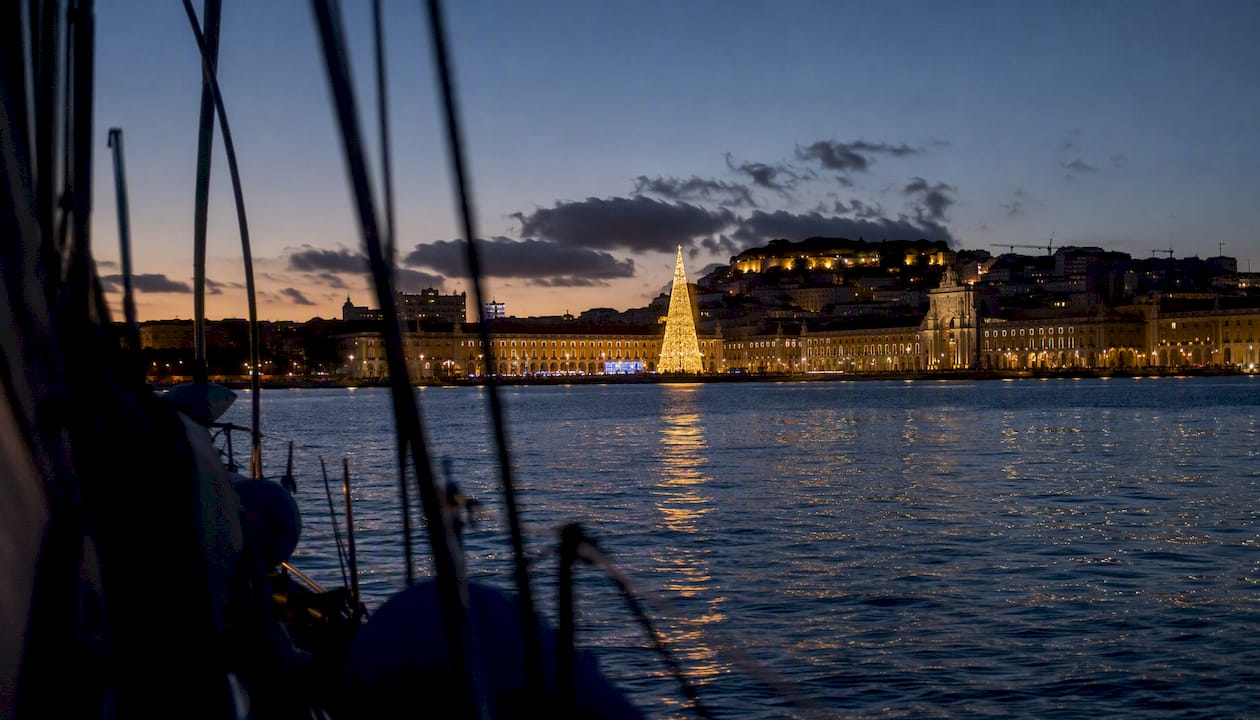
The best way to experience Lisbon’s Christmas decorations is an evening walk through Baixa and Chiado, starting at Rua Augusta, sweeping past the 30-meter Christmas tree at Praça do Comércio, up Rua do Ouro, through Rua Garrett, and finishing at Praça de Luís de Camões. For a completely different perspective, a short Tagus cruise lets you see the entire lit waterfront reflected on the water without the street-level crowds.
Walk vs. boat, in one line: Walk if you want close-up installations, shop windows, and the Rua do Carmo tunnel of light; take a boat if you want the full skyline in one frame and a quieter experience.
Three things to do right now:
Start at Rua Augusta arch around 7:00 PM, after dark but before the biggest weekend crowds arrive.
Take the metro to Baixa-Chiado (Green or Blue line) to reach the heart of the route in under 20 minutes from most hotels.
Book a sailing tour in advance for holiday weekends, when shore-side crowds peak and boat spots fill quickly.
The city’s festive display spans 182 kilometers of low-energy LED lights across 46 locations, using roughly 1,050 structures and 5,900 decorative elements, making it one of the most extensive public light installations in Southern Europe.
Key Takeaways
Lisbon’s Christmas decorations span 182 kilometers of LED lights across 46 locations, best experienced on a 60–90 minute evening walk through Baixa and Chiado, or from the Tagus on a 2-hour sailing tour.
Point | Details |
Best start point | Begin at Rua Augusta arch around 7:00 PM for the full downtown route. |
Top photo spot | Praça do Comércio, 50 meters back from the 30-meter tree, facing the river. |
Timing advice | Weekday evenings in early December offer the same lights with far smaller crowds. |
Boat vs. walk | Walk for close-up installations; sail with Lisbonbyboat for the full lit skyline and Tagus reflections. |
Eco-friendly display | The city uses LED lights and reused materials across all 46 decorated locations. |
Table of Contents
Where are the best Lisbon Christmas decorations?
Local guides consistently rank Avenida da Liberdade, Baixa/Rua Augusta, Praça do Comércio, and Chiado as the top areas for festive decor in Lisbon. Here is what you will actually find at each one.
Praça do Comércio (Terreiro do Paço): The centerpiece of the entire display. A 30-meter tree dominates the square, surrounded by lights that frame the riverside colonnade. This is where the official switch-on ceremony and fireworks take place. Photo tip: shoot from the far end of the square with the Tagus behind you to get the tree and the arch in one frame. Crowds are heaviest on opening night and weekend evenings after 8:00 PM.
Rua Augusta / Baixa: The pedestrian spine of downtown Lisbon is strung with overhead lights that create a corridor effect all the way from the arch to Rossio square. Flat, wide, and easy to walk, it works well for families with strollers. Weekday evenings are noticeably calmer.
Rua do Ouro: A quieter parallel street to Rua Augusta with its own overhead installations. Worth walking for the contrast and for avoiding the densest foot traffic on Rua Augusta.
Rua Garrett / Chiado: Upscale boutiques and café terraces line this street, and the holiday window displays here are among the most polished in the city. The decorations lean toward golden tones and elegant arrangements rather than large-scale spectacle.
Rua do Carmo: The tunnel of light here is synchronized with music, and the effect only lands if you stop and stand inside it for a full cycle. Rushing through misses the point entirely.
Praça de Luís de Camões: A palace-inspired installation anchors this square at the top of Chiado. It is a natural endpoint for the downtown walking route and a good spot for a final photo before heading to dinner.
Avenida da Liberdade: Lisbon’s grand boulevard is lined with illuminated trees running its full length. The scale here is different from the tight streets of Baixa — wider, more open, and impressive from a distance. Good for a pre-dinner stroll if you are staying in the Marquês de Pombal area.
Parque Eduardo VII: Large-scale light installations fill the park at the top of Avenida da Liberdade. The elevated position gives a sweeping view back down toward the river. Families tend to gather here, and it connects naturally to the Wonderland Lisboa market.
Belém: A detour worth making if you have a full evening to spare. The area around the Jerónimos Monastery gets its own seasonal lighting, and the riverside setting adds a different mood from the downtown bustle.
When should you visit for the best experience?
The lights typically switch on in late November. In 2025, the official inauguration took place on November 24 at Praça do Comércio, with a live countdown, tree lighting, and fireworks. Thousands gathered around Terreiro do Paço for the ceremony, and AP News documented the official counts for the display alongside the crowd visuals. Switch-on night is spectacular but genuinely packed — if you are not specifically there for the ceremony, a weekday evening in early December gives you the same lights with a fraction of the people.
Lights generally run from dusk until around midnight, with extended hours on Christmas Eve, Christmas Day, and New Year’s Eve. The busiest evenings are opening night, any Friday or Saturday in December, and the nights immediately before Christmas.
December weather in Lisbon is mild by Northern European standards but cool enough to need a jacket. Temperatures typically sit between 50°F and 60°F in the evenings, with occasional light rain. A dry, clear night dramatically improves photo quality, especially for long-exposure shots of the waterfront lights. Check the forecast before heading out — a misty evening softens the light in a way that can actually look beautiful, but heavy rain empties the streets fast.
Central metro stations, particularly Baixa-Chiado and Rossio, get congested on busy weekend evenings. If you arrive by metro, exit early and walk the last few blocks rather than waiting on a packed platform.
A practical walking route through the decorated downtown
This route covers the main festive decor in Lisbon’s downtown in a logical sequence, keeping hills to a minimum. Allow 60–90 minutes for a brisk pace or 2–3 hours if you stop at markets and cafés.
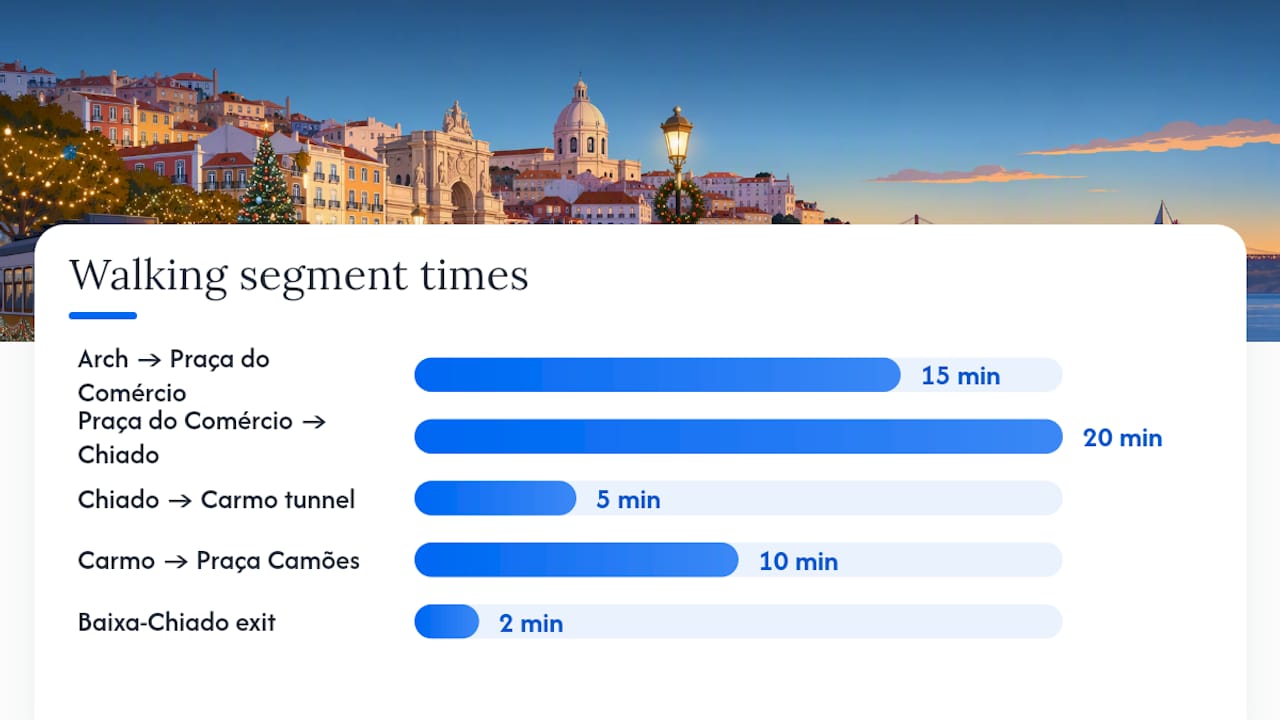
Start at Rua Augusta arch (7:00–7:30 PM). The arch is lit and makes a strong opening photo. Walk south through the pedestrian street toward the river.
Praça do Comércio (15 minutes from the arch). Spend time at the 30-meter tree and walk the perimeter of the square. The riverside view at night is worth the extra five minutes.
Back up Rua do Ouro toward Rossio. This parallel route avoids the thickest Rua Augusta crowds on the return leg and has its own overhead lights.
Rua Garrett / Chiado (20 minutes from Praça do Comércio). Browse the window displays and stop at one of the café terraces if the weather allows.
Rua do Carmo tunnel (5-minute detour from Rua Garrett). Stop inside and wait for a full music-synchronized light cycle before moving on.
Praça de Luís de Camões (10 minutes from Rua do Carmo). The palace-inspired installation here is the natural end of the route.
Transport shortcuts: the Baixa-Chiado metro station sits directly between steps 3 and 4, so you can exit the route at any point and be on a train within two minutes. Tram 28 passes near Chiado if you want to continue toward Alfama or Belém.
The recommended route anchors the historical downtown in Baixa and Chiado, which are the flattest and most pedestrian-friendly zones in the city — a real advantage when you are navigating in the dark with a crowd around you.
What does seeing the lights from the Tagus actually look like?
From the water, the entire Baixa waterfront appears as a single illuminated band. The Praça do Comércio tree is visible from a considerable distance, and the colonnade behind it glows in a way that is simply not visible from street level. The Tagus reflects the lights, giving photographers a natural second composition that street-side shots cannot replicate.
Walk vs. boat at a glance:
Viewing angle: Street gives close-up detail; boat gives the full skyline panorama.
Crowd level: Shore-side is dense on weekends; a small sailing group is far quieter.
Photo opportunities: Street works for tunnel and window shots; water works for long-exposure skyline and reflection shots.
Mobility: The boat is accessible and requires no hill climbing.
Lisbonbyboat runs 2-hour daily sailing tours that cover the lit waterfront, with guides pointing out the major monuments and installations visible from the Tagus. Private options on yachts and catamarans are available for groups who want a more exclusive experience. For holiday dates, booking at least a week in advance is practical — spots on evening departures fill faster than daytime ones in December.
Pro Tip: For waterfront photos, switch your phone camera to night mode and brace against the boat railing for a steadier shot. The reflections on the Tagus are sharpest on calm, clear evenings — check the wind forecast alongside the weather.
Christmas markets and seasonal events worth adding to your itinerary
The decorations are only part of the picture. Visit Lisboa’s city-wide program includes free concerts and immersive light sculptures that run alongside the street installations throughout December.
Wonderland Lisboa (Parque Eduardo VII): The largest seasonal market in the city. Expect food stalls, craft vendors, a Ferris wheel, an ice rink, and live performances. It runs from late November through early January and is well-suited for families. Entry to the park is free; individual attractions are ticketed.
Campo Pequeno market: A more local-feeling alternative to Wonderland, with a stronger emphasis on Portuguese crafts and regional food products. Less crowded than Parque Eduardo VII on weekend afternoons.
Praça da Figueira: A smaller square market near Rossio with a relaxed atmosphere, good for picking up seasonal pastries and warm drinks without the full market experience.
Free concerts and installations: The city program typically includes fado performances, orchestral concerts in public squares, and immersive light sculptures you can walk through. Schedules vary by year, so checking Visit Lisboa’s event calendar before you go is the most reliable way to catch what is running during your specific dates.
For food at the markets, look for rabanadas (Portuguese-style French toast with cinnamon), bolo rei (the traditional Christmas ring cake), and ponche (warm spiced wine). Prices at Wonderland Lisboa run slightly higher than at smaller neighborhood markets.
Practical tips for visiting safely and comfortably
Baixa and Chiado are the right areas to focus on, and both are comparatively flat and accessible for visitors with strollers or reduced mobility. Praça do Comércio is entirely step-free. Rua Augusta is wide and paved. The hillier neighborhoods — Alfama, Mouraria, Graça — are beautiful but genuinely steep and harder to navigate at night in a crowd.
On transport: walking between the clustered Baixa highlights is often faster than waiting for a crowded metro on a busy evening. Use the metro to get to the start point and to exit at the end, but walk the route itself. Keep your bag in front of you in crowded squares and on packed metro cars — Praça do Comércio and Rua Augusta attract pickpockets during peak evenings, as any major tourist area does.
Pack warm layers, not just a single coat. December evenings in Lisbon can feel colder than the thermometer suggests when you are standing still at a market or waiting for a boat departure. Comfortable, flat-soled shoes matter more than you might expect on Lisbon’s uneven cobblestones. Bring a portable phone charger — you will use your camera more than you plan to.
Pro Tip: For the best low-light photos on the walking route, use portrait mode for close-up window displays and switch to wide-angle for the open squares. The Praça do Comércio tree photographs best from the far riverside end of the square, roughly 50 meters back.
Official dates, schedules, and how to pay for transit
The switch-on ceremony typically falls in the third or fourth week of November. Lights run nightly from dusk (around 5:30–6:00 PM in December) through approximately midnight, with extended hours on December 24, 25, 31, and January 1.
Detail | Typical schedule |
Lights switch-on | Late November (official ceremony at Praça do Comércio) |
Nightly hours | Dusk (~5:30 PM) to midnight |
Extended hours | December 24, 25, 31 and January 1 |
Wonderland Lisboa | Late November through early January |
Official schedule source | visitlisboa.com/en/events |
For public transit, the most practical option is a reloadable Viva Viagem card, available at any metro station. It works on metro, bus, and tram. Contactless bank cards are accepted on metro turnstiles. Single-ride tickets are more expensive per trip, so if you plan to use transit more than twice in a day, load the card with credit.
Wonderland Lisboa and some immersive installations charge entry fees for specific attractions; the street decorations and public squares are entirely free. Check the official Visit Lisboa event page and the Câmara Municipal de Lisboa website for last-minute schedule changes, since specific concert dates and installation hours can shift.
The city’s 182 kilometers of LED lighting across 46 locations, with materials reused from prior years and some installations running on solar power, reflects a genuine municipal commitment to reducing the display’s energy footprint. For visitors who care about sustainable tourism, that is a meaningful detail — and worth noting when you read about the scale of the display.
What families with children will enjoy most
The Baixa route is genuinely family-friendly. The streets are wide, the terrain is flat, and the overhead lights are low enough that young children can see them clearly without being lifted. Praça do Comércio is large enough that even a busy evening does not feel claustrophobic, and the tree is simply impressive at that scale for kids.
Wonderland Lisboa at Parque Eduardo VII is the obvious family anchor. The ice rink, Ferris wheel, and carousel give children something to do beyond looking at lights, and the food stalls make it easy to turn the visit into a full evening. The park’s elevated position also means the view back down Avenida da Liberdade is a natural spectacle.
For younger children, the Rua do Carmo tunnel of light tends to be a highlight — the music synchronization makes it feel interactive in a way that a static display does not. Arrive on a weekday evening to avoid the densest crowds, which can be overwhelming for small children. The Christmas tips guide from Lisbonbyboat covers additional logistics for families planning a full holiday evening in the city.
Where to eat and drink near the decorated areas
The Chiado neighborhood, which sits at the top of the walking route, has the highest concentration of good cafés and restaurants within easy reach of the main decorations.
A Brasileira on Rua Garrett is one of Lisbon’s most storied cafés, open since 1905, and sits directly on the decorated street. It is worth stopping for a bica (espresso) and a pastel de nata even if the queue is long. The outdoor seating faces the street decorations directly.
For a full dinner, the streets around Praça de Luís de Camões and Rua do Alecrim have a range of Portuguese restaurants at different price points. Tasca do Chico on Rua do Diário de Notícias is a small, well-regarded spot for traditional food and occasional live fado — book ahead for December evenings.
If you are visiting Parque Eduardo VII and Wonderland Lisboa, the Marquês de Pombal area has several reliable options along Avenida da Liberdade, though prices trend higher than in Baixa. The market stalls inside Wonderland are a practical and atmospheric option for a lighter meal.
How to combine the lights with other seasonal cultural experiences
The decorations are most rewarding when they anchor a broader evening rather than standing alone. A few combinations that work particularly well:
A fado dinner in Alfama pairs naturally with the downtown lights walk if you sequence them correctly. Do the Baixa-Chiado route first (7:00–9:00 PM), then take Tram 28 or a taxi up to Alfama for a late fado show, which typically starts at 9:30 PM or later.
The Museu Nacional do Azulejo runs extended holiday hours in December and has its own seasonal programming. It is a 20-minute taxi ride from Praça do Comércio and makes a strong cultural counterpoint to an evening of outdoor lights.
For a full holiday day, combine a morning visit to the Jerónimos Monastery in Belém (decorated for the season and far less crowded in the morning) with an afternoon at the Belém waterfront, then return to Baixa for the evening lights. The December activities guide from Lisbonbyboat covers additional seasonal programming across the city.
A sailing tour fits naturally at the end of any of these combinations. After walking the route or visiting a market, an evening on the Tagus gives you a different angle on the same city you have been exploring on foot — and the contrast between the two perspectives is genuinely striking.
What the lights look like from the water at night
Standing on the deck of a sailing boat as Lisbon’s waterfront comes into view after dark is one of those moments that does not photograph as well as it feels. The colonnade at Praça do Comércio glows amber across the water. The 30-meter tree is visible from well out on the Tagus, its reflection stretching toward you in a long, broken line. The hills of Alfama rise behind it, dotted with lights from the castle and the miradouros.
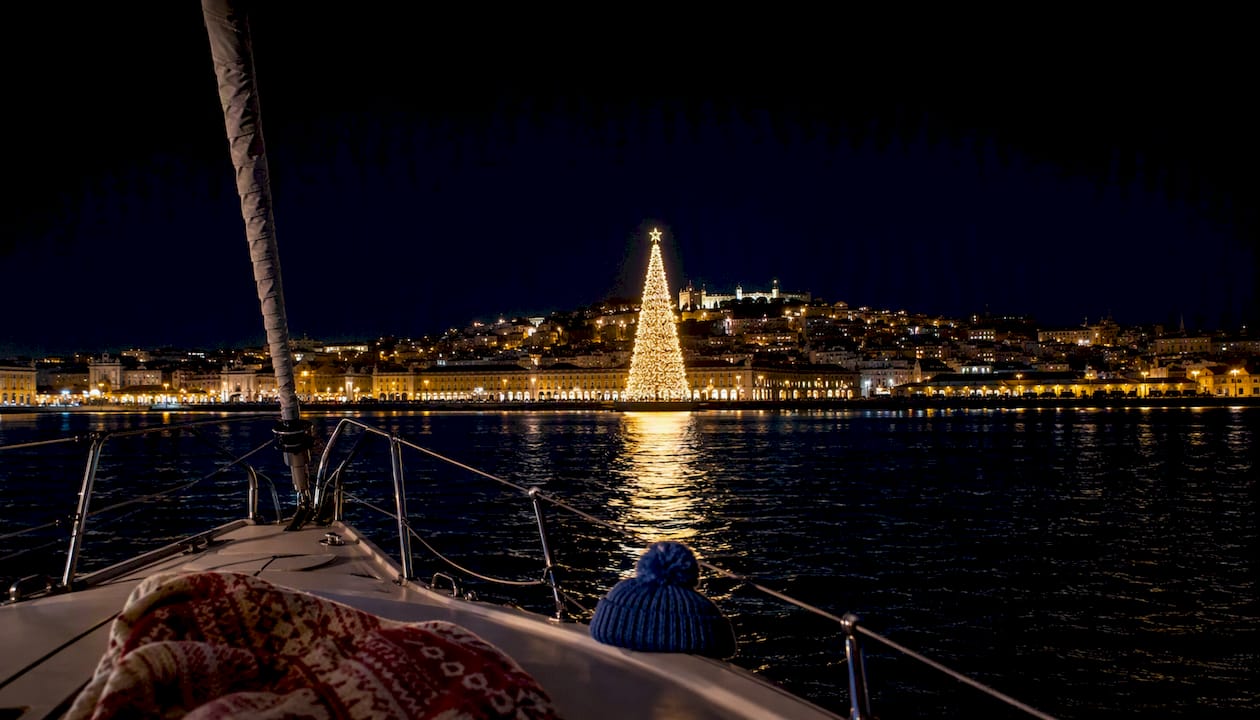
What catches most visitors off guard is the silence relative to the shore. You can hear the city — faint music, the occasional crowd noise from the square — but you are removed from it in a way that makes the whole display feel composed rather than chaotic.
One thing to watch for on switch-on night: the fireworks sequence over Praça do Comércio, seen from the water, is framed by the entire riverside skyline. From shore, you are inside the crowd looking up. From the boat, you are looking at the city the way a photograph looks at a subject.
See Lisbon’s festive waterfront on an evening sail
The street-level walk gives you the close-up details. The boat gives you the city.
Lisbonbyboat runs 2-hour daily sailing tours along Lisbon’s historical coastline, with guides covering the major monuments and waterfront installations visible from the Tagus. For the holiday season, private cruises on yachts and catamarans are available from 2 hours to a full day, with small groups that keep the experience relaxed. The luxury yacht options are particularly well-suited for couples or groups who want a private evening on the water without the shore-side crowds.
Holiday dates book out faster than the rest of the year. Check availability and reserve your spot at Lisbonbyboat before your travel dates lock in.
Sources
Before you go, verify current schedules directly with official sources, since specific dates and hours can shift year to year.
Check Visit Lisboa or the Câmara Municipal de Lisboa website in the week before your trip for any last-minute changes to hours or event locations.
Recommended
Comments